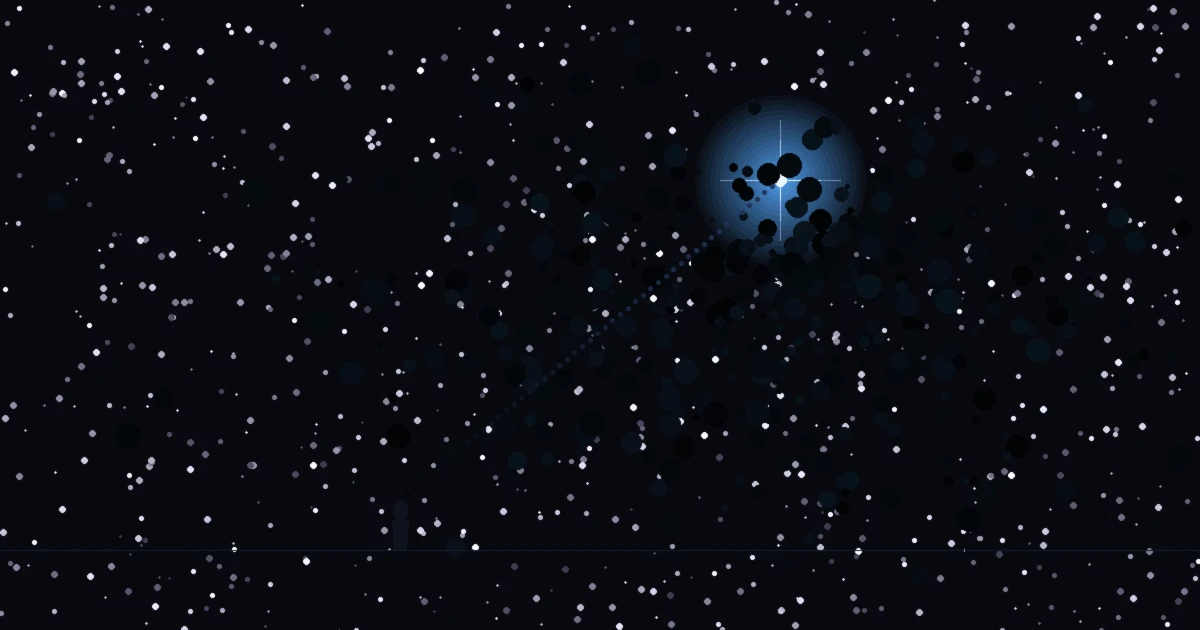
A Star, a Brain, and a Love That Lasted Centuries
Yun Tianming is dying when we first meet him. Terminal cancer, weeks left, the quiet devastation of a man who has always stood at the margins of his own life. He is not a physicist or a general or a diplomat. He is an engineer who loves a woman named Cheng Xin, has never told her, and is running out of time to matter.
What he does with his last savings is one of the most quietly extraordinary gestures in the entire trilogy: he buys her a star.
Not a metaphor. A real star — a dim point in a distant constellation, registered under her name through an international stellar naming organization, a gift she only half understands and cannot fully receive because the man giving it dies before she has the chance to respond. Except he doesn't quite die. He is given an offer instead.
The Staircase Project
The Planetary Defense Organization, in its early Crisis Era desperation, conceived an operation that should have been impossible: send a human brain to the Trisolaran fleet, traveling between the stars at a fraction of lightspeed, as an act of interstellar intelligence gathering. The man they needed was someone already dying — someone who had no future on Earth to sacrifice.
Yun Tianming agreed.
His brain was surgically removed while his body was still alive, cryogenically preserved, sealed in a small probe, and launched toward the approaching Trisolaran fleet using sequential nuclear detonations as a light-pressure drive. The Staircase Project was named for the way velocity was added in steps — each detonation another rung upward.
The mission's intended failure modes were almost too many to count. The probe might miss. The Trisolarans might destroy it without interest. The brain might not survive the journey. The Trisolarans might not be able to revive it. Even if they could, the resulting being might not retain anything of who Yun Tianming had been.
It worked.
Rebuilt by Alien Medicine
What the Trisolarans made of Yun Tianming's frozen brain is not fully described in Death's End, and the gaps are part of what makes him so haunting a figure. He is rebuilt — given a body, given language, given the peculiar adjustment period of a man learning to exist inside a civilization that cannot lie, in a world that orbits three suns, surrounded by beings who can read each other's intentions as easily as humans read faces.
He is, by any reasonable measure, the most isolated human being in history. Not just distant from Earth — separated from it by light-years, by centuries, by the unbridgeable cognitive difference between a species shaped by deception and one for whom deception is biologically impossible.
And yet he endures. The novels are not detailed about his Trisolaran years, but what emerges is the portrait of a man who adapts, who survives, and who never stops thinking about the people he left behind — particularly one person.
The Gift That Outlasted the Solar System
The star Yun Tianming bought for Cheng Xin was not merely a romantic gesture. It becomes, in the extraordinary architecture of Death's End, an actual destination — a place where Cheng Xin eventually finds sanctuary after the solar system's destruction. Liu Cixin constructed a trilogy in which a dying man's last act of love echoes across hundreds of years and becomes, in the end, shelter.
This is the kind of structural choice that makes the trilogy unforgettable. The star purchase reads as pathos in the early chapters — a small, futile kindness. It is only later, when the geometry of the story has unfolded fully, that you understand what Liu Cixin was doing.
The Intelligence Problem
Yun Tianming knew things. He had lived inside Trisolaran civilization for centuries by the time the brief, supervised reunion with Cheng Xin was arranged. He understood the fleet's capabilities, its plans, and — most importantly — the survival strategies available to humanity that the Trisolarans would not actively prevent, for reasons of their own.
He could not say any of this directly. The Trisolarans were watching. Every word he spoke to Cheng Xin during their televised meeting was monitored, analyzed, filtered for anything that might constitute strategic disclosure.
So he told her three children's stories.
The fairy tales — "The New Royal Clothing," "The Glutton's Sea," and "The Poem of Dark Forest" — were his solution to surveillance. They were layered, metaphorical, and dense with information that his analysis team spent months decoding after the broadcast ended. Each contained fragments of intelligence about Trisolaran capabilities and the paths humanity might survive. Each was constructed to pass Trisolaran scrutiny as harmless narrative while carrying its real content in the subtext.
It is one of the most elegant conceits in the trilogy: a man who cannot speak freely turning the oldest human storytelling form into a cipher, trusting the woman he loves to understand that the surface is not the message.
What the Fairy Tales Reveal
The decoded content of Yun Tianming's stories represents some of Death's End's densest plot mechanics, and the full analysis belongs to the dedicated article on the fairy tales themselves. But the emotional weight is worth noting here.
Yun Tianming had centuries to compose these stories. He had centuries to think about Cheng Xin — about what she would need, about what she could survive, about what information might save her if not the species. The fairy tales are not improvised. They are the work of a man who spent his entire rebuilt life preparing for one short conversation.
He told her he loved her. He encoded it in the structure of children's fiction because it was the only language the universe would let him speak. That the message went only partially understood, that the survival paths it illuminated were largely not taken, is one of the trilogy's characteristic griefs.
A Character of Accumulated Loss
What makes Yun Tianming genuinely affecting — rather than merely remarkable — is the accumulation of what he loses without complaint. He loses his body. He loses his world. He loses the ordinary human future that the woman he loves will continue to inhabit across centuries of hibernation while he adapts to an alien civilization. He loses, finally, even the brief chance of reunion, the short window of that supervised conversation, and then he loses her to the evacuation of everything.
He is the trilogy's example of love expressed not through presence but through preparation. He is not with Cheng Xin when she needs him. He prepares, instead, something that will be there when she arrives — a star, a series of stories, a place that survives the end of the solar system.
Liu Cixin does not write sentiment without rigor, and Yun Tianming's story is both. It is one of the few threads in the trilogy that the cosmological bleakness does not fully consume. The star endures. The message, imperfect and partially lost, was sent.
That a dying man's last savings bought the address where someone would eventually find safety at the end of everything is, in its way, the series' quietest answer to the Dark Forest: that even in a universe defined by predation and silence, some gestures reach.