A Gift Across the End of Everything
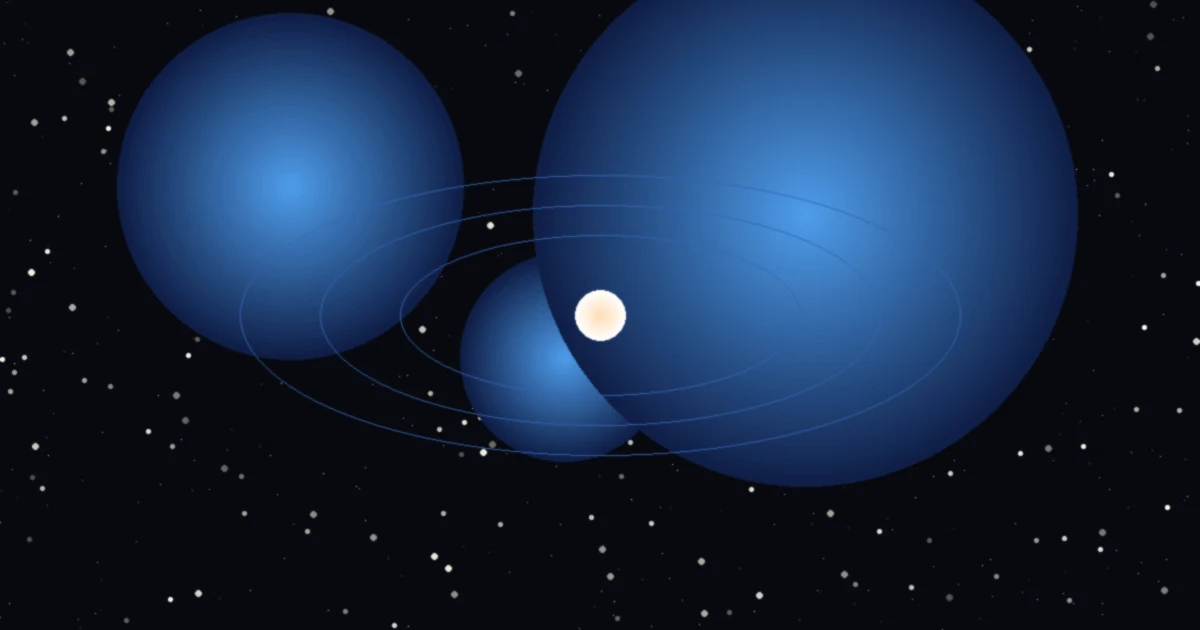
Near the close of Death's End, Cheng Xin and Guan Yifan find themselves in a place that should not exist: a universe inside the universe. Roughly the size of a sphere with a radius of a few astronomical units, their small pocket of spacetime contains a star, at least one planet, and the remnants of a life carefully prepared for them across centuries. It is, as far as the trilogy tells us, the last truly safe place in existence.
The mini-universe — or pocket universe — is one of Liu Cixin's most audacious scientific inventions. But it is not merely a plot convenience. It is a philosophical trap, a monument to one person's impossible love, and finally the site of the trilogy's last and most quietly devastating moral question.
The Physics: Inflation, Vacuum Energy, and Baby Universes
To understand what a mini-universe actually is in Liu Cixin's cosmology, it helps to start with the real science it draws on.
Modern cosmology holds that our universe began with a period of extraordinarily rapid expansion called inflation — a fraction of a second after the Big Bang during which space itself expanded faster than light, smoothing out irregularities and seeding the large-scale structure we observe today. Inflation was driven by a field with enormous energy density, called the inflaton field, which eventually decayed and dumped its energy into ordinary matter and radiation.
What inflation theory also predicts — in its more speculative extensions — is that this process need not have happened only once. In eternal inflation models, quantum fluctuations constantly seed new inflationary bubbles in the broader multiverse. Each bubble expands and becomes its own universe, causally disconnected from its neighbors. If this is correct, the creation of new universes is not a one-time event; it is an ongoing feature of the larger cosmic structure.
A mini-universe, as Liu Cixin imagines it, is a deliberate application of this principle: the artificial initiation of a localized inflationary event, creating a self-contained bubble of spacetime with its own physical laws — or nearly its own. In the trilogy, mini-universes appear to be created at a technological level far beyond anything humanity has achieved, consistent with a civilization operating at or above Type II on the Kardashev scale.
The energy required to manufacture one is never specified in the novels, but the implication is clear: we are talking about stellar-scale engineering at minimum. The fact that Yun Tianming arranged for this gift — from within Trisolaran civilization — tells us something important about the true ceiling of Trisolaran technology: it is considerably higher than what they chose to reveal to humanity.
The Vacuum Energy Problem
Inside a mini-universe, the physics is stable. Outside — in the main universe — it is dying.
The trilogy introduces the concept of a universe gradually degraded by the Dark Forest wars: the speed of light has been reduced from its original value across billions of years of technological combat. This is not a metaphor. Liu Cixin proposes that the constants of physics are not truly constant — they are more like current conditions, and they can be changed by sufficiently advanced technology.
The connection to vacuum energy is subtle but important. In quantum field theory, the vacuum is not empty. It seethes with virtual particle pairs and has an intrinsic energy density — the cosmological constant. The accelerating expansion of the universe is attributed to this vacuum energy, often called dark energy. If dark energy is a fixed property of the vacuum, then a universe with a different value of the speed of light would also have different vacuum energy — different stability conditions.
A mini-universe can be thought of as a region where the original vacuum state has been preserved, or deliberately set: a bubble where physics still operates at its original parameters, sealed off from the main universe's slow deterioration. From outside, it looks like a small enclosed space. From inside, it is functionally infinite in the sense that matters most — it is stable, and it is survivable.
The Life Inside
Cheng Xin and AA — and eventually Guan Yifan — live inside their mini-universe for 638 years. This is not continuous waking experience; much of it passes in a kind of careful wait. But the mini-universe does what it was designed to do: it keeps them alive and gives them a home when the main universe has been reduced to a two-dimensional smear and an expanding darkness.
The life they build there is quiet and strange. They have a garden, a small star, enough room to grow old slowly. It is comfortable. It is also, unmistakably, a prison — not because it confines them against their will, but because it is the only place left. The outside is not accessible. The main universe is dying around them. There is nowhere else to go.
This is the paradox at the heart of the mini-universe's design. Yun Tianming created it as the ultimate expression of care: the last safe place, reserved for one person. But the very completeness of his gift seals Cheng Xin inside a bubble of survival that is also a bubble of separation. The universe she was born in, the civilizations she watched rise and fall, the billions of people she outlived by centuries — all of it is outside. And she is in here, safe.
Liu Cixin has always been interested in the moral cost of survival. The mini-universe is his most concentrated version of that theme — one that echoes the Staircase Project that first set Yun Tianming on his long path toward Cheng Xin. To live, you must accept being sealed away from everything that made living meaningful.
The Final Demand
The moral weight arrives in the novel's closing pages.
Cheng Xin and Guan Yifan receive a message — across the vast silence of a dying cosmos — informing them that their pocket universe has consumed a significant quantity of mass-energy that belongs to the main universe. The mathematics of this are precise and unsparing: every gram of matter inside a mini-universe is borrowed mass. At civilizational scale, across millions of mini-universes created by thousands of species seeking safety at the end of everything, the cumulative effect is significant. The next Big Bang, if one occurs, will have less material to work with. The next universe will be slightly smaller, slightly less capable of producing stars and planets and life.
The message asks them to return the mass.
This is not framed as a command. It is a request from a kind of cosmic accounting — a recognition that survival at personal scale, multiplied across all the species that ever lived and sought refuge in manufactured pockets of spacetime, has a cost that compounds over universal timescales.
The choice Cheng Xin and Guan Yifan face is the purest form of the trilogy's central moral question: what do you owe the universe when it asks you to give something back? To open the mini-universe and release its mass is to end their haven — possibly to end themselves. To keep it sealed is to participate, in a small but real way, in the diminishment of whatever comes next.
Liu Cixin does not let this choice be easy, and he does not explain it away. What he offers instead is the suggestion that this moment — two people in a small garden at the edge of everything, deciding whether to open a door — is of a piece with every other moral choice in the trilogy. The scale changes. The mathematics changes. The weight does not.
What It Tells Us About Yun Tianming
The mini-universe is, at its origin, a love story.
Yun Tianming bought Cheng Xin a star when he was dying. He sent his brain across light-years to reach her. He hid intelligence about Trisolaran technology inside three fairy tales so she might survive what was coming. And somewhere along the centuries, in the depths of a civilization that had rebuilt him body and mind, he arranged for a pocket universe to be waiting at the coordinates of that original star — the one he gave her before he had any reason to expect she would need it.
The mini-universe as a gift is the expression of a love so patient and so vast that it outlasted the death of the solar system. It is also evidence that Yun Tianming, working from inside an alien civilization across hundreds of years, reached a technological level — or at least a level of access — that exceeds anything the trilogy makes explicit.
This is Liu Cixin's version of romance: not a feeling but an infrastructure. Not a declaration but a place that will still be there when everything else is gone.
The final demand — return the mass — transforms the gift into a question. Was the love that built this place large enough to encompass the cost of unmade future universes? Cheng Xin has to decide. The trilogy ends with her answering.
The Three-Body trilogy is a work of Liu Cixin, translated into English by Ken Liu (Books 1 and 3) and Joel Martinsen (Book 2). The science discussed in this article represents a blend of the novels' speculative framework and real contemporary cosmological theory.