The Three-Body Problem
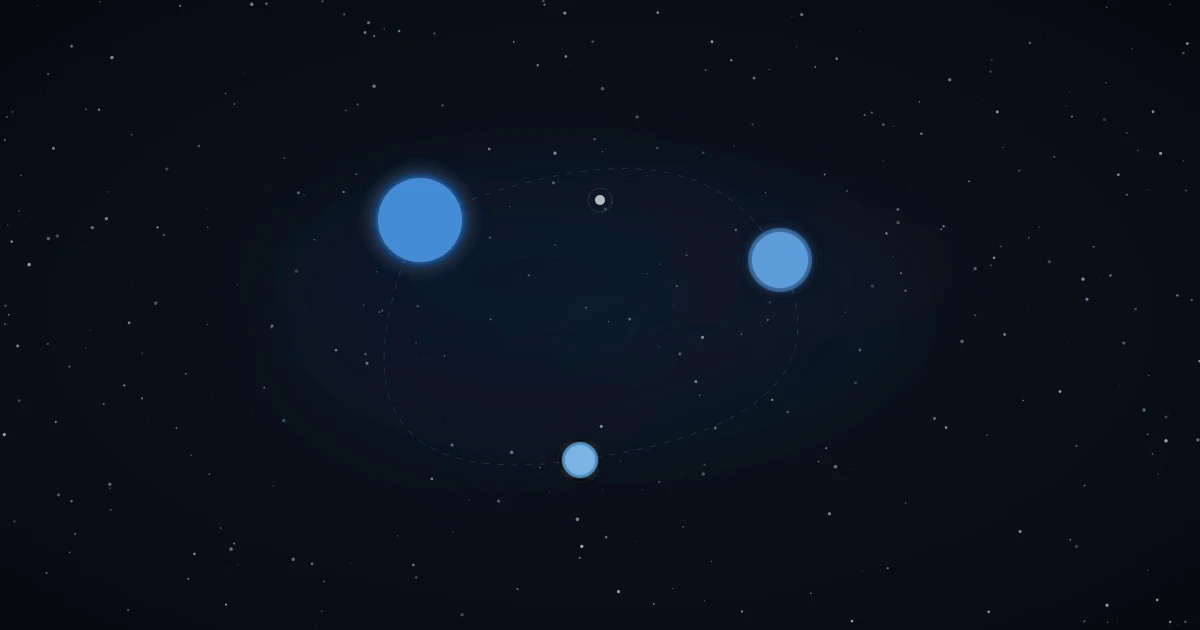
The three-body problem describes the difficulty of predicting the motion of three gravitational bodies interacting with each other.
Unlike two-body systems, which produce predictable orbits, three-body systems can become chaotic and unstable.
This instability plays a crucial role in the story's depiction of planetary systems, and explains the desperate motivation behind the Trisolaran invasion.
For more on how this shapes one of the trilogy's key characters, see Ye Wenjie, the scientist who grew up amid its consequences.
Background
The mathematics of planetary motion has fascinated scientists for centuries. In the 1600s, Isaac Newton demonstrated that the gravitational interaction between two bodies — the Earth and the Moon, or the Earth and the Sun — can be solved precisely. Given the masses, positions, and velocities of the two objects, you can calculate their future positions at any point in time.
But the moment you add a third body, that clean predictability breaks down.
The three-body problem is not merely harder than the two-body problem — it is fundamentally different. There is no general closed-form solution. You cannot write down a formula that tells you where three gravitating bodies will be at an arbitrary future time. Instead, physicists must use numerical methods, running computer simulations step by step, and even those methods are limited because small errors accumulate and the system can become genuinely chaotic.
This was first demonstrated rigorously in the late 19th century by Henri Poincaré, who showed that the three-body problem could exhibit chaotic behavior — sensitivity to initial conditions so extreme that even tiny differences in starting position produce wildly different outcomes over time.
What Chaos Really Means
In everyday language, "chaotic" means disordered or random. In physics, it has a precise meaning: a system is chaotic when its long-term behavior is extremely sensitive to initial conditions. The famous illustration is the butterfly effect — the notion that a butterfly flapping its wings in Brazil might, through a chain of atmospheric interactions, affect weather patterns in Europe weeks later.
For three gravitating bodies, chaos means that two nearly identical starting configurations can produce completely different orbital paths over time. One configuration might result in two bodies orbiting each other while the third is flung away. Another might lead to a complex braided orbit. A third might end in collision. And you cannot know which outcome you will get without running the numbers — and even then, the answer is only valid for a finite stretch of future time before errors accumulate beyond usefulness.
This is not a failure of our computational tools. It is a property of the physics itself.
The Trisolaran Problem
In the Three-Body Problem trilogy, this scientific reality shapes the entire history and culture of the Trisolaran civilization. Trisolar is a star system with three suns locked in a gravitational dance that exhibits precisely the chaotic behavior Poincaré described. The planet the Trisolarans inhabit experiences wildly unpredictable climate swings as the gravitational balance of the three suns shifts.
Sometimes the planet enjoys long, stable "Stable Eras" where one sun dominates and conditions are benign. But without warning, "Chaotic Eras" can begin, during which the gravitational pulls shift, temperatures swing from lethal cold to lethal heat, and civilization must either hibernate or rebuild from scratch.
This unpredictability drives Trisolaran culture toward a deep obsession with prediction, order, and survival — and ultimately toward looking outward for a more stable home, a desire that Ye Wenjie inadvertently enabled.
The brilliance of this setup is that Liu Cixin is not merely using a scientific concept as a backdrop. The three-body problem is the reason for everything that follows: the Trisolarans' desperation, their contact with Earth, and the events that cascade across three novels.
Real-World Research
Despite being unsolvable in the general case, mathematicians have found special solutions to the three-body problem — configurations where the bodies follow stable, repeating paths. The most famous are Lagrange points, where a small body can orbit stably in the presence of two larger ones, and figure-eight orbits, discovered mathematically in 1993 and independently confirmed in 2017 by a collaboration of physicists who found a class of stable periodic solutions.
Modern research continues to classify the enormous landscape of possible three-body behaviors. Computational physicists have catalogued hundreds of distinct families of periodic orbits. But these are islands of stability in a vast ocean of chaos, and most random initial conditions do not land on them.
Why This Concept Matters
Understanding the three-body problem grounds the trilogy in real science rather than pure fantasy. When Liu Cixin describes the Trisolaran civilization's suffering across Chaotic Eras, he is describing a world shaped by a genuine mathematical phenomenon that has resisted complete analysis for centuries.
It also serves as a thematic touchstone. The three-body problem is a metaphor for unpredictability itself — for the limits of human (and Trisolaran) knowledge in the face of a universe that does not offer clean answers. This theme of irreducible uncertainty echoes throughout the trilogy, from the Fermi Paradox to the logic of Dark Forest deterrence and the first contact it ultimately enabled.
In a story full of vast technologies and grand civilizational stakes, the three-body problem is a reminder that some of the universe's deepest puzzles are also its simplest to state.