The Problem at the Bottom of the Well
Every kilogram humanity ever launched into orbit before the Crisis Era was lifted the hard way: strapped to a controlled explosion and thrown upward at tremendous expense. Chemical rockets are staggeringly inefficient. To reach low Earth orbit, roughly 90 percent of a rocket's launch mass is propellant. Launching enough steel, water, electronics, and human beings to build a warfleet capable of resisting an interstellar invasion would bankrupt any individual nation — and nearly broke the entire planet.
The Crisis Era needed something better. It needed a ladder.
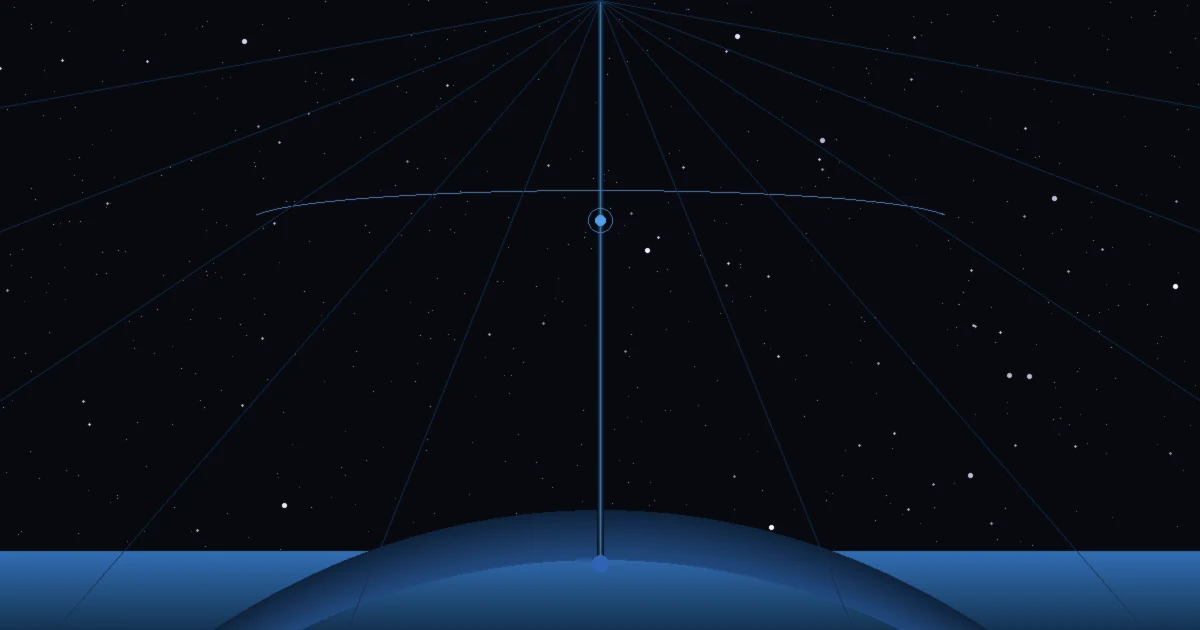
The space elevator is that ladder. The concept is straightforward in outline: anchor a cable at the equator, extend it upward to geostationary orbit (roughly 35,786 kilometers above Earth's surface), and keep going — far enough that the centrifugal force on the cable's outer portion exceeds the gravitational pull on its inner portion, keeping the whole structure taut. Once the cable exists, payloads can be lifted electrically, like a freight elevator, at a fraction of the energy cost of rocket launch.
In the Three-Body universe, this infrastructure made the fleet-building program possible. In our own world, it remains tantalizingly just out of reach — held back by a single materials science problem that Wang Miao's field was working to solve.
The Physics of Tension
Why doesn't the cable simply fall down? The answer lies in orbital mechanics. A satellite at geostationary orbit is moving at exactly the right speed to match Earth's rotation — it appears stationary from the ground. If the cable extends well beyond geostationary orbit, the outer section moves too fast for its altitude, generating centrifugal force that pulls outward. This outward pull on the upper cable balances the gravitational pull on the lower cable, keeping the whole ribbon under tension.
The cable, in other words, is a giant tether spinning with the Earth, held taut between gravity pulling inward and centrifugal effect pulling outward.
This is elegant physics. The engineering challenge is that the cable has to support its own weight. As the structure hangs from geostationary altitude down through the atmosphere, the lower sections must bear the weight of everything above them. The required tensile strength is extraordinary — far beyond steel, far beyond Kevlar, beyond nearly every material available in the twentieth century.
The number engineers care about is specific strength: tensile strength divided by density. A space elevator cable needs a specific strength roughly 76 times greater than the best steel. For most of human industrial history, no such material existed.
Carbon Nanotubes and Wang Miao's World
This is where Wang Miao enters. He is introduced in The Three-Body Problem as a nanomaterials researcher — a specialist in the class of materials that includes carbon nanotubes, the only substance that has ever come close to meeting space elevator requirements.
A carbon nanotube is a cylinder of carbon atoms rolled into a seamless tube, typically just one to a few nanometers in diameter. The chemical bonds between carbon atoms in this configuration are extraordinarily strong. Theoretical calculations suggest that a perfect single-walled carbon nanotube could achieve a specific strength roughly 100 times what a space elevator requires. The problem, in our world and in Wang Miao's, is manufacturing them.
Producing carbon nanotubes in bulk — uniform, defect-free, in lengths greater than a few centimeters — remains one of the central challenges of materials science. Every defect in the nanotube structure dramatically reduces its practical strength. A cable strong enough for a space elevator would require continuous nanotube fibers of extraordinary purity and length. Wang Miao's research, and by extension the Crisis Era's industrial program, presumably solved problems that remain open today.
In the Three-Body universe, the space elevator cable is described as a ribbon of carbon nanotube composite — a thin, flat band rather than a round cable. The flat geometry distributes wind loading more evenly, which matters in the lower atmosphere where the ribbon passes through weather. This is the same design real-world engineers have proposed when running elevator feasibility studies.
How the Crisis Era Version Worked
The Three-Body trilogy doesn't describe the elevator in comprehensive technical detail, but its role is clear. The elevator's anchor station sits on the equator — most real proposals locate the anchor point on a platform in the Pacific Ocean, or in equatorial regions like Ecuador or the Maldives, where atmospheric conditions are most favorable. From there, the ribbon rises through the troposphere, the stratosphere, and beyond — a structure that takes days to traverse at climbing speeds practical for heavy cargo.
Climbers — the elevator cars — grip the ribbon and ascend using electric motors powered by wireless energy transmission from ground-based sources. Because they're not carrying their own propellant, the energy cost per kilogram of payload is dramatically lower than rocket launch. Estimates for mature elevator technology suggest a cost reduction of two to three orders of magnitude compared to chemical rockets.
For the Crisis Era fleet program, this was the difference between feasibility and impossibility. Lifting millions of tons of refined metal, processed electronics, drive components, and crew into orbit required a mechanism that didn't consume a significant fraction of Earth's industrial output just in propellant. The elevator provided it.
Strategic Importance
A space elevator is not a weapon, and it is easy to overlook its strategic significance. But in the Three-Body universe's Crisis Era, it was arguably as important as any warship in the fleet.
Consider what it enabled. Without the elevator, every component of every warship had to be either manufactured in orbit (requiring orbital industrial facilities to be bootstrapped by even more expensive rocket launches) or launched at crushing cost from Earth's surface. The elevator changed the economic calculus entirely. Earth's surface could build and refine; the elevator could lift; orbital shipyards could assemble. The division of labor that made the fleet possible depended on affordable access to orbit.
There is also a vulnerability dimension. A space elevator is a single point of failure. The cable, for all its tensile strength, can be severed — and if it breaks, the lower section falls back into the atmosphere and the upper section drifts outward into higher orbit. The debris cascade from a severed elevator would be catastrophic. In a conflict context, the elevator would be among the highest-priority defensive assets humanity possessed.
This vulnerability was understood by real-world elevator engineers long before the Crisis Era existed only in fiction. Proposals for defense of the anchor station, dispersal of the cable into multiple redundant ribbons, and rapid repair protocols all appear in serious feasibility literature.
Why It Matters That Wang Miao Was Recruited
The Planetary Defense Council didn't recruit Wang Miao because they needed someone to check on the Three-Body game. They recruited him because his field — nanomaterials, specifically high-performance carbon nanotube composites — was foundational to the Crisis Era's industrial infrastructure.
The sophon science block targeted high-energy physics. It disrupted fundamental particle research. But materials science — the painstaking empirical work of synthesizing, characterizing, and improving substances — was harder to block wholesale. Wang Miao's career was spent in the discipline that made the elevator work. His expertise was, in a literal sense, structural to everything that followed.
When Operation Guzheng deployed a nano-filament wire to slice an ocean freighter, it was deploying the same class of technology that held humanity's access to space together. The same tensile properties that made nanotube composites ideal for elevator cables made them ideal for weapons of extraordinary precision. Wang Miao's world was dual-use technology in the deepest sense: the material that built the ladder off the planet was also the material that cut through steel like paper.
The Quiet Infrastructure of Survival
Space elevators don't appear in the dramatic set pieces of the Three-Body trilogy. They don't fight the water-drop probes. They aren't piloted by characters with names. They are infrastructure — the category of human achievement that is most essential and least celebrated.
But the Crisis Era's entire strategic posture rested on the ability to move mass from Earth's surface to orbit efficiently. Without that capability, there is no fleet, no deterrence, and no Wallfacer Program funded by the resources of an industrial civilization that had figured out how to reach space at scale.
The space elevator is, in this sense, the quiet foundation under everything. A ribbon of impossibly strong carbon atoms, stretching from equator to geostationary orbit, holding the weight of humanity's only viable response to the end of the world. It doesn't look like much from the ground. From orbit, it is everything.