A Name That Means Something
Most science fiction series take their names from invented concepts — made-up places, fictional technologies, characters. Liu Cixin did something different. He named his trilogy after a real, centuries-old unsolved problem in mathematics, one that predates modern physics and continues to resist complete solution today.
That choice is not cosmetic. The three-body problem is the conceptual spine of the entire trilogy: a universe where the future cannot be computed in advance is also a universe where civilizations cannot plan for each other's existence, where trust is structurally impossible, and where the silence of the cosmos carries an explanation that is worse than mystery. Before any of that makes sense, the mathematics deserves a proper introduction.
Two Bodies: The Problem That Works
Start with two bodies — a star and a planet, or the Earth and the Moon. Under Newtonian gravity, each body exerts a gravitational force on the other proportional to their masses and inversely proportional to the square of the distance between them. The result is elegant: the two bodies orbit their shared center of mass in perfect ellipses, and those ellipses are predictable forever.
Isaac Newton solved this in the seventeenth century. Given the position and velocity of two gravitating bodies at any moment, you can calculate their positions at any future time with arbitrary precision. The equations close cleanly. The solution is analytic — it can be expressed in a finite formula.
This is the mathematical foundation of everything from GPS satellites to interplanetary missions. We can send a probe to Saturn because two-body orbital mechanics works.
Three Bodies: Where Calculation Breaks
Add one more body, and everything changes.
A three-body system — three masses mutually attracting each other through gravity — almost never settles into a stable, predictable configuration. The interaction between any two bodies is constantly disturbed by the gravitational pull of the third, which is itself being disturbed by the other two. The forces feed back on each other in ways that compound exponentially over time.
Henri Poincaré, one of the greatest mathematicians of the nineteenth century, proved in 1890 that no general closed-form solution to the three-body problem exists. You cannot write down a formula, however complex, that tells you where three gravitating bodies will be after an arbitrary amount of time. The best available approach is numerical integration: computing the forces at each timestep and advancing the system forward incrementally. This works well for short time periods, but tiny errors in measurement — or in the computation itself — grow without bound. The further ahead you try to project, the more wildly the prediction diverges from reality.
This is the mathematical definition of chaos.
Sensitive Dependence on Initial Conditions
The term most associated with chaos theory is "sensitive dependence on initial conditions" — sometimes illustrated by the butterfly effect. In a chaotic system, two trajectories that start almost identically will eventually diverge completely.
For a three-body gravitational system, this means that knowing the current positions and velocities of three stars to extraordinary precision is still not enough. Measure a star's position to within one meter, and your prediction of its location a thousand years from now might be off by billions of kilometers. The universe does not care about your measuring equipment.
This is not a limitation of current technology. Poincaré's proof is mathematical, not empirical. No instrument, however perfect, and no computer, however powerful, could resolve this problem by brute precision. The chaos is intrinsic to the dynamics, not a gap in our knowledge.
What This Means for Trisolaris
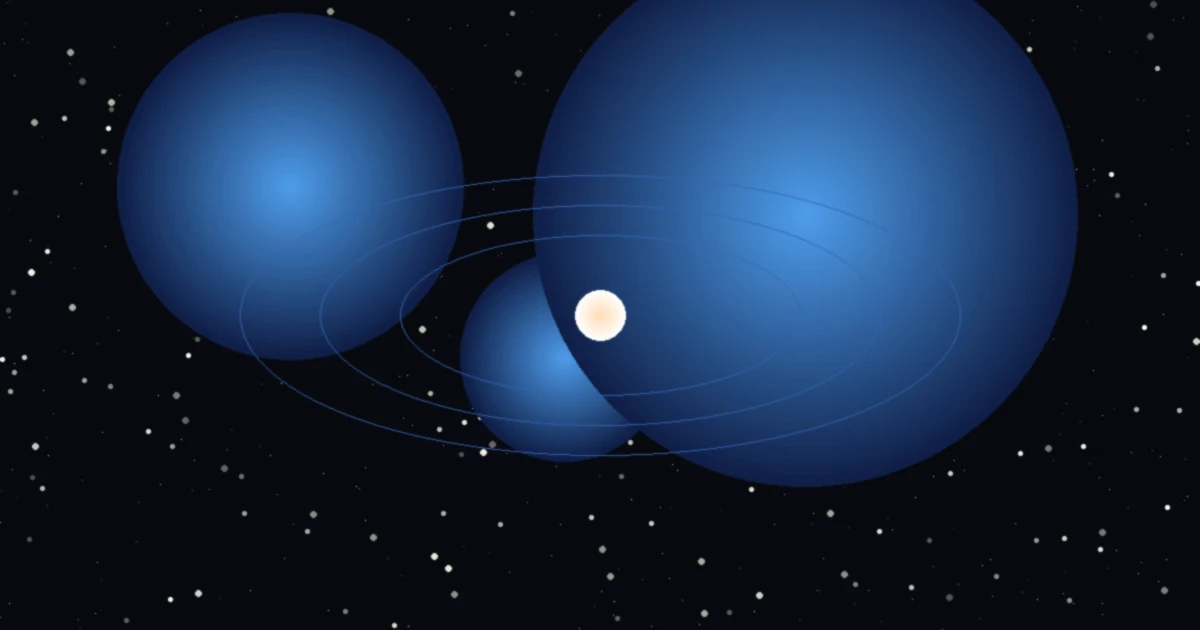
Liu Cixin builds his fictional Trisolaran civilization around exactly this reality. Trisolaris orbits not one stable star but three — the Alpha Centauri system — and the gravitational interactions between those three suns produce the Chaotic and Stable Eras that define Trisolaran history.
During Stable Eras, the stars' motions temporarily settle into a configuration that allows predictable seasons, stable temperatures, and something like a normal planetary civilization. During Chaotic Eras, the unpredictable interplay of gravitational forces sends the planet careening — sometimes too close to one of the suns for liquid water to exist, sometimes flung into the freezing void between them.
The Trisolarans cannot predict when the next Chaotic Era will begin or how long it will last. Their entire civilization has been built around the impossibility of knowing. Dehydration technology, cultural fatalism, and a 400-year interstellar invasion all flow from that single mathematical fact.
The Title as Metaphor
Liu Cixin chose this problem for more than scientific accuracy. He uses it as a metaphor for the entire trilogy's worldview.
The three-body problem tells us that even a closed, deterministic system — one governed entirely by known laws, with no randomness introduced — can produce behavior that is in practice unforeseeable. The universe is not random. Every particle follows the laws of physics precisely. And yet the future cannot be computed.
A cosmos full of civilizations, each trying to predict the behavior of every other, is a three-body problem scaled to galactic dimensions. The Dark Forest is not merely a strategic doctrine — it is the only rational response to a universe where you cannot know what any other civilization will do before it is too late to respond. You cannot compute your way out of mutual suspicion when the computation itself is the problem.
Recent Advances — and What They Don't Change
It is worth noting that mathematics has not stood still since Poincaré. Researchers have used computer simulations and, more recently, machine learning to discover particular three-body solutions that are periodic — configurations where three bodies will repeat their trajectories indefinitely. As of the 2020s, thousands of such solutions have been catalogued.
But these periodic solutions occupy a vanishingly small corner of all possible configurations. They are the exception so rare as to be irrelevant in practice. The general three-body problem remains unsolvable in the sense Poincaré proved. No amount of computing power changes the fundamental topology of phase space.
Trisolaris did not land in one of the periodic solutions. Neither does the universe Liu Cixin imagines.
Why the Name Hits Differently
Once you understand what the three-body problem actually is — not just "a hard orbital mechanics puzzle" but a mathematical proof that certain futures are permanently beyond prediction — the trilogy's title stops being a clever reference and becomes a statement of intent.
Liu Cixin is writing about a universe where the future simply cannot be computed in advance. Not because we lack information, not because our tools are inadequate, but because the laws of physics themselves make reliable prediction of complex interacting systems impossible.
In that universe, hope is not irrational. But neither is fear.
Everything follows from there.