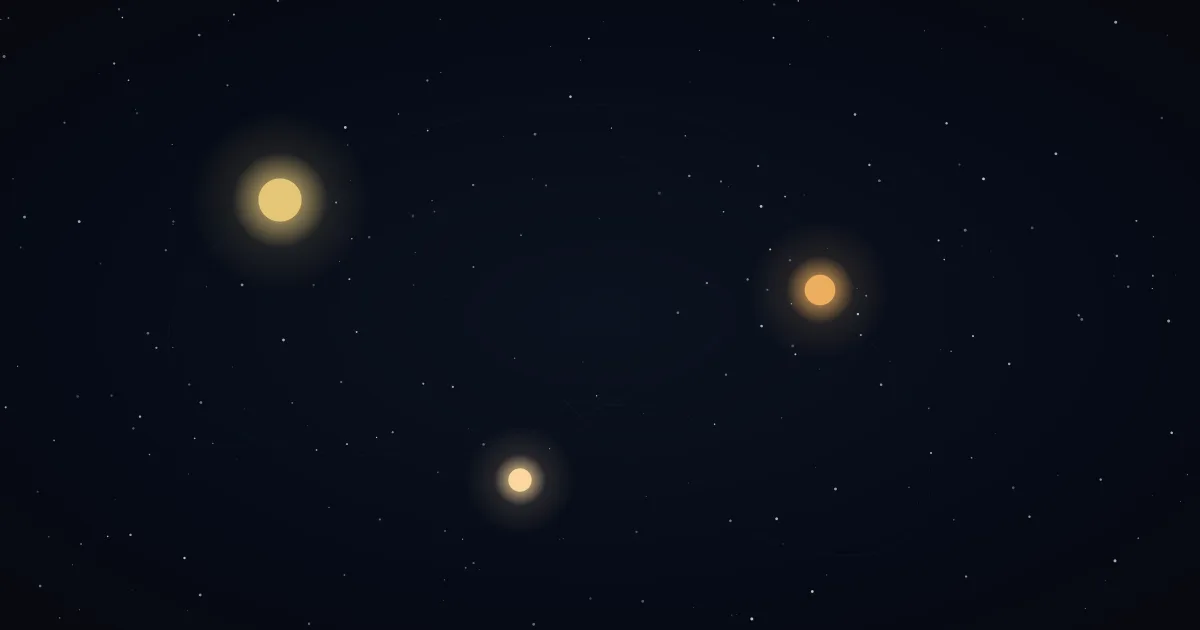
Trisolar System: Living in Chaos
The title of Liu Cixin's novel is not metaphor. It is physics. The three-body problem is one of the most notorious puzzles in classical mechanics — a system so complex that no clean, general solution exists. The Trisolarans don't just face this problem in the abstract. They live inside it.
What Is the Three-Body Problem?
In physics, the two-body problem — predicting how two objects orbit each other under gravity — has a clean, elegant solution. Isaac Newton cracked it in the 17th century. Planets orbit stars in ellipses. The math works out neatly, and the paths repeat predictably.
Add a third object and everything breaks down.
When three bodies of comparable mass are all pulling on each other gravitationally, their interactions become extraordinarily sensitive to initial conditions. Tiny differences in starting position or velocity cascade into wildly different outcomes. The system does not settle into a stable, repeating pattern. Instead, it careens through phases of near-order and sudden disorder in ways that resist long-term prediction.
Henri Poincaré proved in 1890 that the three-body problem has no general closed-form solution. Modern physicists can simulate specific cases numerically, but there is no formula you can plug three sets of numbers into and get a precise answer a million years out. The system is, in the technical sense, chaotic.
This is the world Trisolaris orbits.
Three Suns, No Promises
Trisolaris exists in the Alpha Centauri system — specifically in what Liu Cixin imagines as a triple-star system (the real Alpha Centauri is a binary system with a distant third star, Proxima Centauri). In the novel, Trisolaris orbits all three stars simultaneously, subject to the gravitational pull of each.
The consequences are catastrophic in the most literal sense.
Most of the time, one star dominates Trisolaris's sky and the planet settles into something like a stable orbit. The Trisolarans call these Stable Eras — periods when seasons are predictable, temperatures are livable, and civilization can build and grow. These eras can last decades or even centuries.
But eventually, the gravitational geometry shifts. A second or third star swings close, its pull disrupting the dominant relationship. The planet's orbit destabilizes. It might be flung toward a star, baking the surface. It might be yanked outward into freezing void. It might oscillate wildly between extremes with no warning.
These are Chaotic Eras — and they are extinction events.
What Chaotic Eras Actually Mean
Imagine trying to survive in a world where the sun might double in apparent size tomorrow. Or vanish behind another star's competing glare. Or where a second star rises on the horizon while the first hasn't set — and the temperature swings from 200°C to -100°C within a single generation.
For Trisolaris, this is not catastrophe planning. It is history. The planet has been largely wiped clean of life multiple times over, only for whatever survived underground or in extremophile niches to crawl back and rebuild.
Liu Cixin uses this as more than atmosphere. The constant threat of annihilation explains nearly everything about Trisolaran civilization:
- Dehydration: Trisolarans learned to survive Chaotic Eras by desiccating their bodies — essentially drying themselves into dormancy — until the crisis passed. This is not metaphor; it is their primary survival adaptation.
- Technological urgency: A civilization that knows it could be scoured off its planet without warning has a different relationship to science than one living in a stable solar system. Survival creates a frantic pressure to understand, predict, and ultimately escape.
- Collective psychology: There is little room for individualism when the species itself is perpetually on the brink. Trisolaran society, as glimpsed in the novel, reflects a kind of hardened collectivism born of necessity.
- The impulse to expand: Ultimately, Trisolaris is not a home that can be defended — it is a liability. The drive to find a new world is existential, not aspirational.
The Science Behind the Fiction
Liu Cixin's physics is largely accurate in spirit. The three-body problem's chaos is real, well-documented, and genuinely intractable in the general case. A planet in a three-star system would experience wildly variable conditions.
That said, some nuance is worth noting. Not all three-body configurations are equally unstable. Hierarchical systems — where two stars orbit each other closely and a third orbits that pair from far away — can be remarkably stable. In such systems, a planet orbiting one of the close pair might behave almost like a planet in a two-body system, barely feeling the distant third star's influence.
What makes Trisolaris so extreme in the novel is that the three stars are of comparable mass and proximity — the worst-case configuration. Real-world astronomers have found planets in binary and even trinary systems, but the stable ones tend to exist in those hierarchical arrangements.
The Trisolarans got the unlucky draw.
Knowing the Unknowable
One of the most haunting aspects of Trisolaran civilization is its relationship to prediction. They have invested enormously in forecasting the behavior of their three stars — not because they can solve the three-body problem, but because even imperfect warnings buy time.
The VR game that the Earth-Trisolaris Organization uses to recruit sympathizers on Earth — a scheme rooted in Ye Wenjie's original contact — essentially lets players experience this. (For more on the game's role as propaganda, see The Three-Body VR Game.) Human players are dropped into Trisolaran history, surviving Chaotic Eras, watching civilizations rise and collapse. The game is propaganda, but it also transmits a genuine truth: Trisolaran history is a succession of magnificent attempts to build something permanent in a universe that refuses permanence.
There is something deeply sympathetic in that, even if the Trisolarans' solution — conquer Earth and abandon their doomed home — is hardly admirable.
Chaos as Character
The three-body problem isn't just the title of the first book. It is the engine of the entire trilogy's moral universe. A civilization forged in unpredictable, existential chaos develops differently from one that evolved under a single, steady sun. Their fatalism, their pragmatism, their ruthlessness — all of it traces back to orbits that could not be trusted.
In that sense, Liu Cixin's central insight may be this: the physical environment doesn't just shape civilizations. It becomes them. The Trisolarans are not evil. They are what you get when intelligence evolves inside a chaos machine with no exit. Their desperation ultimately explains the sophon deployment and the logic of cosmic civilization theory.
Understanding their star system is the first step to understanding why contact with them — and the first contact timeline that followed — was always going to go the way it did.