A Game That Was Never Just a Game
When Wang Miao first dons his virtual reality headset and enters the world of Three Body, he expects a puzzle game. What he finds is something stranger and more disturbing: an immersive simulation of a civilization dying and being reborn, again and again, under three erratic suns. The game is addictive. It is also a trap — a beautifully engineered piece of ideological recruitment designed to identify and convert humanity's most disillusioned thinkers. The detective who worked alongside Wang Miao to unravel this conspiracy is profiled in Da Shi.
The Three-Body VR game is one of Liu Cixin's most inventive storytelling devices. It does double duty: it delivers the novel's central lore about Trisolaran civilization, while simultaneously functioning as a diegetic object — something that exists and operates within the world of the story, with its own logic, purpose, and creators.
How the Game Works
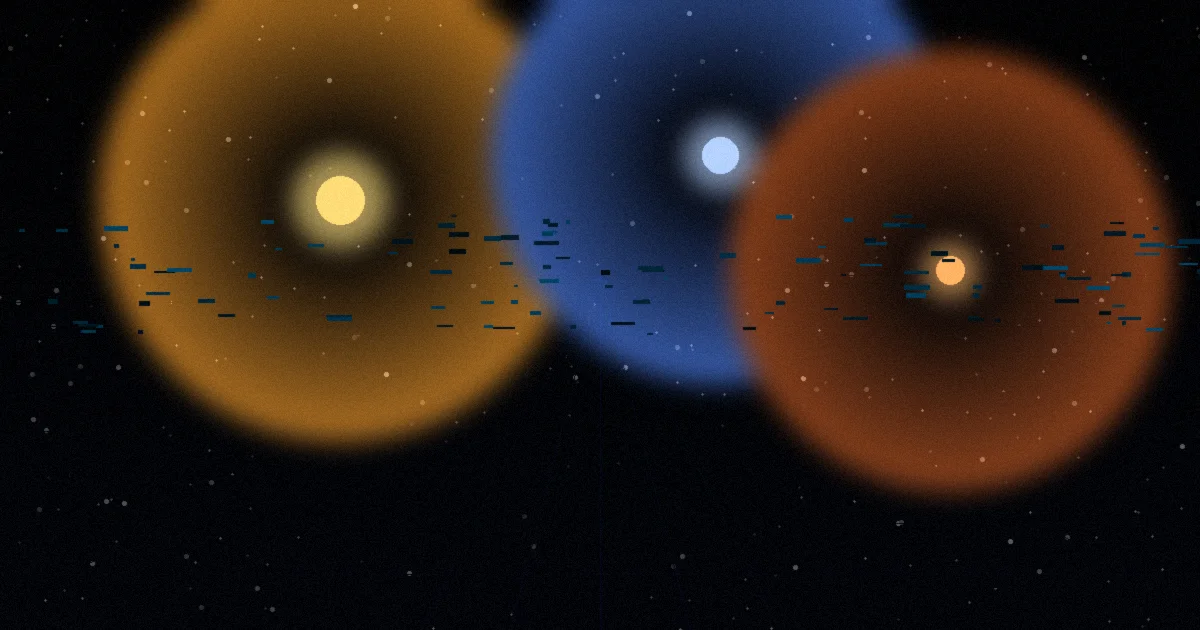
The game simulates Trisolaris, a planet orbiting three suns whose gravitational interactions are chaotic and unpredictable. Players wake in a civilization that may be experiencing a Stable Era, with moderate temperatures and time to build — or a Chaotic Era, where temperatures swing from burning heat to absolute cold in ways that obliterate everything. The goal is survival and the accumulation of knowledge.
Players interact with historical and legendary figures — Newton, Von Neumann, the Qin Shi Huang simulacrum — and attempt to calculate the pattern of the suns. Every attempt fails. The point is not to win. The point is to feel the desperation of a species on the edge of extinction, searching the stars for a way out.
The game is sophisticated enough to be genuinely compelling as a game, but it is not designed for entertainment. It is designed to provoke a specific emotional conclusion: that a civilization facing existential destruction has not just the right but the need to find a new home — at any cost.
The ETO's Recruitment Logic
The Earth-Trisolaris Organization was not monolithic. Its members included committed idealists who believed human civilization was irredeemably corrupt, scientists disillusioned by the Cultural Revolution or the failures of rationalism, and people drawn in by something that looked like a mystery and turned out to be a calling.
The game served the ETO's recruitment strategy in several ways.
First, it operated through the internet with no obvious connection to any organization. Players could find it, become obsessed with it, and seek out others who had played it — which led them, step by step, toward people who could explain what they had experienced. The game was the door. The community that formed around it was the threshold.
Second, it filtered for a particular psychological profile. Casual players dropped off. The game rewarded persistence, systems thinking, and a willingness to sit with futility — qualities the ETO valued in potential members. Someone who spent weeks trying to solve the three-body problem and emerged from the experience with sympathy for Trisolaran suffering was exactly who the organization wanted.
Third, it provided plausible deniability. The ETO could distribute the game as a commercial product and maintain distance. There were no manifestos attached, no explicit calls to action. Just a simulation of extinction, running on loop.
Hidden Messages and the Deeper Layer
The game contains more than atmosphere. Embedded within its simulation are encrypted communications, philosophical texts, and coordinates that function as contact points for ETO recruiters. Players who reached a certain level of investment — and demonstrated the right ideological leanings in forums and discussions — were eventually contacted directly.
This layered structure mirrors the ETO's own organizational hierarchy. The organization was divided into two main factions: the Adventists, who welcomed human extinction as just punishment for civilization's sins, and the Redemptionists, who hoped that cooperation with the Trisolarans might spare some portion of humanity. For more on how this hierarchy developed around its founder, see Ye Wenjie and the Earth-Trisolaris Organization. The game fed both. For Adventists, it was evidence of human smallness. For Redemptionists, it was a portrait of a civilization deserving of empathy and aid.
The fact that the same game could speak to both factions reveals something important about how the ETO maintained cohesion: it operated through shared feeling rather than shared doctrine. The game made you feel Trisolaran suffering. What you concluded from that feeling was, apparently, up to you.
What the Game Reveals About ETO Strategy
The Three-Body game represents the ETO operating at its most patient and sophisticated. Rather than issuing propaganda, it created an experience. Rather than making arguments, it generated empathy. Rather than recruiting openly, it built a self-selecting community of the already-alienated.
This patience is characteristic of Ye Wenjie's influence on the organization. Her own decision to betray humanity was not made in anger — it was made after decades of quiet observation during the Cultural Revolution and a deepening conviction that human civilization could not save itself. The game she helped inspire was designed to lead others to a similar conclusion, at their own pace, through their own emotional logic.
It also reflects a certain dark sophistication about how belief systems form. People do not join movements because they are given facts. They join because they have an experience that reconfigures their emotional world, and the movement offers a framework that explains what they now feel.
The Game as Literature
From a craft perspective, the Three-Body game is also doing structural work in the novel. It allows Liu Cixin to deliver enormous amounts of Trisolaran history and physics to the reader through Wang Miao's experience, while grounding that information in human stakes. We learn about Chaotic Eras not through exposition but through Wang Miao's repeated failures and the desperation of the simulated civilization around him. The science behind those chaotic eras is explored in Trisolar System: Living in Chaos.
It is, among other things, a meditation on simulation and reality — a theme that runs throughout the trilogy. That same gap between perceived reality and Trisolaran manipulation is at the heart of the sophon science blockade. The Trisolarans built a game to make humans feel their history. Later, they would deploy far more sophisticated tools to shape human reality directly. The VR game is the crude early version of a strategy that culminates in sophons: the use of constructed experience to redirect human perception and behavior. For context on the chaotic civilization the game depicts, see Trisolaran Chaotic Eras.
Conclusion
The Three-Body VR game is propaganda — but it is propaganda of an unusually honest kind. It does not lie about Trisolaran history or manufacture false sympathy. It simply presents the facts of Trisolaran suffering and trusts that a certain kind of human being, experiencing genuine despair about their own civilization, will draw the conclusions the ETO needs them to draw.
Whether that makes it more or less disturbing is a question the novel leaves open. It is, in the end, a game about the limits of human empathy — and about how easily that empathy can be aimed. For how the two TV adaptations handled the game's sequences differently, see Three-Body on Screen.