Trisolaran Chaotic Eras: Why Their Home Planet Was a Death Trap
At the center of Liu Cixin's The Three-Body Problem lies an astronomical fact that is not fiction at all: the motion of three gravitationally interacting bodies is genuinely, provably unpredictable over long timescales. The Trisolarans didn't just have bad luck. They were trapped by mathematics itself.
The Setup: Three Suns, One Planet
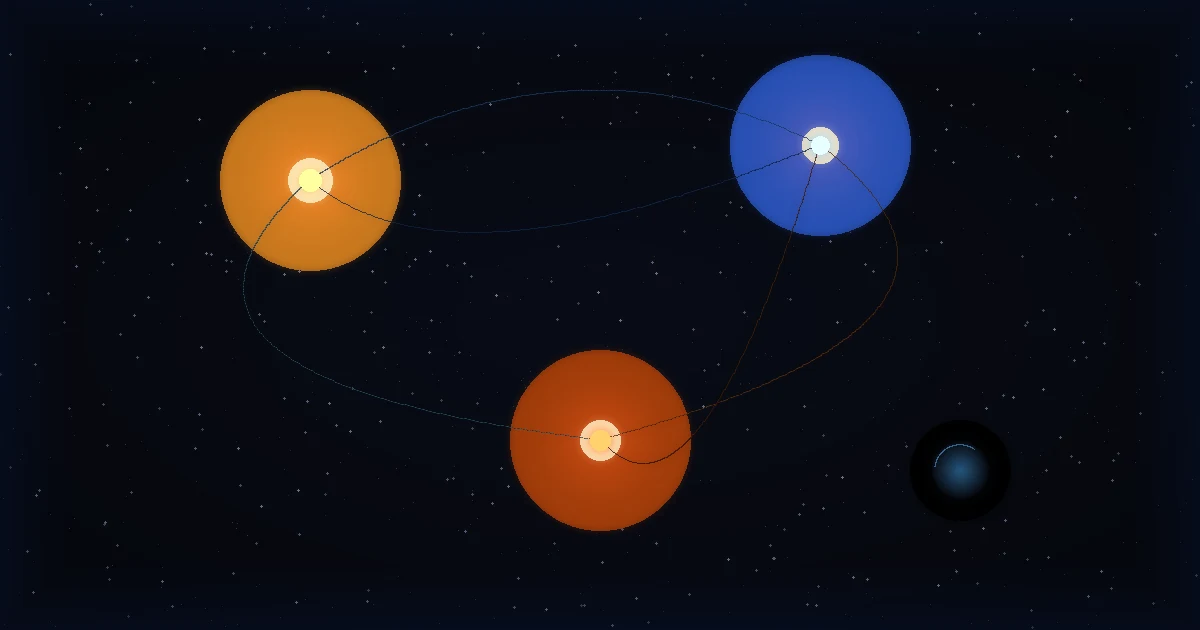
Trisolaris orbits within the Alpha Centauri system — or something like it — where three stars exert competing gravitational pulls on a single inhabited world. For brief periods, one star dominates and the planet settles into a stable, predictable orbit. The Trisolarans call these Stable Eras: seasons of warmth and reliable sunlight during which agriculture, civilization, and culture can tentatively take root.
Then everything changes.
When the gravitational balance shifts and two or three suns begin tugging the planet in conflicting directions, Trisolaris enters a Chaotic Era. The planet's path becomes erratic. It may careen toward one sun, scorched by lethal radiation. It may drift outward into freezing dark. Temperatures swing hundreds of degrees within what passes for seasons. The duration of Chaotic Eras is unknowable in advance — they may last decades or centuries — and civilizations built during Stable Eras are periodically erased.
The Trisolarans have rebuilt from scratch hundreds of times. This is their entire history.
The Real Physics: Why Three Bodies Are So Difficult
The two-body problem — predicting how two objects move under mutual gravity — has an exact, elegant solution worked out by Newton. Given any starting conditions, you can compute the future orbit precisely.
Add a third body and the problem becomes, in the technical sense of the word, chaotic. This doesn't mean random. It means that tiny differences in starting conditions — the position of a sun off by a kilometer, a velocity off by a meter per second — compound over time into wildly different outcomes. There is no general closed-form solution to the three-body problem. Mathematicians and physicists have proven this is not a gap in our knowledge but a property of the equations themselves.
Henri Poincaré first demonstrated this in 1887 while working on a prize competition about the stability of the solar system. His discovery — that the gravitational three-body system is inherently unpredictable over long timescales — was one of the seeds from which modern chaos theory grew.
In practice, simulating three-body orbits requires numerical methods: calculating each tiny time-step by brute computational force. And while researchers have discovered special periodic orbits (figure-eight configurations, for instance, where three equal masses chase each other in precise loops), these solutions are exquisitely sensitive to perturbation. Any deviation sends the system spiraling toward a chaotic trajectory.
Liu Cixin took this real science and asked a simple, terrifying question: What if someone had to live there?
The Human Cost of Orbital Chaos
The in-universe Three-Body video game reconstructs Trisolaran history across dozens of civilizational cycles, and what it reveals is a planet-sized exercise in existential endurance. Each civilization that rises during a Stable Era knows — or should know — that destruction is eventually coming. The timing is unknowable. The form it takes varies. The outcome is always the same.
This shapes Trisolaran psychology in profound ways. Their concept of civilization is defined by emergency, by the imperative to survive the next Chaotic Era. There is no long-term thinking in the human sense, no civilization that expects to outlast its founders by many generations. Every generation is potentially the last.
When a Stable Era lasts long enough, Trisolarans develop technology, culture, philosophy. But it is always haunted. The three suns hanging in their sky are not a source of wonder but of dread — a countdown that no one can read.
Why Escape, Not Survival, Became the Goal
After hundreds of cycles of rebuilding and extinction, Trisolaran civilization eventually reached a conclusion that is, in retrospect, entirely rational: you cannot solve the three-body problem. You can only leave it behind.
Their astronomical observations — aided eventually by sophon-scale computing — confirmed what the mathematics already implied. There is no stable configuration they could engineer. There is no shield against a star. Their planet is not a home to be defended but a trap to be escaped.
This is why, when Red Coast Base on Earth broadcasts its first signal, the Trisolarans respond so swiftly and so absolutely. They have been scanning the universe for an alternative. Humanity's signal is not an invitation to friendship — it is a beacon pointing to a new world, unclaimed and stable, orbiting a single, well-behaved sun. The full chain of events that followed is documented in the First Contact Timeline.
From Trisolaris's perspective, the invasion of Earth is not aggression. It is rescue. It is a civilization that has survived the unsurvivable, finally finding a door out.
Stable Eras Were Never Really Safe
One of the novel's most unsettling implications is that Trisolaris's Stable Eras were always an illusion of safety. The planet's inhabitants are never truly living in a safe period — they are living in the calm between catastrophes, unable to know when the next one begins.
This is not entirely foreign to the human condition. Plate tectonics, pandemic disease, asteroid impacts: Earth's stability is relative, measured in geological time rather than stellar time. But human civilization has enjoyed roughly ten thousand years of relatively stable climate — enough to build everything we consider civilization. Trisolarans have never been granted that luxury.
Their psychology, their ethics, their relationship to deception and strategy — all of it is downstream of orbital mechanics. A civilization that has died and been reborn hundreds of times develops different values than one that has never faced extinction. They are not cruel by nature. They are survivors by necessity.
What the Chaotic Eras Tell Us About the Story
Liu Cixin's genius is in rooting the novel's largest themes in real, comprehensible science. The Dark Forest Theory — the idea that all civilizations must hide or be destroyed — makes a kind of terrible sense when you understand what produced it. For the full logical framework, see Cosmic Sociology. A species that grew up on Trisolaris would naturally assume that the universe is hostile, that resources are scarce, that the default state of existence is emergency.
They are not wrong to think this. Their own sky proved it.
The three-body problem is not a metaphor in The Three-Body Problem. It is the physical foundation on which everything else is built — the reason the Trisolarans exist at all, the reason they invaded, the reason they could not simply wait for a better solution. Three suns in gravitational competition created a civilization of profound competence and profound fear.
They are, in the end, the universe's most coherent argument for the Dark Forest: a species that looked at the cosmos and saw, with complete scientific accuracy, that comfort was a temporary illusion and destruction was always one Chaotic Era away.