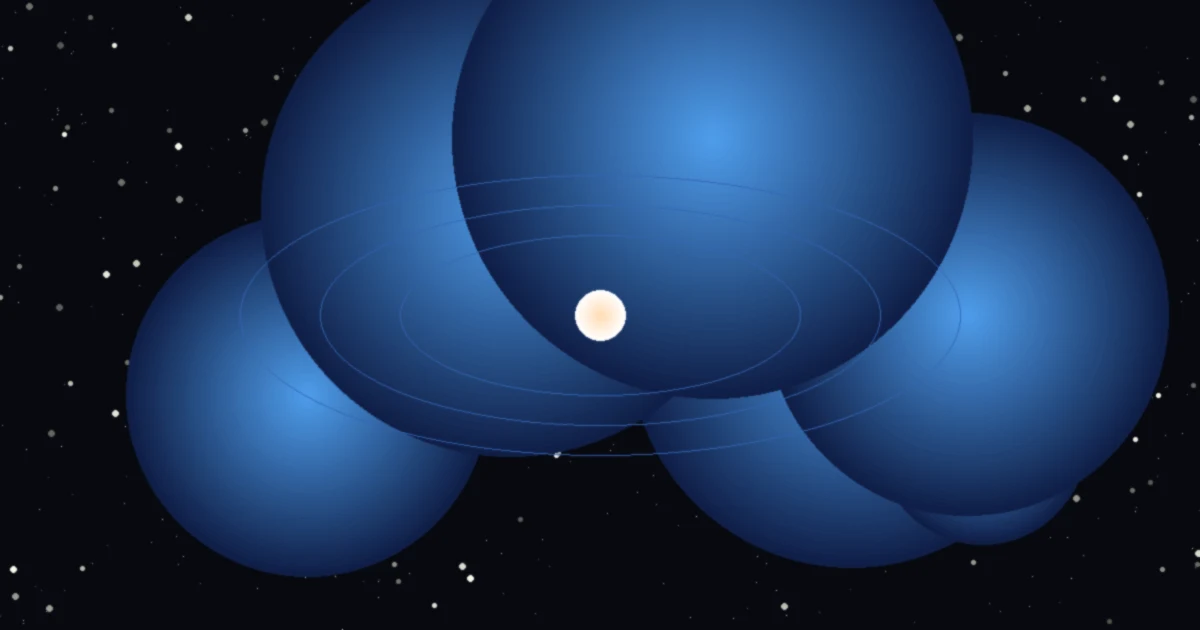
In Death's End, the destruction of the solar system arrives not as an explosion but as a transformation. A small, coin-like object drops into the ecliptic plane and begins to expand — slowly at first, then with gathering speed — turning everything it touches from three-dimensional matter into a spreading two-dimensional film. Stars, planets, and people are flattened into a glittering sheet racing outward at the speed of light. It is, by any measure, one of the most conceptually devastating weapons in science fiction.
What makes it so effective is not just the scale. It's that Liu Cixin grounded the idea in genuine theoretical physics.
What Are Compactified Dimensions?
To understand dimensional reduction, you need a concept from string theory: not all dimensions are the same size.
In the standard model of physics, the universe has three spatial dimensions we can perceive — length, width, and height. String theory and M-theory propose that the universe actually has ten or eleven spatial dimensions, but that all but three of them are compactified: curled up on themselves at scales so small they are effectively invisible at any energy level we can probe. Imagine a garden hose viewed from a great distance. It looks like a one-dimensional line. Up close, you see it also has a circular cross-section — a second dimension, compact and curled.
In the standard cosmological picture, these extra dimensions are compactified at around the Planck length: approximately 10⁻³⁵ meters. Nothing at human scales, or even nuclear scales, could interact with them. They are there in principle; they are irrelevant in practice.
The two-dimensional foil in Death's End exploits this structure. In Liu Cixin's universe, a weapon of sufficient sophistication can trigger a phase transition — forcing an already-unstable region of space to collapse from three large spatial dimensions to two. The third dimension doesn't disappear; it becomes compactified. The matter that occupied it is flattened as the spatial geometry it existed within is rewritten.
Phase Transitions and False Vacuums
The physics analogy Liu Cixin is reaching for here is the concept of a vacuum phase transition, or false vacuum decay.
The quantum vacuum — empty space — has an energy level. Current physics suggests the vacuum we inhabit may not be at its lowest possible energy state. It may be a false vacuum: stable enough to persist indefinitely under ordinary conditions, but capable of tunneling to a true, lower-energy vacuum if disturbed in just the right way. If that transition occurred, it would propagate outward at the speed of light, and the new vacuum's physical constants — the laws of physics themselves — would differ from ours. Everything inside the expanding bubble would be restructured according to different rules.
This is the mechanism the two-dimensional foil triggers: not a conventional explosion, but a localized, self-propagating change in the geometry of spacetime itself. Once initiated, it cannot be stopped. The physics of the expanding region is simply different from the physics outside it, and there is no way to push back.
The foil doesn't deliver enough energy to force this transition everywhere at once. It just needs to start it. The expansion does the rest.
What Happens to Three-Dimensional Matter
The trilogy gives us the experience of this from the perspective of observers at the edge of the expanding sheet. Matter that encounters the boundary is restructured instantly. It doesn't burn or shatter — it is remapped onto a two-dimensional surface. The particles, fields, and forces that made up a three-dimensional object are reconfigured into a flat analog, compressed along the lost dimension.
Liu Cixin takes care to note that the resulting two-dimensional matter is not simply flat — it has extraordinary stability. Compactification of a dimension changes the allowed states of quantum fields. The result is something like an infinitely thin material with properties unlike anything in ordinary chemistry: a stable, self-consistent structure that can persist indefinitely as it expands outward.
The visual Liu Cixin gives us — a glittering plane of two-dimensional light spreading across the solar system — is not purely aesthetic. It reflects what would actually happen if matter's internal structure were forced onto a plane and its electromagnetic interactions reconfigured accordingly. What we would perceive as light and shimmer is the two-dimensional material's way of radiating.
Why the Speed of Light?
The expanding foil spreads at c. This is not arbitrary. Vacuum phase transitions, if they occur, propagate at exactly the speed of light — the speed at which cause can precede effect in our spacetime. No warning is possible. The edge of the foil arrives simultaneously with the first photons that could have warned you it was coming.
This is the weapon's true horror, and its most theoretically grounded feature. It is not faster than light, which would violate relativity. It is precisely at light speed, which means detection and destruction are the same event. By the time you see it, you are already part of it. The only survivors — including Cheng Xin and her companions — escaped because they were already traveling at near-lightspeed aboard curvature drive ships when the foil struck.
Dimensional Weapons in Context
The two-dimensional foil is not the only dimensional weapon in the trilogy. Photoids — which appear to disrupt the quantum structure of spacetime at the stellar scale — suggest an even higher tier of technological civilization. The foil is a precision instrument by comparison: it targets a specific region and relies on phase transition propagation to do the work.
What both weapons share is a reliance on physics at scales far below the nuclear: quantum geometry, vacuum structure, dimensional topology. Liu Cixin is suggesting that a sufficiently advanced civilization would not bother with chemistry or even nuclear physics. It would go deeper, to the level where spacetime itself is a manipulable substrate.
This aligns with the Dark Forest's broader implication: that the universe's hunters are not merely technologically more powerful than their prey. They operate in a different conceptual register entirely. The gap between humanity and the civilization that dropped the foil is not a gap in engineering — it is a gap in what kind of physics each civilization understands as real.
The Science and the Story
String theory and compactified dimensions are genuine, if unverified, physics. Vacuum phase transitions are genuine, if hypothetical, phenomena that cosmologists take seriously enough to calculate timescales for. The Planck-scale structure of spacetime is genuinely unknown, and the question of whether our vacuum is stable is currently unanswerable.
Liu Cixin took this collection of real open questions in theoretical physics and asked: what would a weapon look like if it exploited the answers? The two-dimensional foil is the result — one of science fiction's rare cases where the most devastating imaginable weapon is also the most physically coherent one.
The solar system does not end in fire. It ends in geometry. And somehow, that is worse.
For a broader look at how dimensional weapons fit into the trilogy's cosmological hierarchy, see Dimensional Reduction Attacks and Cosmic Civilization Theory.