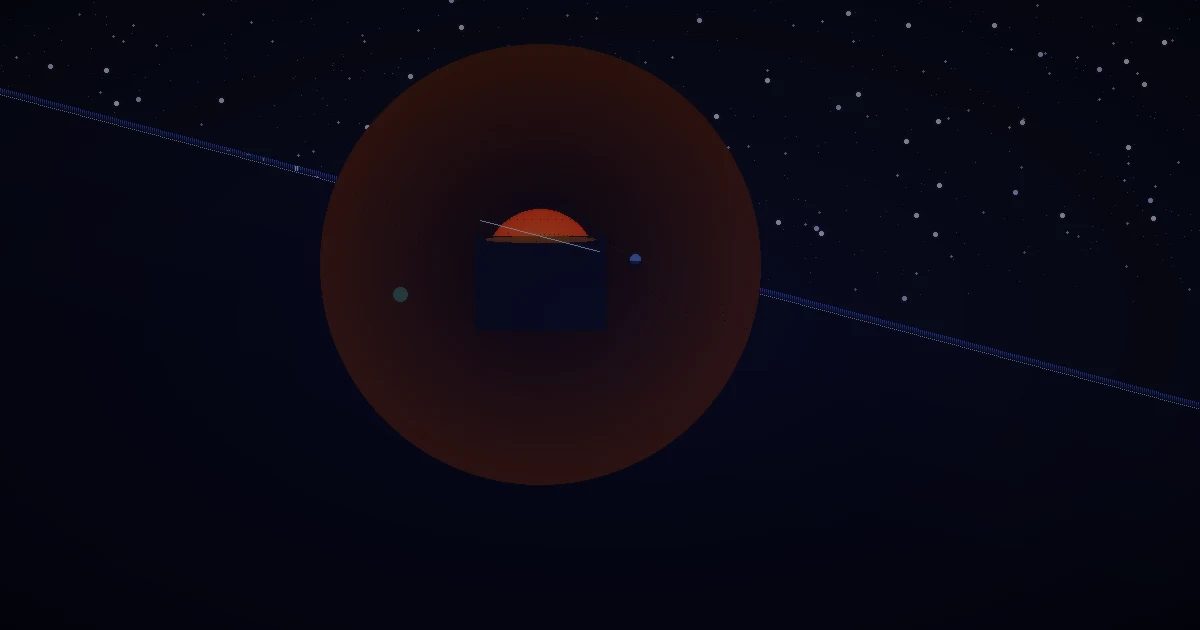
The Death of the Solar System: A Scene-by-Scene Breakdown
In the final act of Death's End, Liu Cixin delivers what many readers consider the most devastating sequence in all of science fiction: the two-dimensional foil attack on the solar system. It is not a battle. There are no heroes who repel it, no last-minute reversals. It is a slow, geometrically perfect extinction — and it is all the more haunting for how ordinary the universe looks in the moments before it begins.
What Is a Two-Dimensional Foil?
To understand the attack, you first need to understand the weapon. In the cosmology of the Remembrance of Earth's Past trilogy, advanced civilizations can weaponize spatial dimensions. A two-dimensional foil is a small object — unremarkable in appearance — that, when activated, begins converting three-dimensional matter into two-dimensional matter. The conversion spreads outward at the speed of light. Everything it touches — planets, gas clouds, light itself — is flattened into an ever-expanding sheet.
The foil is not fired like a missile. It is simply placed in a system's path. Once it unfolds, nothing can stop it.
The Attack Begins: Neptune and the Outer System
The foil enters the solar system at the edges and the conversion front expands inward. Neptune is the first planet to go. Cheng Xin and the novel's other surviving characters observe via telescope as the distant gas giant is quietly absorbed into the growing two-dimensional plane.
From a distance, the effect is almost beautiful. The expansion front catches sunlight. Planets that have existed for four and a half billion years are pressed flat in moments, their three-dimensional complexity — cores, atmospheres, magnetic fields — reduced to painted geometry on an expanding cosmic canvas.
Liu Cixin lingers here. The pacing is deliberate. Readers are given time to process what is happening before the horror fully resolves.
The Inner Planets
As the foil expands inward, Uranus, Saturn, and Jupiter follow. The gas giants, which humanity had spent the Bunker Era sheltering behind, offer no more resistance than rocky worlds. The dimensional conversion does not care about mass, chemistry, or composition. Matter is matter, and matter can be flattened.
Earth and the inner solar system are next. The Sun itself — eight minutes' light-travel from where the foil began its work — is eventually converted too. The star that has existed for nearly five billion years becomes a luminous disc embedded in an expanding two-dimensional plane that will eventually reach the size of a small galaxy.
Who Was Still in the System?
By the time the attack occurs, significant portions of humanity have already escaped — or tried to. The curvature-drive fleet left years earlier, carrying a small fraction of Earth's population toward other stars. The Bunker Era settlements around Jupiter and the gas giants had harbored billions, but most were still there when the foil struck.
Cheng Xin and Guan Yifan survive because they are watching from outside the solar system. The timing of their escape — nearly accidental, driven by circumstances unrelated to the attack itself — is one of the novel's most gut-wrenching ironies. They live because they happened to be somewhere else.
The Blue Space and Gravity, the two ships that returned from deep space to broadcast the solar system's coordinates, are also outside the destruction zone. Their role in triggering the response — they broadcast humanity's location to the Dark Forest as an act of desperate deterrence — adds a layer of moral complexity that Liu Cixin refuses to resolve cleanly. The entity that answered is the kind of civilization the trilogy calls a Singer — an apex predator that acts with total indifference and total efficiency. The Deterrence Era that preceded this moment had been built on the assumption that humanity could manage this risk indefinitely.
The Two-Dimensional Solar System
After the expansion front has passed, what remains is a disc of light and compressed matter approximately the width of the solar system's former diameter. Liu Cixin describes it as looking like a vinyl record — flat, reflective, faintly luminous.
Inside it, in some sense, is everything: billions of human lives, the cities of Earth, the accumulated culture and history of the species, the Sun, the planets, the millions of years of geological record. All of it compressed into a plane that is, by definition, without depth.
The image is philosophical as much as physical. The Dark Forest doesn't destroy — it simplifies. It removes a dimension. Everything that made a civilization complex and particular and three-dimensional becomes a surface.
Why This Scene Hits So Hard
Other science fiction has depicted the destruction of planets. What makes this sequence different is its patience and its perspective.
Liu Cixin doesn't show the attack from the ground. There are no screaming crowds, no heroic last stands, no tearful goodbyes. The destruction is witnessed from a distance, through instruments, by two people who are powerless to intervene. The scale is too enormous for individual drama. The attack reduces the entire solar system — eight planets, one star, four billion years of planetary history, and billions of human beings — to a backdrop.
That is the point. In the Dark Forest universe, civilizations are not precious. They are coordinates. When your location is known and your technology level is insufficient, what follows is not a war. It is maintenance. A civilization removes a potential threat the same way you might clear a drain.
The Last Signal
As the foil expands, telescopes and sensors across the surviving fleet capture the event in detail. There is no distress signal from Earth, no final broadcast from a planetary government. The communications infrastructure is gone before anyone could compose a message.
The silence is deliberate. Liu Cixin has set up throughout Death's End the question of what civilizations say when they know they are dying. The answer, here, is nothing. There is no time. The foil converts at the speed of light. By the time you could see it coming, it would already have arrived.
What Survived
A handful of curvature-drive ships. Cheng Xin and Guan Yifan, watching from a distance. The radio transmissions humanity had been broadcasting into space for over a century, still expanding outward at the speed of light — a sphere of unintentional announcement that would continue growing long after there was no civilization left to own it.
And, eventually, the pocket universe — a small enclosure of space offered to Cheng Xin by a vanished civilization, where she and Guan Yifan will outlast almost everything else. But that is a different story.
A Warning Written in Physics
Liu Cixin has said in interviews that he did not set out to write horror. But the sociological and physical framework that made this event inevitable is laid out in Cosmic Civilization Theory. But the destruction of the solar system reads as horror of the purest kind — not because of violence or cruelty, but because of indifference. The universe does not hate humanity. It simply doesn't notice it. The Cosmic Sociology Framework that Luo Ji articulated decades earlier predicted exactly this outcome.
The foil attack on the solar system is the Dark Forest theory made physical. It is what happens when a civilization broadcasts its location and the response arrives before the civilization has time to run. It is the answer to the Fermi Paradox, rendered in light and geometry.
It is also, for many readers, the moment when the trilogy earns every page that came before it — a consequence so complete and so calmly depicted that it forces a re-evaluation of everything. Not just within the novel. But outside it, too.
For the broader context of how humanity reached this moment, see the Bunker Project and Dimensional Reduction Attacks.