The Most Terrifying Weapon Imaginable
In the long history of human warfare, weapons have become progressively more powerful: swords gave way to cannons, cannons to bombs, bombs to nuclear warheads. But all of these operate within the same basic framework — they destroy things that exist inside space and time. Liu Cixin's Death's End introduces something categorically different: weapons that destroy space itself.
Dimensional reduction attacks are the apex of Dark Forest escalation. Rather than killing the inhabitants of a civilization, they eliminate the very geometry that civilization inhabits. The most harrowing example — the destruction of the solar system — is explored in detail in its own breakdown. These attacks represent the final escalation of Dark Forest logic, where civilizations eliminate not just enemies but the geometry of space itself. There is no defense, no countermeasure, no recovery. The target does not burn. It is simply removed from the universe's higher-dimensional structure and left as a thin, silent photograph of what once was.
What Is Dimensional Reduction?
To understand the attack, you first need to understand the universe as Liu Cixin imagines it.
The cosmos did not always have three spatial dimensions. In the earliest moments after the Big Bang, the universe existed in a much higher-dimensional state — ten or eleven dimensions, depending on the physical framework you use. Over billions of years, most of those dimensions collapsed or compactified into scales too small to observe, leaving us in the three-dimensional space we experience today.
The critical idea in Death's End is that this dimensional collapse was not inevitable. It was caused — triggered by technological civilizations waging war on each other at scales we can barely comprehend. The three-dimensional universe we inhabit is not the original state of reality. It is a scarred, diminished remnant of a much richer cosmos.
Dimensional reduction weapons are the tools that created those scars.
Two-Dimensionalization: The Death of a Solar System
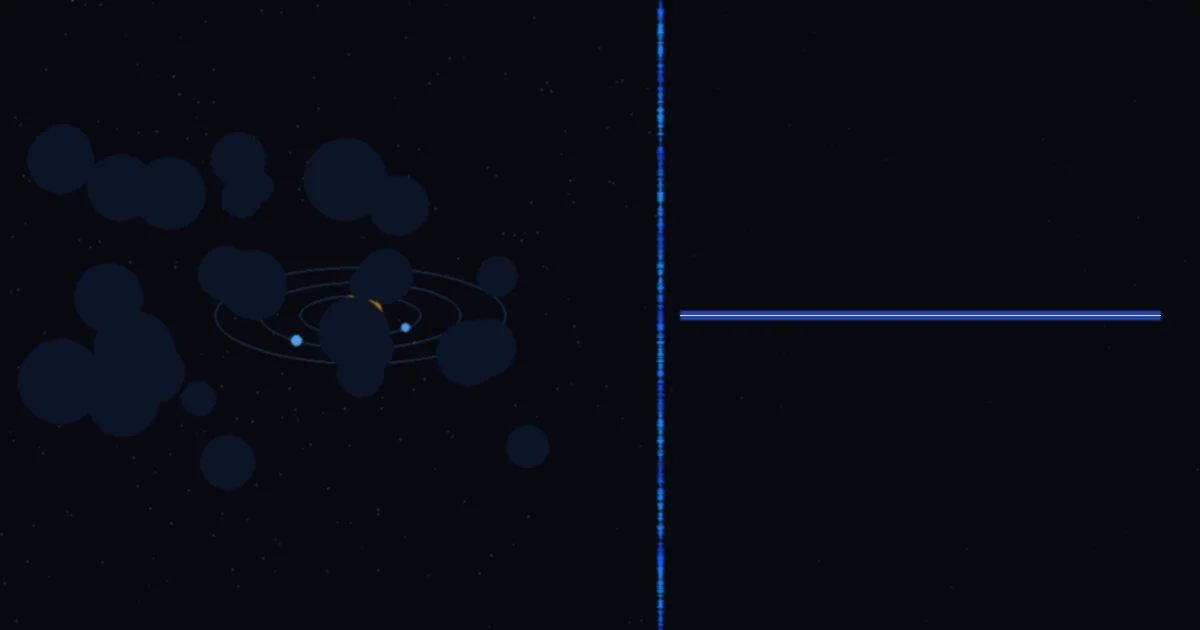
The most vivid example in the trilogy is the two-dimensionalization of the solar system — a process set in motion by a single small object dropped into the sun.
That object is a two-dimensional photino particle, sometimes called a "two-way foil" in fan discussions. When it enters the solar system, it begins converting three-dimensional matter into two-dimensional matter. The process is self-sustaining and irreversible. Everything it touches collapses into a flat plane: gas, rock, water, living things. Mountains become brushstrokes. Oceans become shimmering films. The sun itself is slowly pressed into a vast, glowing disc.
Liu Cixin describes the two-dimensionalization in hallucinatory detail. It does not look like destruction. It looks like art. Clouds of glittering flakes spiral outward. Entire continents become delicate, luminous sheets. There is even a terrible beauty to it — right up until you remember that every one of those flakes was a person, a city, a history.
Once complete, the solar system exists as a two-dimensional object drifting through space. It is not dead in the conventional sense. The atoms are all still there. The information is technically preserved. But it is utterly, permanently inert. Nothing three-dimensional can interact with it in any meaningful way.
Why It Cannot Be Stopped
What makes dimensional reduction attacks so philosophically horrifying is their completeness. A nuclear weapon requires a delivery mechanism, a target, a chain of physical events you could theoretically intercept. A dimensional reduction weapon is more like gravity: once initiated, it follows the laws of physics, not the intentions of any combatant.
There is no material strong enough to resist it. There is no energy input that can reverse the collapse. You cannot shoot it, block it, or outrun it — at least not on planetary or stellar scales. The only civilizations that could theoretically escape are those already traveling at significant fractions of the speed of light, giving them just enough time to flee the expanding front.
This is precisely what happens with the Timespace — the ship carrying Cheng Xin, Guan Yifan, and AA. Their near-lightspeed velocity allows them to watch the solar system's destruction from a distance, alive only because of physics, not because of any technological defense humanity managed to devise.
The Evidence Written Into the Cosmos
One of Liu Cixin's most haunting ideas is that we can infer the history of cosmic warfare by studying the structure of the universe itself.
Consider this: physicists have long puzzled over why the universe has exactly three large spatial dimensions. String theory and M-theory suggest the universe should have ten or eleven. Cosmological models often assume higher-dimensional origins. The question of why we observe three has no fully satisfying answer in real-world physics.
Liu Cixin offers a fictional answer: the universe used to have more. Civilizations in earlier eras waged wars so devastating that they progressively collapsed higher dimensions into compactified remnants. The universe we inhabit is the battlefield — and three dimensions is what's left after billions of years of escalating destruction.
The stars you see at night are not just light sources. In this framing, they are the survivors of a war so old no record of it remains, shining in a universe that has been slowly flattened by its own inhabitants.
The Moral Logic of the Ultimate Weapon
Dimensional reduction weapons exist at the extreme end of a logic that runs throughout the entire trilogy: in a universe of scarce resources and perfect distrust, the safest weapon is one that eliminates not just an enemy but the possibility of an enemy.
Dark Forest theory already establishes that civilizations must destroy each other before being destroyed. Conventional weapons fulfill this logic but leave wreckage — a destroyed planet could still harbor survivors with the knowledge and will to retaliate. A dimensionally reduced solar system leaves nothing with the capacity for revenge. It is total, absolute, and silent.
This is the grim endpoint of cosmic deterrence: not mutually assured destruction, but mutually assured geometry. The Bunker Project was humanity's attempt to survive in that geometry — and it was ultimately insufficient. Cheng Xin's choices during this period are central to understanding how humanity arrived at this moment. The universe's arms race does not end in a bang. It ends with a flat, beautiful, lifeless disc tumbling through empty space.
What It Means for the Fermi Paradox
Liu Cixin's dimensional weapons also offer one of the bleakest resolutions to the Fermi Paradox. Why don't we detect advanced civilizations? Because the most advanced ones are engaged in a form of warfare that erases not just life, but the three-dimensional space life depends on. The universe is quiet not because civilizations are rare, but because the survivors have learned to be invisible while the losers have been reduced to geometry.
If the history of cosmic warfare is written into the number of dimensions we can observe, then physics itself is a kind of archaeology — and three dimensions tells you everything you need to know about how many wars have already been fought and lost.
Conclusion
Dimensional reduction attacks are more than a science fiction weapon. They are a thought experiment about the final form of power — the ability to alter not what exists in the universe, but what kind of universe can exist. They represent the point at which war transcends destruction and becomes cosmological engineering.
What makes them unforgettable is not the scale, but the implication: the universe we inhabit was shaped by violence we can never witness, carried out by beings we will never know, using weapons that left their mark not in craters or ruins, but in the very geometry of space. We live inside the aftermath of a war that ended before life on Earth began.
That is not a comforting thought. But it is an extraordinary one.