The Moment Everything Changed
When Cheng Xin became Swordholder and the Dark Forest deterrence collapsed, humanity lost the one threat that had kept Trisolaris at bay. But that wasn't the worst of it. During the frantic hours of the Trisolaran advance, a far more terrifying signal arrived from deep space: a two-dimensional foil, a thin shimmering plane expanding outward from a star in the Milky Way. The universe had noticed something — and it was sending a response that had nothing to do with Trisolarans.
The implications were stark. The broadcast that once kept Earth safe had also announced the solar system's coordinates to every predatory intelligence in the galaxy. Now the solar system was lit up on the Dark Forest's map, and there was no way to turn off that light. For the full breakdown of what that attack looked like, see The Death of the Solar System.
For more on what triggered that exposure, see Curvature Propulsion.
The question became: where do you hide eight billion people when your entire star system is a target?
The Logic of the Bunker
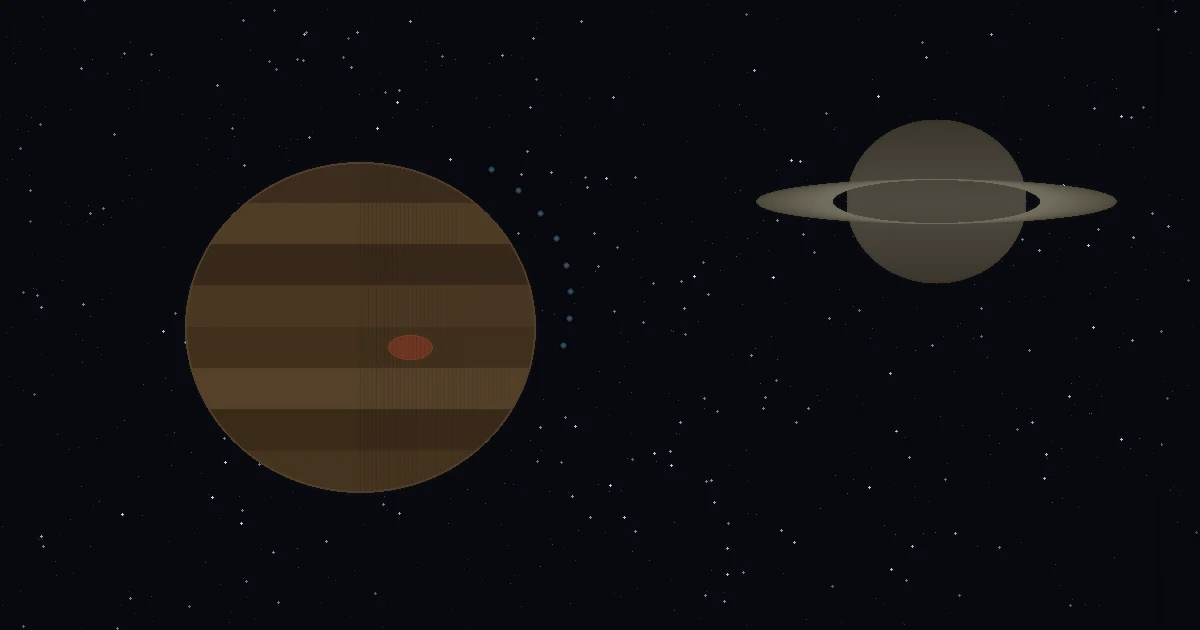
The Bunker Project was humanity's answer — audacious, enormously expensive, and built on a single core insight: if a two-dimensional foil attack is coming, it expands outward at a finite speed. And the solar system's gas giants are very, very large.
Jupiter, Saturn, Uranus, and Neptune are collectively vast enough that a colony sheltered on their far sides — or in orbital positions directly behind them — could survive the initial wave of a dimensional reduction attack while the inner solar system was destroyed. The gas giants would serve as shields, blocking the expanding foil long enough for survivors to scatter into deep space or live out decades in orbit.
This wasn't a plan to defeat the attacker. It was a plan to not be on the front row when the axe fell.
Engineering at Planetary Scale
Building civilization-sustaining habitats around the outer planets was the largest engineering undertaking in human history. Millions of people would need to be relocated — not to temporary shelters, but to permanent orbital colonies with self-sustaining ecosystems, agricultural infrastructure, and the industrial capacity to maintain themselves indefinitely.
The gas giants presented their own challenges. They offer no solid surface. Their magnetic fields are intense and deadly. Their moons — Ganymede, Callisto, Titan, Europa — became the foundation of the project, with some used as construction platforms and others as habitat sites. Orbital stations were built at gravitationally stable points, designed to remain precisely positioned behind their host planet relative to the inner solar system.
Energy was the central problem. Far from the Sun, solar panels become inefficient. The Bunker colonies relied heavily on nuclear power — both fission and fusion — as well as harvesting the thermal and gravitational energy available near massive planets. Some proposals explored the use of miniature black holes as power sources, exotic even by the standards of the post-deterrence era but consistent with the theoretical physics of the time.
The Social Rupture
The Bunker Project didn't just move people — it divided them.
Only a fraction of humanity could realistically relocate to the outer solar system in time. Resources were finite. The habitats had limited capacity. This created an immediate and agonizing question: who goes?
The answer was never clean. Wealth, government position, technical skill, and political connection all shaped who received berths in the outer system. Those left behind — the majority of humanity — were assigned to shelters in the inner solar system or simply left to their lives on Earth, knowing that a foil attack could end everything without warning.
This division produced lasting psychological and political fractures. The "Bunker faction" and those who remained behind developed different cultures, different priorities, and different relationships to the future. The outer colonies saw themselves as survivors-in-waiting, humanity's backup copy. Those on Earth, watching the gas giants through telescopes, knew their neighbors had already decided they were expendable. The same moral tension echoes in Cheng Xin's choices throughout the era — her inability to choose who survives and who doesn't defines her arc.
It was a slow, bureaucratic cruelty — not designed to be cruel, but producing cruelty as an arithmetic byproduct.
The Philosophers of Escape
Not everyone accepted the Bunker Project's logic without question. A significant intellectual movement argued that sheltering behind gas giants was psychologically toxic: it normalized the idea that humanity's survival was conditional, that some people's lives were worth more than others, and that the correct response to cosmic threat was to optimize for a remnant rather than fight for the whole.
Others made the opposite argument — that the Bunker Project didn't go far enough. The Escapist movement (foreshadowed by Zhang Beihai's unauthorized escape in The Dark Forest), running parallel to the Bunker era, believed that even the outer solar system was ultimately indefensible. If the Dark Forest was real, then no shelter within a known address could be safe forever. For more on the underlying logic, see Dark Forest Theory Explained. The only genuine survival strategy was to vanish entirely into interstellar space, leaving no forwarding address.
The Bunker Project split the difference in a way that satisfied neither camp fully: it acknowledged the threat, moved people, but kept them within a system whose coordinates were already broadcast. It was, in some senses, a very human compromise — ambitious enough to feel like action, incomplete enough to guarantee it wouldn't be the last word.
Futility at Astronomical Scale
History judged the Bunker Project harshly, and not without reason. When the two-dimensional foil attack on the solar system finally came, the gas giants did provide exactly the shielding they were designed to provide — for a time. The foil's expansion was not instantaneous. Some orbital habitats survived the initial wave.
But no shelter lasts forever when the attack is an expanding plane of reduced dimensionality that will eventually encompass the entire solar system. The Bunker colonies were never designed for permanent independence; they were designed to buy time. Time to flee, time to organize, time to send ships outward into the dark. In that limited sense, they functioned.
What they couldn't do was save civilization as it had existed. The inner solar system — Earth, Mars, the Belt, the accumulated infrastructure of centuries — was gone. The survivors in the outer system were castaways with sophisticated equipment, watching the boundary of a flattened solar system approaching and making decisions about whether to run or remain.
What the Bunker Project Reveals
The Bunker Project is one of the trilogy's most efficient pieces of worldbuilding. It doesn't require elaborate exposition to communicate its meaning. The simple image of millions of people relocating behind gas giants — sheltering behind the largest things in the neighborhood while the rest of the solar system waits to be destroyed — captures something true about how civilizations respond to existential threats they cannot stop.
They don't stop them. They optimize the geometry of survival.
There is engineering brilliance in the Bunker Project, genuine human ingenuity applied to an impossible situation. There is also something quietly heartbreaking about it: the acknowledgment, built into the project's very design, that Earth was probably lost. Every habitat constructed behind Jupiter was also a monument to the decision that saving everyone was no longer on the table.
Liu Cixin doesn't moralize about this. He simply shows it: the institutions, the social fractures, the incomplete escapes, the survivors who made it and the billions who didn't. In the cold arithmetic of the Dark Forest, the Bunker Project was rational. It was also a kind of grief, expressed in orbital mechanics.