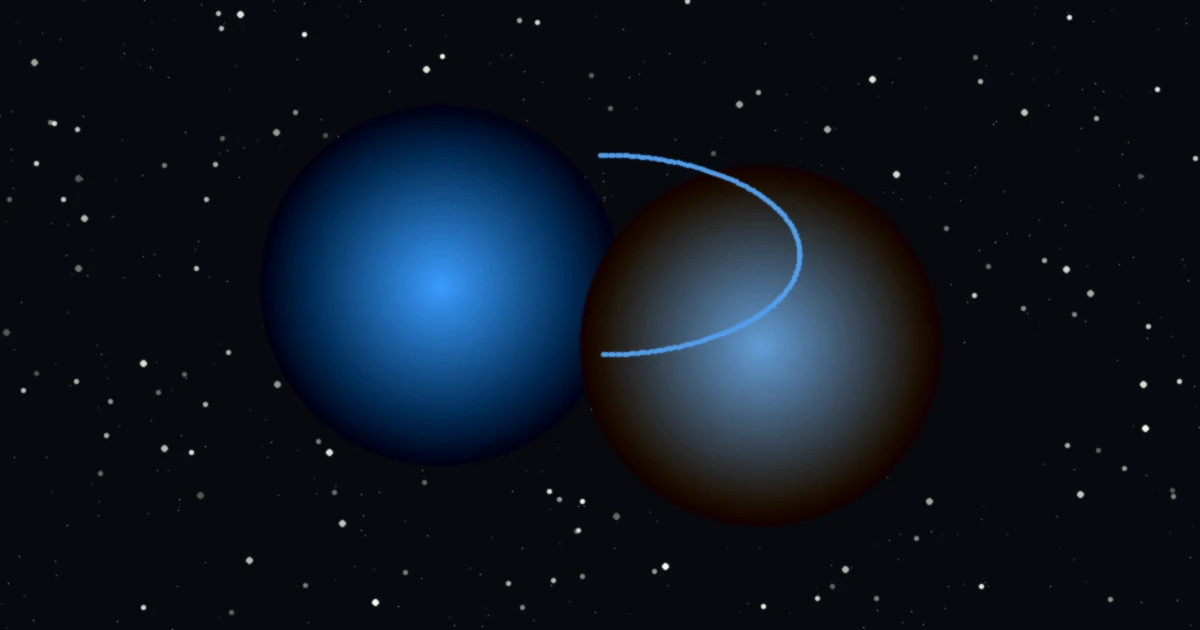
In Liu Cixin's Dark Forest cosmology, most civilizations crouch in silence, terrified of being heard. But silence is not universal. Some civilizations have made a different calculation — that the safest position in a universe full of hidden hunters is to become the most dangerous hunter of all. These are the civilizations that fire. The ones that listen for signals and respond with annihilation. The ones the trilogy calls, in its final and most devastating volume, Singers.
The Logic of Hunting
The Dark Forest theory begins with two axioms: survival is the primary goal of every civilization, and matter in the universe is finite. These are also the cornerstone of Cosmic Sociology. From these premises, Liu Cixin constructs an iron logic — once you detect another civilization, you cannot know its intentions, cannot trust its communications, and cannot afford to wait. The rational response to detection is preemptive destruction.
Most civilizations, by this logic, choose the defensive posture: hide, go dark, broadcast nothing. But a subset takes the offensive step further. If hiding means others might still find you, and if eliminating any detected signal reduces the number of potential threats in the forest, then actively hunting becomes rational. These civilizations don't merely refrain from revealing themselves. They listen for anyone who does, and they fire.
This is the role of the Singers in Death's End — and understanding what they are requires understanding how Liu Cixin chose to depict the moment humanity finally learned the Dark Forest was real.
The Two-Dimensional Foil
The attack that destroys the solar system in Death's End is not a fleet, not a missile, not anything built to scale with human or even Trisolaran comprehension. It is a two-dimensional foil — a packet of collapsed spacetime that, once deployed, expands at the speed of light, converting everything three-dimensional it contacts into a flat, lifeless sheet. Planets, stars, the geometry of space itself: all reduced to a two-dimensional membrane spreading outward forever.
Before the foil strikes, a single photon arrives — a carrier of coordinates, a notification that a signal has been detected and answered. The solar system was heard. Someone responded. And the response is total.
The entity that fired is never named, never described, never shown. For more on how this logic was first confirmed within the story, see 647 Stars: Dark Forest Proof. In the novel, it is referred to poetically as the Singer — a civilization that heard humanity's signal the way a human might hear a note in the dark, and replied with complete, dispassionate erasure. The Singer did not investigate. Did not communicate. Did not hesitate. The detection was sufficient justification for destruction, and the weapon deployed was one that humanity, in all its centuries of preparation, had never imagined possible.
Who Is the Singer? What the Text Tells Us
Liu Cixin gives us almost nothing directly. The Singer fires and disappears. We know a few things by inference:
Technological tier. The two-dimensional foil is a weapon of spatial geometry — not a device built from matter, but an alteration of spacetime itself. Whatever civilization developed it operates at a level so far beyond humanity and the Trisolarans that comparison is nearly meaningless. The Trisolarans, who could unfold a proton through eleven dimensions to etch circuits on its surface, were themselves destroyed by the same Dark Forest logic. The Singer outclasses them as completely as they outclassed us.
Patience and efficiency. The Singer doesn't announce itself. It doesn't linger. It fires and moves on. This implies a civilization that has been doing this for a very long time and has optimized the process — detecting signals, calculating the most efficient elimination method, deploying it, and continuing the hunt. The foil is economical. It expands on its own. The Singer doesn't need to maintain it.
Indifference. Perhaps the most chilling implication: the Singer almost certainly does not know or care what humanity is. We are not an interesting case. We are a signal in the dark, and signal in the dark means threat, and threat means elimination. The act is not hostile in any emotional sense. It is simply logical.
Fan Theories: Who They Might Be
The deliberate blankness of the Singer has made it one of the most compelling objects of fan speculation in the trilogy's universe. Several major theories have circulated widely.
The higher-dimensional civilization hypothesis. Some fans argue that the Singer is not merely a very advanced three-dimensional civilization, but an entity that operates primarily in higher spatial dimensions and perceives three-dimensional civilizations the way we might perceive insects under glass. The two-dimensional foil, under this reading, is less a weapon and more a form of environmental management — a way of tidying a lower-dimensional space that contains potential irritants.
The automated system hypothesis. One of the darker possibilities is that there is no Singer in any meaningful sense — only a system. A civilization long since extinct or transformed that left behind automated detection-and-elimination infrastructure still running on its original programming. The foil was fired by a machine following rules laid down millions of years ago, with no living mind authorizing the act. This reading makes the destruction of the solar system not just horrifying but absurd: humanity eliminated by a dead civilization's automated threat response.
The Trisolaran enemy hypothesis. Some readers have proposed that the Singer might be the civilization responsible for the destruction of the 647 stars — the cascade event that provided the first empirical proof of Dark Forest theory. The broadcast that ultimately exposed the solar system came from the Gravity and Blue Space ships, whose own dark logic led them to commit cannibalism in the void between stars. If a single civilization has been systematically eliminating detected signals for long enough to rack up 647 stellar destructions, it is operating at a scale and duration that makes it effectively incomprehensible. The solar system attack becomes one entry in a very long list.
The transcended humanity hypothesis. This is the most speculative and philosophically interesting fan theory: that the Singer is humanity itself, or a descendant of it, operating from so far in the future that the attack on the solar system is an act of self-protection by beings who remember their origins only dimly, or not at all. Liu Cixin never suggests this, but the recursive logic has a certain dark poetry — the species that invented Dark Forest deterrence becoming, eventually, one of the Dark Forest's most efficient predators.
Did Liu Cixin Intend Them to Be Identified?
Almost certainly not. The anonymity of the Singer is not a puzzle to be solved — it is the point.
The Dark Forest theory's most disturbing implication is not that dangerous civilizations exist, but that they are indistinguishable from any others until they act. You cannot look at a star and determine whether the civilization it hosts is hiding or hunting. The Singer's invisibility is structural. It is what makes the Dark Forest dark.
By giving readers no handle on the Singer — no name, no appearance, no motivation beyond the cold logic of survival — Liu Cixin ensures that the attack on the solar system feels the way it would actually feel: not like a villain's scheme, but like a natural disaster. A force of the universe as impersonal as a supernova, except that someone, somewhere, chose it.
This is the trilogy's deepest horror. The Dark Forest doesn't require evil. It doesn't require hatred, or ambition, or even awareness of the civilizations it consumes. It only requires logic — the same logic that answers the Fermi Paradox. The Singer fires not because it wants to destroy us, but because wanting and not wanting are irrelevant categories at the scale where it operates. Humanity was a coordinate. The coordinate was answered. The forest moves on.
What the Singer Leaves Behind
The two-dimensional foil expands at the speed of light. By the time any survivor of the solar system's destruction understands what happened, the foil has already consumed everything. Earth, the sun, the inner planets, the gas giants, the Oort Cloud — all converted to a flat geometry spreading outward, beautiful and terrible and utterly indifferent.
The Singer never knows the result. It fired and moved on. Somewhere in the galaxy, or beyond it, it is listening again. There are always more signals in the dark.
This, ultimately, is what Liu Cixin leaves us with: not a face for the enemy, but a process. The Dark Forest does not have a master. It has rules, and the rules are sufficient. Any civilization advanced enough and frightened enough will eventually find itself on the same side of the trigger — not because it is cruel, but because the mathematics of survival in a universe of finite matter and infinite suspicion leads there as surely as water finds the sea.
The Singer is all of us, given enough time and enough fear.