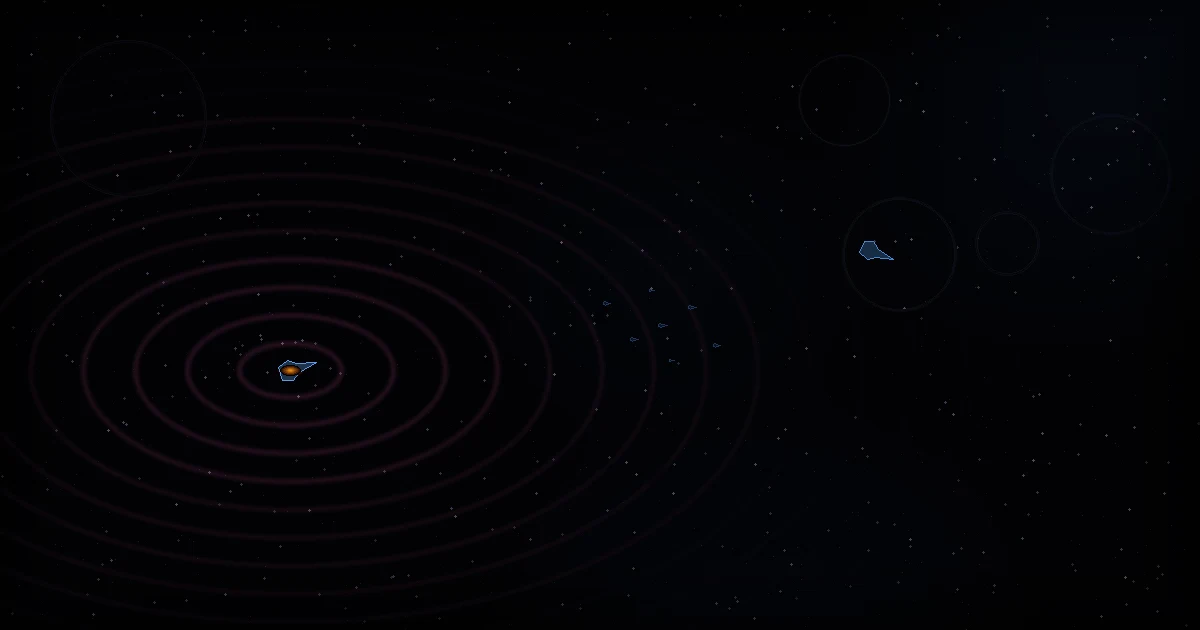
The Fleet That Humanity Sent Into the Dark
When the Crisis Era reached its peak, humanity did not wait passively for the Trisolaran fleet to arrive. Among the many preparations was the construction of a deep-space fleet — warships capable of operating far from Earth, crewed by the most disciplined and forward-thinking officers the species could produce. These were not ships of exploration. They were instruments of survival.
Two of the most storied vessels in that fleet were the Gravity and the Blue Space. Their names became synonymous with one of the most consequential — and most ethically fraught — acts in the entire trilogy.
The Escape from the Main Fleet
When Dark Forest deterrence finally held humanity in a fragile equilibrium, the fleet was ordered to stand down. But the Gravity and the Blue Space did not comply. Their commanders, unwilling to accept what they saw as the reduction of humanity's greatest strategic assets to passive deterrence props, broke away from the main fleet.
This was not impulsive insubordination. The officers aboard these ships had spent years — in some cases, their entire adult lives — preparing for genuine combat against Trisolaris. Being told to orbit quietly, forever the leverage in a political standoff rather than active defenders of the species, was a betrayal of everything they believed the fleet existed to do.
Their departure was seen from Earth as mutiny. But from the perspective of the crews, it was the only rational act available to people trained for war who had been handed a permanent ceasefire.
The Dark Matter Map
What the Blue Space found changed everything.
During their voyage deep into interstellar space, the crew intercepted a Trisolaran probe — a piece of alien technology drifting through the void, almost certainly overlooked by the enemy fleet. What the probe contained was not a weapon or a communication. It was a map.
Not an ordinary map of stars and distances. This was a map of the universe's hidden structure — rendered in dark matter, revealing a geometry invisible to conventional instruments — tangible evidence of the Dark Forest theory at work. The probe showed that the universe was not the featureless void human astronomers had always assumed. It had architecture. And some of that architecture was the residue of civilizations that had been destroyed.
The dark matter map provided the first concrete, visual evidence that the Dark Forest theory was not just a logical argument. It was a documented history. The universe had been killing its inhabitants for a very long time.
The Decision: To Broadcast or Not
Armed with this knowledge, the commanders of the Gravity and the Blue Space faced the defining choice of their voyage. The Gravity carried an onboard gravitational wave transmitter — one of the most powerful weapons in the human arsenal, capable of broadcasting a civilization's coordinates to every predator in the galaxy.
They could use it.
Broadcasting the Trisolaran fleet's coordinates would almost certainly trigger a Dark Forest strike — a response from some unknown civilization powerful enough to erase the Trisolarans entirely. It would end the invasion of Earth. It might also confirm, to every other intelligence in the galaxy, that the solar system existed and was worth noticing.
The choice was debated with full understanding of what it meant. Using the transmitter would not just be a military act. It would be a cosmic one. It meant accepting the Dark Forest logic completely — using the universe's most savage rule as a weapon, and accepting that in doing so, humanity itself might one day be targeted by the same mechanism.
They broadcast.
Was It the Right Decision?
This is the question that lingers long after the act itself.
From a narrow tactical perspective, the broadcast worked. The Trisolaran fleet was eventually destroyed — not by human ships or conventional weapons, but by a Dark Forest strike triggered by the exposure of Trisolaran coordinates. The existential threat to Earth that had defined human civilization for centuries was eliminated.
But the costs were staggering. The broadcast accelerated the exposure of the solar system to forces humanity had no hope of resisting. It confirmed that the Dark Forest was real and operational. And it set in motion the chain of events that would eventually lead to the two-dimensional attack — the foil that consumed the solar system itself.
The commanders of the Gravity and Blue Space knew some of these consequences and accepted them. Others they could not have foreseen. That gap — between the decision and its full ramifications — is where the moral weight of their choice lives.
What These Ships Represent
The Gravity and the Blue Space are not just plot devices. They represent a particular kind of human response to impossible circumstances: the refusal to accept passivity when action is available, even when action carries catastrophic risk.
Zhang Beihai, the character who most embodies this spirit in the earlier volumes, would have understood the commanders of these ships immediately. They are people who decided that the species was better served by those willing to act than those willing to wait.
Whether they were right is a question the trilogy refuses to answer cleanly. Liu Cixin is not interested in providing moral verdicts. He is interested in showing what decisions look like when civilizations are the unit of survival, and when the cosmos does not care about guilt.
Legacy
The voyage of the Gravity and Blue Space occupies a strange place in the history of the Three-Body universe. It was mutiny and heroism simultaneously. It was the act that ended one existential threat and accelerated another. It demonstrated that the Dark Forest theory was not a metaphor but a mechanism — and that humanity had learned, perhaps too well, how to use the Dark Forest.
Their story is a reminder that in Liu Cixin's universe, there are no clean victories. There is only the question of what you were willing to do, and what came after.