A Gift of Impossible Scale
Near the end of Death's End, Cheng Xin and Guan Yifan — survivors of the solar system's destruction — receive one of the stranger gifts in all of science fiction: a universe. Not a planet, not a station — a self-contained pocket of spacetime, roughly a cubic kilometer in volume, with its own stable physics and a small garden growing inside it.
The gift comes from a civilization so advanced it is never named. The note accompanying it is brief and practical. The pocket universe is theirs to inhabit. It has enough mass-energy to sustain them. It is isolated from the deteriorating cosmos outside.
This moment, quiet and almost domestic amid the trilogy's cosmic catastrophe, raises a question that Liu Cixin has been building toward across three books: what exactly is a mini-universe, and could one exist?
What the Trilogy Tells Us
In the cosmology of Death's End, the universe we inhabit is not the only one. Across billions of years of Dark Forest warfare — the same logic explored in Cosmic Sociology — advanced civilizations have carved out private volumes of spacetime — mini-universes — by manipulating the geometry of higher-dimensional space. These pockets are not metaphorical. They obey physics. They have boundaries. Matter and energy can enter or leave, but only through intentional engineering.
The pocket universe Cheng Xin and Guan Yifan inhabit is described as containing approximately one kilogram of mass converted from the larger universe. This is the key exchange: mass-energy from the three-dimensional cosmos is used to "seed" and maintain the enclosed space. The garden grows. Time passes. The pocket universe is, in a functional sense, real.
Liu Cixin is drawing on a genuine area of theoretical physics: the idea that our universe may not be the only region of spacetime, and that the geometry of space itself can be manipulated given sufficient energy and understanding.
Inflation, Bubble Universes, and the Multiverse
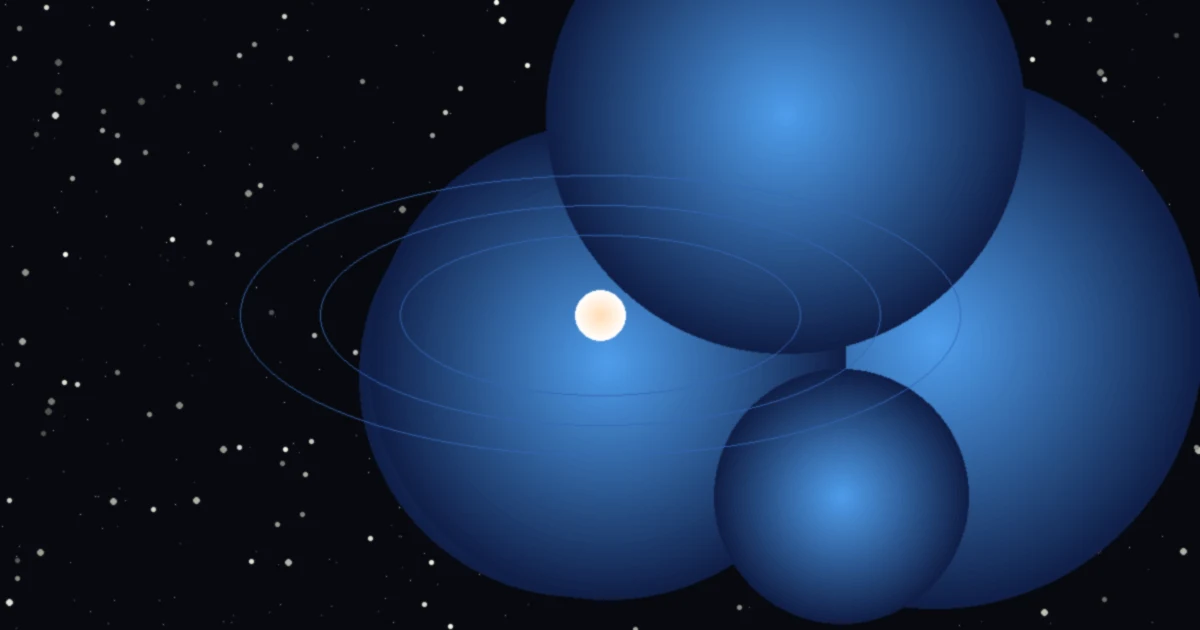
Modern cosmology already takes seriously the possibility of multiple universes. The leading mechanism is cosmic inflation — the theory that in the first fractions of a second after the Big Bang, space expanded at a rate vastly exceeding the speed of light. If inflation can begin, it can also end at different times in different regions. The result, according to some models, is a multiverse: an enormous ensemble of bubble universes, each with potentially different physical constants, forever separated from one another by the relentless expansion of space between them.
In this picture, creating a new universe isn't science fiction in principle — it's a question of engineering. Physicist Alan Guth, one of the architects of inflation theory, has written about the theoretical possibility of igniting inflation in a laboratory setting, producing a new bubble universe that would rapidly expand away from our own spacetime, invisible and unreachable but genuinely real. The energy requirements are extreme. The practical obstacles are vast. But the underlying physics does not obviously forbid it.
Liu Cixin takes this premise and projects it forward by billions of years. Civilizations with the technological maturity to manipulate higher-dimensional geometry don't just contemplate pocket universes — they build them.
The Hidden Dimensions Problem
There's a second layer of physics at work here, drawn from string theory and its relatives. In these frameworks, space has more dimensions than the three we experience — typically ten or eleven total, with the extra dimensions "compactified" into structures so small they are invisible at any energy level current physics can probe.
The three-body trilogy treats these extra dimensions as exploitable. When the Trisolarans unfold a proton into higher dimensions to inscribe sophon circuitry — a process explained in detail in Sophon Technology — they are using the same conceptual architecture that underlies the pocket universe: the hidden geometry of spacetime is not fixed but malleable, at least in principle, given enough technology and understanding.
A pocket universe, in this model, is a region where the geometry of those extra dimensions has been configured to create a stable enclosed space — a bubble in the higher-dimensional fabric, sustained by a controlled input of mass-energy. The garden inside Cheng Xin's pocket universe exists because someone has, in effect, tied off a corner of the cosmos and kept it intact.
The Universe Is Running Down
The pocket universe subplot carries a darker weight in the trilogy's final pages. Cheng Xin and Guan Yifan learn, eventually, that the larger universe is not recovering from the Dark Forest wars. Dimensional reduction — the conversion of three-dimensional space into two-dimensional sheets — has been happening for billions of years across the cosmos. The universe that was originally born with more spatial dimensions has been repeatedly attacked and diminished. What we experience as three-dimensional space may itself be the scar tissue of ancient warfare.
More critically: every time a civilization seals matter inside a pocket universe, it removes that mass-energy from the larger cosmos permanently. And there is a lot of mass missing. The universe's expansion is accelerating in ways that standard models of matter and energy cannot fully explain. In Death's End, Liu Cixin suggests an answer — not dark energy in the conventional sense, but the accumulated theft of mass by billions of civilizations across cosmic history, each one taking a small portion of the universe into private storage.
This is the message that arrives for Cheng Xin near the novel's end: the universe is dying, in part, because too many civilizations did exactly what she has done. The request is simple and enormous. Return the mass. Put it back.
A Garden as a Moral Act
What makes the pocket universe one of the most resonant images in the trilogy is the way Liu Cixin frames it. Cheng Xin, a character defined by compassion and its consequences — most notably her role as Swordholder — has been given an escape from a universe she could not save. The garden is genuinely beautiful. The physics are stable. She could stay.
But the mass matters. Every kilogram locked away in a private universe is a kilogram the larger cosmos cannot use to maintain the conditions for future life. The pocket universe, framed as a gift, turns out to be a moral question: what do you owe a universe that is dying?
The trilogy's answer is characteristic of Liu Cixin's larger project. The universe does not reward compassion or punish cruelty. It operates according to mathematics. But within that mathematics, individual choices accumulate into consequences that span billions of years. Cheng Xin's small garden is, in this sense, a perfect final image for the series — a space where human-scale tenderness exists inside a cosmos of incomprehensible scale, and where even the most intimate act of refuge carries consequences written in the laws of physics.
What We Actually Know
The honest answer to "could a pocket universe exist?" is: we don't know, and we currently have no way to find out. The physics of inflation and the physics of higher-dimensional geometry are both well-developed theoretical programs, but neither has been experimentally confirmed at the level that would make pocket universe engineering a serious engineering question. We have no direct evidence of extra dimensions. We have no confirmed observation of a bubble universe beyond our own.
What we do have is a set of ideas that are genuinely consistent with our best current theories, that have been seriously considered by working physicists, and that Liu Cixin has extrapolated with the rigor and imagination that characterizes the trilogy throughout.
The pocket universe is not a fairy tale. It is a physics thought-experiment at the end of the world — and it turns out that thought-experiment has something to say about what we owe each other, and what we owe the cosmos we were born into.
For the larger story of how the solar system reached this endpoint, see the Solar System Destruction Breakdown and Dimensional Reduction Attacks.