AA and Guan Yifan: Love at the Edge of the Universe
At the furthest reaches of Liu Cixin's trilogy, when the solar system is gone and humanity itself exists only in scattered remnants across the stars, two figures remain beside Cheng Xin: a woman named AA and a man named Guan Yifan. They are among the last witnesses of everything humanity was. And between them, quietly and without fanfare, something very human endures.
Who Is AA?
AA — her full name never given in the novels, her identity defined by her closeness to Cheng Xin — first appears in Death's End as a young aerospace engineer working on the Halo project. She is warm, clever, and irreverent in ways that Cheng Xin, weighed down by the fate of civilizations, rarely allows herself to be.
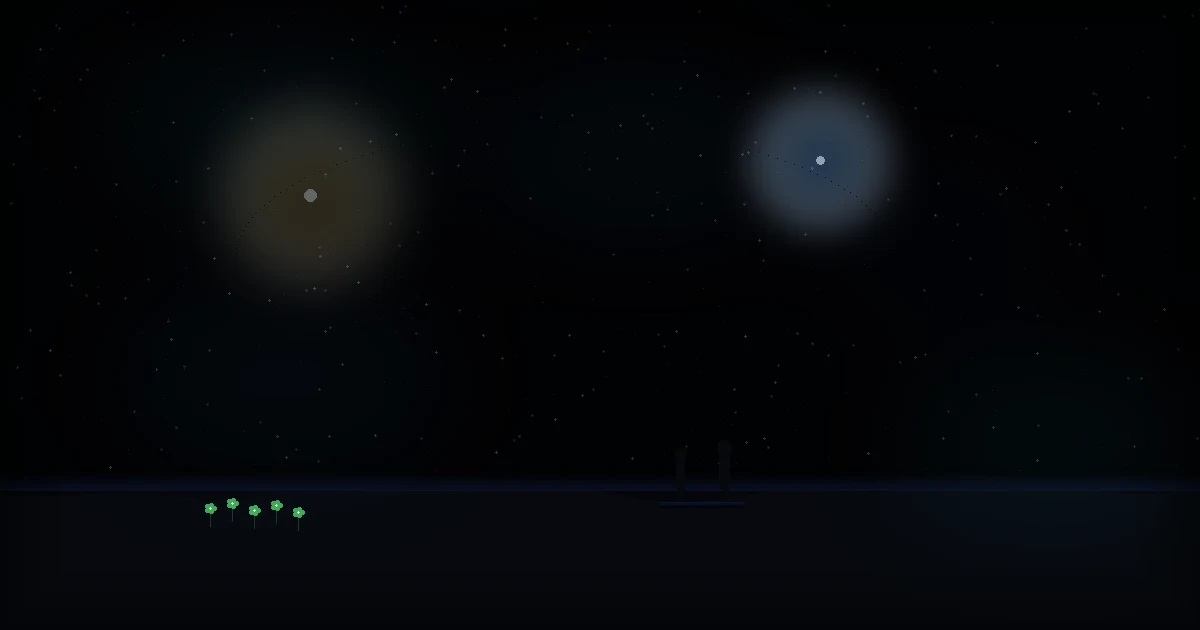
What makes AA remarkable isn't any single dramatic act. It's her persistence. Through the long centuries of hibernation, through civilizational collapse and exile, she stays. She follows Cheng Xin into the DX3906 system — a binary star hundreds of light-years from what used to be home — and builds a life there with her. She plants a garden. She names the moons. She insists on small, ordinary joys in the face of cosmic annihilation.
In a trilogy full of characters defined by grand choices and moral weight, AA represents something quieter: the value of simple companionship. She doesn't carry the fate of humanity on her shoulders. She carries the weight of friendship, and that turns out to matter just as much.
Who Is Guan Yifan?
Guan Yifan arrives later in the story — a physicist and member of the Gravity crew who ends up in the DX3906 system under desperate circumstances. He is thoughtful, careful, and carries his own kind of grief. Like everyone in the Deterrence Era and beyond, he has survived things that should not have been survivable. Like Cheng Xin, he has watched worlds end.
But Guan Yifan is also a scientist to his core. It is he who helps explain the pocket universe that a mysterious civilization has gifted to Cheng Xin — a space the size of a room that contains, somehow, room enough for a whole world. It is he who interprets the message left by an ancient civilization and understands what it asks of them.
And it is he who falls in love with Cheng Xin.
Their relationship is restrained by the standards of most science fiction romances. Liu Cixin doesn't linger on it. But it is real, and it is earned through shared loss. Two people at the end of everything, finding in each other a reason to go on.
The DX3906 Exile
After the solar system is destroyed by the two-dimensional foil — one of the most devastating passages in modern science fiction — Cheng Xin and AA make their way to the binary star system of DX3906, guided by coordinates provided by Yun Tianming in his fairy tales. Guan Yifan is already there, or arrives shortly after.
What follows is a strange, sad interlude at the edge of existence. The three of them inhabit a tiny fragment of humanity in a universe that has been picking off civilizations for billions of years under the logic of the Dark Forest. They tend their garden. They sit with their grief. They receive, eventually, the pocket universe.
This section of the novel asks a question it doesn't fully answer: what do you owe to the dead? Cheng Xin, AA, and Guan Yifan are the last inheritors of human civilization. Nothing they do will restore what was lost. But they can remember it. They can carry its values — beauty, tenderness, curiosity — into whatever the universe holds next.
What AA Represents
For the full sweep of events they survived, see the Human Civilization Timeline.
In a trilogy often criticized for its treatment of women — and the criticism is not entirely unfair — AA is one of the more fully realized female characters. She isn't defined by her relationship to men, or by her failures, or by her symbolic role in humanity's moral arc. She's defined by her loyalty, her humor, and her sheer refusal to be beaten down by the cosmos.
She plants flowers in an alien world. She gives the moons nicknames. She makes the extraordinary feel livable.
This is not a small thing. In the face of civilizational extinction, the ability to create a home — to say this matters, even now — is an act of profound defiance. AA's domesticity isn't a limitation. It's a stance.
What Guan Yifan Represents
Guan Yifan, meanwhile, represents the scientific mind trying to make sense of a universe that has revealed itself to be terrifying and indifferent. He is the one who reads the message left by an older civilization in the pocket universe — a message that asks its inhabitants to return any matter they've borrowed before the universe undergoes its next phase change.
It's a stunning moment. Even at the heat death of everything, there are rules. Even at the end of time, something is owed.
Guan Yifan understands this. He accepts the obligation. He and Cheng Xin return the matter they've taken — a single gram — and surrender the pocket universe. They let even this last refuge go.
That act of release, of honoring a covenant with the universe itself, is the final note of the trilogy's human story.
Hope at the Closing
There is no triumphant ending in Death's End. The solar system is gone. Humanity is scattered. The universe is dying, slowly and inevitably, of its own entropy. And yet.
AA and Guan Yifan suggest that love persists even here. That gardens grow even here. That a person can wake up in an alien binary system and decide, against all evidence, that life is still worth tending.
The Three-Body trilogy is often described as pessimistic — a dark vision of a cosmos red in tooth and claw. But AA planting her flowers, and Guan Yifan reaching for Cheng Xin's hand at the end of everything, suggest something more complicated. Not that the universe is kind. Only that kindness survives in it, carried forward by the people who refuse to let it die.
For more on Cheng Xin's journey, see Cheng Xin: Humanity's Conscience and Its Cost.
In the end, they are the last witnesses of a destroyed civilization. They remember it with love. That, Liu Cixin seems to argue, is what civilization was always for.