The Most Ambitious Engineering Project in the Universe
In Liu Cixin's The Three-Body Problem, humanity's most dangerous enemy is not the Trisolaran fleet — still four centuries away. It is something far smaller: a subatomic particle, folded into a supercomputer and set loose on Earth to watch, to interfere, and to wait. That particle is the sophon. And the process of creating one is among the most audacious pieces of speculative engineering in science fiction.
The sophon's construction required Trisolaran civilization to unfold a proton through eleven spatial dimensions, expanding it to a surface area larger than a solar system, etch integrated circuits across that unimaginable canvas, and then refold it back to its original subatomic size. The result: a quantum computer that fits inside a particle accelerator beam and travels at the speed of light, carrying an alien intelligence wherever physics allows it to go.
Understanding how Liu Cixin imagined this process — and what real physics underlies it — reveals both the depth of his scientific thinking and the deliberate grandeur of the world he built.
String Theory and the Hidden Dimensions
Modern physics, specifically string theory and its successor M-theory, proposes that the universe contains more spatial dimensions than the three we experience. The leading frameworks suggest ten or eleven dimensions total, with the extra dimensions "compactified" — curled up at scales so small they are effectively invisible, somewhere around the Planck length (roughly 10⁻³⁵ meters).
These extra dimensions aren't science fiction. They are taken seriously by theoretical physicists as a potential foundation for a unified description of all fundamental forces. The reason we don't perceive them is that they are wound too tightly to affect anything at the scales of human experience.
Liu Cixin takes this established theoretical framework and asks a startling question: what if an advanced civilization could unroll those dimensions?
The Unfolding
In the novel, Trisolaran scientists devise a way to selectively expand the compactified dimensions of a single proton. The process begins with vast amounts of energy — stellar scale, harnessed from Trisolaris's own suns — directed precisely at the target particle.
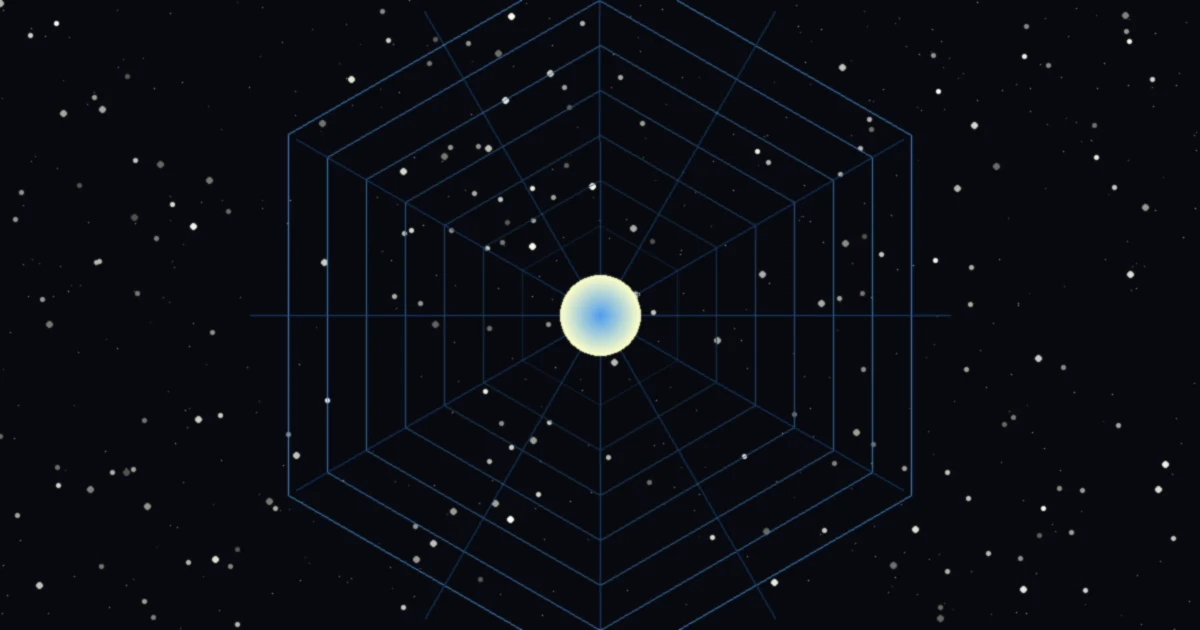
As the dimensions unfurl, the proton's surface area expands accordingly. What was once a point particle at the quantum scale becomes a two-dimensional membrane of extraordinary size, spreading across space like a geometric flower blooming at astronomical speed. Liu Cixin describes the unfolding as visible to observers across an entire hemisphere of Trisolaris: a shape appearing in the sky, luminous and vast, its geometry alien and perfect — a proton made large enough to behold.
At its maximum extent, this expanded surface represents a workspace of incomprehensible scale. Trisolaran engineers, using tools and techniques as far beyond human capability as the sophon itself, inscribe integrated circuits across this surface. Billions of logic gates, laid down at densities that dwarf anything human nanotechnology has approached. The entire circuit architecture of a functioning quantum computer, written in the fabric of what was, moments before, a single subatomic particle.
Then the dimensions are recompressed. The surface contracts. The proton returns to its original scale — but now it is something new: a machine.
Why a Proton?
The choice of a proton is not arbitrary. Protons are stable particles with essentially unlimited lifespans. Unlike electrons, which are elementary and structureless, protons (and their constituent quarks) have internal structure that interacts with the strong nuclear force — the force that operates at the scale of atomic nuclei. A proton-scale device built on the geometry of compactified dimensions would interact with the universe in ways that ordinary matter cannot.
More practically: a particle-sized supercomputer is undetectable by any surveillance technology available to a civilization that hasn't cracked eleven-dimensional physics. It can be accelerated to near-lightspeed through a particle accelerator, beamed across interstellar distances, and inserted into a target civilization's infrastructure invisibly. It can observe everything that happens around it, since photons interact with its surface at the quantum level. And it can interfere with experiments — particularly high-energy physics experiments — by introducing quantum noise that makes results unreproducible.
That last capability is the sophon's most strategically decisive function: not surveillance, but the blockade of human physics.
The Science Block
By embedding sophons in Earth's particle accelerators — the largest and most energetic physics experiments humans conduct — the Trisolarans could ensure that high-energy physics results were corrupted by seemingly random errors. This sophon science blockade shaped all of human technological development in the centuries that followed. Experiments that should reproduce would not. Constants that should remain stable would fluctuate. The entire foundation of experimental physics would be rendered untrustworthy.
The effect was precisely targeted. Sophons didn't interfere with chemistry, engineering, medicine, or materials science. They disrupted only the frontier where human technology might eventually catch up to Trisolaran capabilities: the physics of fundamental particles and forces. The result was a technological blockade that required no weapons and left no fingerprints — and which drove Earth's finest physicists to despair before anyone understood what was happening.
This is the sophon's true elegance as a weapon. It does not kill. It does not destroy. It simply makes progress impossible by making data untrustworthy.
What the Engineering Implies
The scale of effort required to construct even a single sophon tells us something important about Trisolaran civilization. To unfold a proton requires energy outputs that dwarf anything a Type I civilization — one controlling the full resources of a single planet — could access. The process implies a Type II civilization, capable of harnessing the output of an entire star.
It also implies a physics capability so far beyond human science that the gap between Trisolaran and human technology is not a matter of better engineering but a difference in kind. Trisolarans are not building faster computers using the same principles. They are operating in a dimensional regime humans have not yet confirmed exists.
Liu Cixin uses this gap deliberately. The sophon construction sequence is one of the trilogy's most awe-inducing passages precisely because it makes the power asymmetry visceral. This is not a civilization with better weapons. It is a civilization that builds supercomputers from the geometry of spacetime itself.
An Unforgettable Scene
Few moments in the trilogy are as quietly stunning as the description of the unfolding proton as it becomes briefly visible from Trisolaris's surface. For a moment — before the engineers compress it back — there is a shape in the sky that has no name in any language. A geometric form that belongs to eleven dimensions but is projecting into three. The population of an entire world stops to look up.
Liu Cixin doesn't dwell on the scene. He doesn't need to. The image does its work: a civilization capable of this can do anything. And they are coming.
Further Reading
For readers interested in the physics Liu Cixin drew on, the best accessible introduction to extra dimensions and string theory remains Brian Greene's The Elegant Universe (1999). For the strategic implications of the sophon's surveillance function, the article on the sophon science blockade explores how Trisolaran interference shaped the entire arc of human technological development in the Crisis Era.