An Alien Species Shaped by an Impossible World
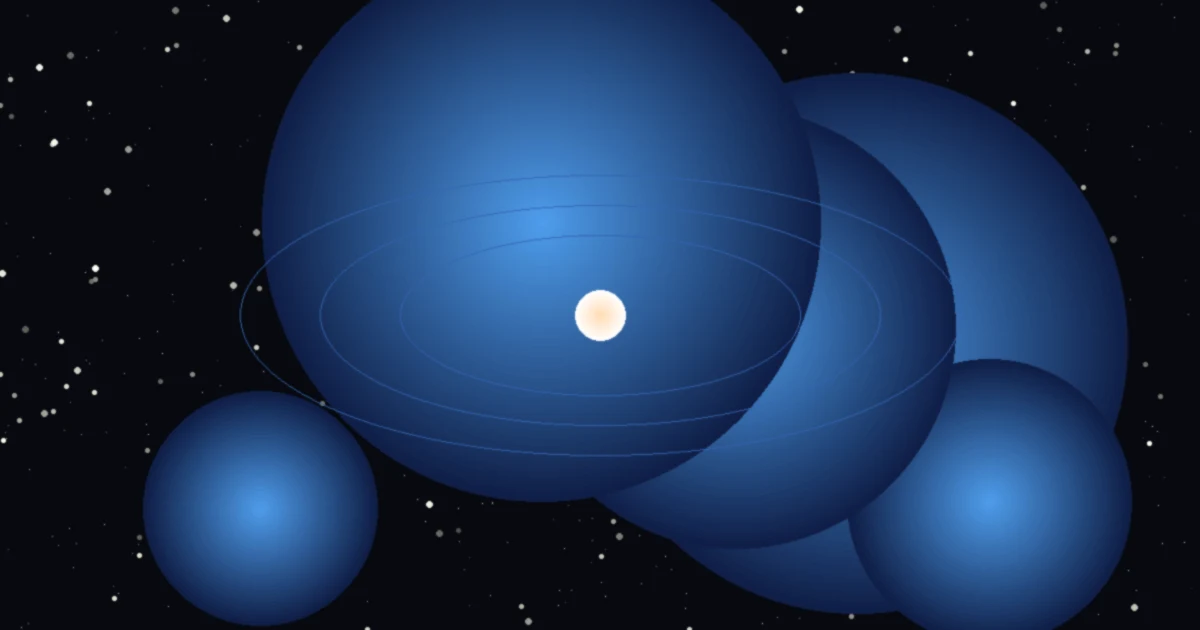
Trisolaris is not a world that invites life. Three suns pull at it from unpredictable angles, dragging the planet through alternating epochs of stability and chaos. For the full astronomical mechanics behind this, see Trisolaran Chaotic Eras. During Stable Eras, the planet settles into a predictable orbit around one star and life is possible. During Chaotic Eras, temperature swings become extreme — a second or third sun swings close and the surface temperature can spike to hundreds of degrees within years, or plunge into deep freeze as all three suns retreat.
No species shaped by this environment could look anything like us. The Trisolarans don't.
Dehydration as Survival Strategy
The most immediately striking feature of Trisolaran biology is their ability to dehydrate voluntarily. When a Chaotic Era approaches — when the suns' movements signal danger — Trisolarans can shed the water content of their bodies almost entirely, reducing themselves to a thin, durable film, like paper dried in the sun.
In this dehydrated state, they can survive temperature extremes that would destroy any water-bearing organism. They do not age. They do not metabolize. They wait.
When conditions improve, they are rehydrated — soaked in water — and resume life roughly where they left off. The process is not painless or simple. Improper rehydration can kill. Leaving a Trisolaran dehydrated for too long, in conditions too extreme, results in irreversible cellular damage. But for a species on a world where survival has never been guaranteed, this mechanism is the difference between extinction and continuity.
This is why Trisolaran civilization has such a peculiar relationship with time. Their history is not a continuous thread but a series of fragments — civilizations that rose, dehydrated, survived a Chaotic Era, and rehydrated into a world that might have changed beyond recognition. The Three-Body problem of their solar system is the root cause: the unpredictable gravitational interactions of three suns make stable orbital conditions temporary at best. Progress is never guaranteed to carry forward. A civilization that dehydrates may wake to find its libraries burned, its cities collapsed, its knowledge lost.
Thought Broadcasting: Communication Without Privacy
Humans evolved in an environment where concealing intent was often useful. Trisolarans did not.
Trisolaran communication is direct — they broadcast thought. What a Trisolaran thinks, others in proximity know. There is no layer of language separating internal state from external expression, no face to arrange into an acceptable mask, no voice to modulate. A Trisolaran that wishes to communicate is simply transparent.
The neurological and social consequences of this are profound. Trisolarans have no word for lying. They have no concept of it. Deception — the act of deliberately creating a false belief in another mind — is not something that occurs to them, because the architecture of their communication makes it functionally impossible.
When Trisolaran characters in the novel encounter human deception, the response is something close to horror. The fact that humans can think one thing and say another — that our words and our inner states are separable — strikes them as a form of biological wrongness. They call it "thinking behind closed doors." To them, the ability to hide one's thoughts is monstrous.
A Civilization Without Lies — and Without Strategy?
Here is the paradox that Liu Cixin threads through the Trisolaran sections of the trilogy: a species incapable of deception is also, in a certain sense, incapable of strategy.
Military strategy, diplomatic negotiation, game theory — all of these human disciplines assume that actors can conceal their intentions. A general who cannot bluff has fewer options than one who can. A diplomat who broadcasts every concession before offering it cannot negotiate effectively. A species whose members share thoughts cannot maintain the information asymmetry that strategy requires.
This is not a minor disadvantage. It is civilizationally shaping.
Trisolaran history shows a species that compensated for this limitation through radical transparency in a different direction: they became exceptionally good at reading physical patterns, at surviving through cooperation rather than competition, at building civilizations that function on shared knowledge rather than competing claims about reality. They are not without intelligence or adaptability — they built a fleet capable of crossing four light-years. But they built it differently.
Their encounter with humanity is, among other things, a collision between two different theories of mind. For the chain of events that brought them into contact, see the First Contact Timeline and the Red Coast Base origin story. The Trisolarans struggle to understand a species that lies by instinct, while humans struggle to grasp beings for whom concealment is literally unthinkable.
The Social Structure of a Transparent Society
What does community look like when all thought is shared?
Trisolaran society appears hierarchical but not coercive in the way human hierarchies tend to be. Authority functions differently when followers know exactly what their leaders believe and why. The social performance of power — the theater of confidence that human leaders often maintain to reassure populations about decisions they're uncertain about — is unavailable to Trisolaran rulers.
This doesn't make Trisolaran civilization more egalitarian, necessarily. But it does mean that legitimacy has to be earned differently. A Trisolaran leader cannot project false confidence. The population knows what he knows, fears what he fears, and calculates the odds alongside him. Authority in this context must rest on genuine competence and correct judgment, not on the ability to seem more certain than one is.
The recurring "Lord" figures in the Three-Body game sequences reflect this: they are not charismatic strongmen ruling through mystique, but figures accepted because, in a crisis, their reasoning is sound. When their reasoning fails, they lose authority immediately — there is no propaganda to hide the failure.
What Trisolaran Biology Reveals About the Dark Forest
Liu Cixin uses Trisolaran biology carefully. These are not humans with alien aesthetics — they are genuinely other, shaped by conditions that made them both formidable and, in certain ways, brittle.
Their dehydration ability and their communication transparency together suggest a species that evolved toward resilience and collective knowledge over individual cunning. They survive not by outcompeting each other but by pooling everything — thought, effort, survival — in the face of a hostile cosmos.
Yet this same transparency makes them, in the context of the Dark Forest, peculiarly vulnerable. A civilization that cannot lie, encountering a universe full of species that can, carries a structural disadvantage the trilogy does not ignore. Their decision to invade Earth — rather than attempt communication or cooperation — reflects not malice but a cold calculation shaped by their own cosmological understanding: in a universe where every civilization eventually competes for the same finite resources, the one that moves first survives.
They are, in this reading, exactly as trapped by the logic of the Dark Forest as humanity. They simply arrived at the same conclusion faster, and with less anguish about it, because they never had the option of deceiving themselves about what survival requires. For a deeper look at the Trisolaran political hierarchy and the decision-making that drove the invasion, see Trisolaran Lords: Political Structure. For the broader framework that describes why this logic is universal, see Cosmic Sociology Framework.
Further Reading
The Trisolaran sections of The Three-Body Problem are most richly explored through the Three-Body game sequences in Part II, where players inhabit Trisolaran history directly. The biology and communication systems are addressed more directly in The Dark Forest, particularly in chapters depicting first contact preparations. Liu Cixin's construction of Trisolaran cognition is discussed at length in Ken Liu's translator notes for the English edition.