The Battle of Darkness: Humanity's Greatest Defeat
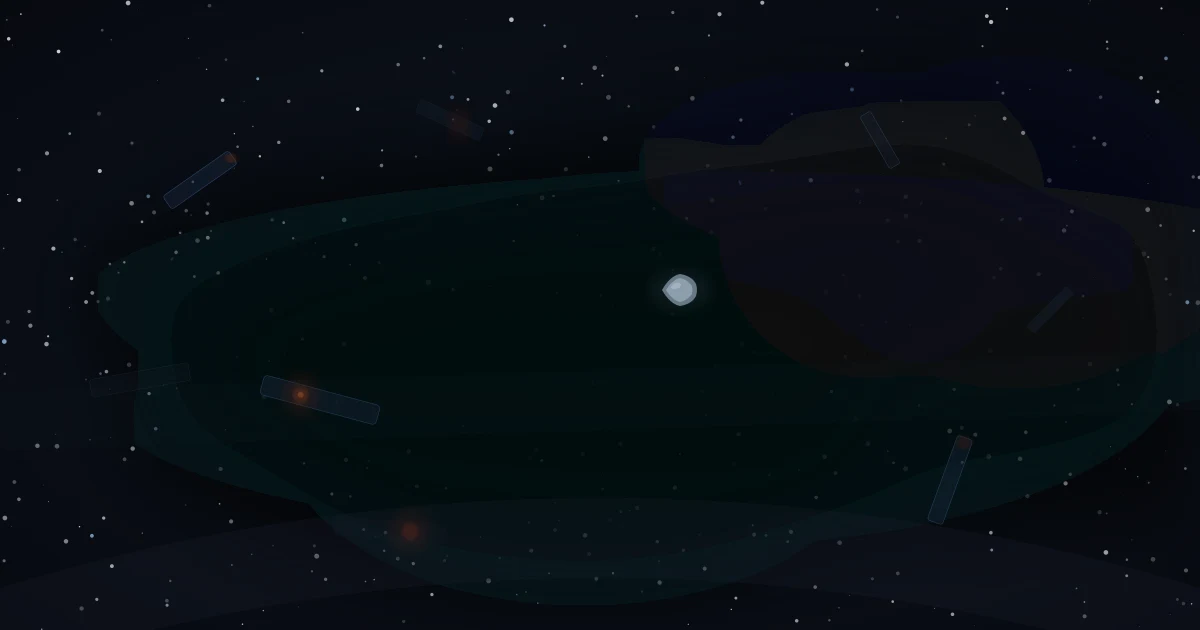
In the history of the Three-Body universe, few events carry the same weight as what fans and scholars of Liu Cixin's trilogy call the Battle of Darkness — the catastrophic engagement at the edge of the solar system in which a single Trisolaran Droplet probe annihilated the combined human space fleet. It was not a battle in any traditional sense. It was a demonstration. And its message was impossible to misread.
The Setup: Humanity's Finest Hour, on Paper
For decades after the Trisolarans announced their arrival, humanity prepared. The Crisis Era produced not just panic and philosophy but genuine military ambition. The United Earth Government assembled what it called the Combined Fleet — nearly two thousand warships drawn from the fleets of Earth's major powers, representing the apex of human engineering and strategic thinking.
These were not primitive vessels. They carried nuclear warheads, high-energy beam weapons, and kilometer-scale detection arrays. The fleet was humanity's insurance policy: if diplomacy, deterrence, or a miracle from the Wallfacer program failed, raw firepower would be the answer.
The fleet gathered near the orbit of Jupiter and waited. Its size alone was meant to send a message across the stars: we will not go quietly.
The Droplet Arrives
When the Trisolaran probe — known as the Droplet — finally reached the solar system — centuries ahead of the main invasion fleet — it appeared almost comically small against the assembled armada. The Droplet (formally called a Strong Interaction probe) was a teardrop-shaped object roughly two meters long, made of a material with a perfect mirror surface. It reflected everything. It emitted nothing detectable.
Scientists who studied it marveled at its construction. The Droplet's outer shell was held together by strong nuclear force rather than conventional molecular bonds, making it effectively indestructible by any weapon humanity possessed. Its surface temperature hovered just above absolute zero. It was, in every way, an object that should not have been possible.
At first, many hoped the probe was a communication device — perhaps the Trisolarans were reaching out to negotiate. The Droplet was observed, catalogued, and cautiously welcomed into proximity of the fleet.
It was not there to talk.
The Engagement: Seven Minutes
What followed happened so fast that the word "battle" is almost too generous.
Moving at extraordinary speed and changing direction with impossible precision, the Droplet began to strike warships. Not with missiles or beams — with itself. It used its indestructible hull as a weapon, ramming through vessels at velocities that converted kinetic energy into catastrophic explosions. Each impact destroyed a ship. Then another. Then dozens.
The human fleet, designed for battles at range, had no answer. Point-defense systems could not track an object moving that fast and that erratically. Nuclear weapons required time to arm and a target that could be damaged. The Droplet could not be damaged. Ships tried to scatter. The Droplet followed.
In under seven minutes, the combined human fleet — nearly two thousand vessels representing the greatest military achievement in Earth's history — was effectively destroyed. A handful of ships survived by fleeing beyond the Droplet's immediate range. Most of humanity's space-based military capability was gone.
The Droplet then went still. Its message had been delivered.
What Made It Worse
The horror of the battle was not just the death toll, though that was staggering — hundreds of thousands of crew members lost in minutes. It was what the engagement revealed.
The Droplet's existence demonstrated that Trisolaran technology operated on physical principles fundamentally beyond human understanding. The gap between their civilization and Earth's was not a matter of decades or centuries of development. It was a civilizational chasm. Humanity had shown up to a gunfight armed with pointed sticks, and not even known it.
The battle also shattered the psychological foundations of the Crisis Era's military strategy. Every war game, every strategic model, every reassuring projection about humanity's chances had been built on the assumption that the laws of physics would constrain both sides equally. The Droplet proved that assumption catastrophically wrong. For a deeper look at the technologies that made this gap possible, see Alien Technologies, Sophon Technology, and Droplet Probe Technology.
Perhaps most damaging of all: the destruction of the fleet came before the Wallfacer program had reached its conclusion. Earth's last conventional military deterrent was gone before the unconventional one — the Wallfacer Project — had borne fruit.
The Survivors and the Aftermath
The ships that escaped — most notably those carrying key characters and observers — became the seeds of a changed humanity. For the survivors, the Battle of Darkness did not produce despair so much as a kind of radical clarity. The old frameworks were gone. Something new would have to take their place.
Back on Earth, the news produced shock and then, eventually, a strange quiet. Governments that had staked their legitimacy on military preparation had nothing left to show. Public trust in authority, already strained by decades of crisis management, fractured further.
The strategic emphasis shifted entirely toward the Wallfacer program — specifically toward Luo Ji, the reluctant sociologist who had seemed for years to be the least promising of the four Wallfacers. The survivors who escaped — including Zhang Beihai, whose unauthorized flight with the Natural Selection represented one of the most controversial acts of the era — carried that lesson into everything that followed. Zhang Beihai's actions during this period represent the Crisis Era's darkest and most consequential individual choices. With conventional deterrence dead, humanity's survival now rested on one man's secret plan and a principle no one fully understood yet.
Why This Moment Matters
The Battle of Darkness is a turning point in the trilogy not just militarily but philosophically. It closes the door on a particular kind of human optimism: the belief that effort, preparation, and scale are enough. The universe, Liu Cixin suggests, does not grade on effort. Understanding why requires reading Dark Forest Theory. It is indifferent to how hard humanity tried. For a broader survey of the era that produced this fleet, see Crisis Era Society.
The engagement also illustrates one of the trilogy's central preoccupations — the technology cliff, the idea that civilizations can reach a point of such radical difference in capability that conflict between them is not really conflict at all. It is simply nature expressing a preference.
For readers, the Battle of Darkness is among the most viscerally affecting sequences in modern science fiction precisely because of how quickly it happens. The speed mirrors the indifference. Two thousand ships. Seven minutes. And then silence at the edge of the solar system, where the mirror-bright Droplet drifted on, waiting.
Humanity would have to find another way. It always did. But after the Battle of Darkness, it could never again pretend that trying very hard was the same as being ready.