Droplets: The Perfect Weapon
When the Trisolaran invasion fleet was still four centuries from Earth, humanity's greatest fear was the unknown. What weapons would the invaders bring? How powerful would they be? The answer, when it finally arrived in The Dark Forest, was more terrifying than anyone had imagined — not because of its scale, but because of its elegance. Two small, teardrop-shaped probes. That's all it took.
What Are the Droplets?
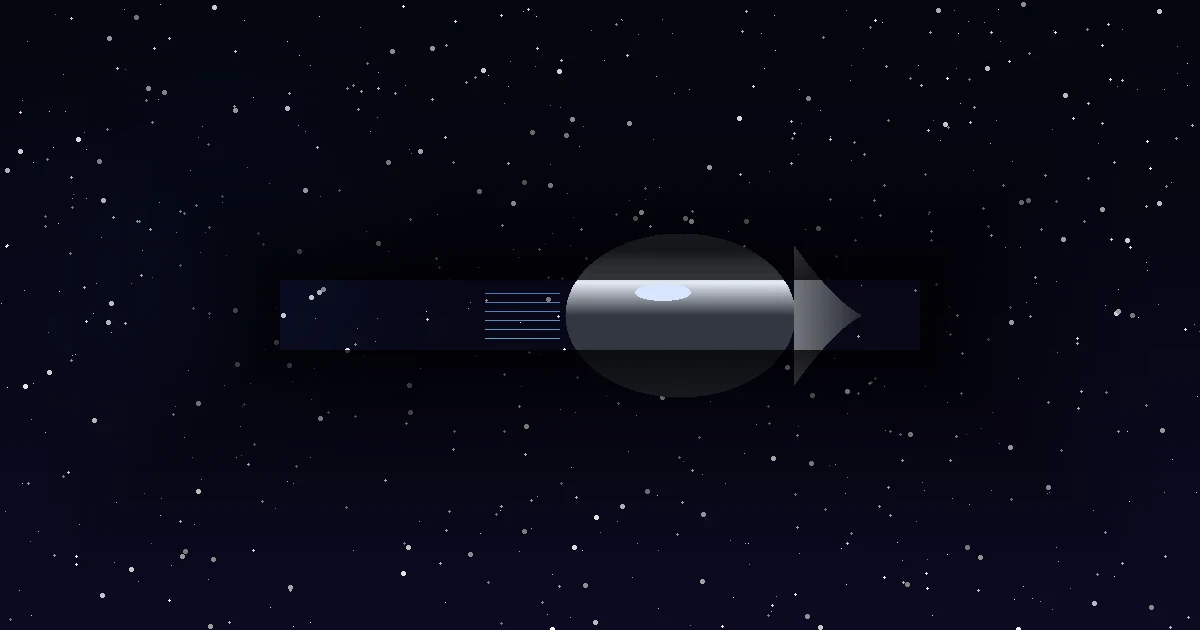
The Droplets — formally called Trisolaran probes — are small, silvery objects roughly the shape and size of a conventional munition. They travel ahead of the main Trisolaran fleet as emissaries, or so humanity initially assumes. Their appearance is remarkable: perfectly smooth, mirror-bright, with a surface that reflects light without a single imperfection visible to any instrument. The same strong-force material concept also underpins the broader Trisolaran technological arsenal.
That surface is the first clue that something extraordinary is at work. Human scientists quickly determine that the Droplet's exterior is made of strong-interaction matter — material in which atomic nuclei have been fused into a single, continuous lattice held together by the strong nuclear force rather than ordinary electromagnetic bonds. This gives the shell a hardness and density orders of magnitude beyond any substance humans could produce. No weapon in the Combined Earth Fleet's arsenal — not nuclear warheads, not kinetic impactors, nothing — can scratch it.
The Droplets are, in the most literal sense, indestructible by any means available to twenty-second-century humanity.
The Tactical Setup
The arrival of the Droplets coincides with a moment of peak confidence for humanity. The Combined Fleet — assembled across decades at enormous cost, comprising thousands of warships and representing the pinnacle of human military engineering — waits at a staging area in the outer solar system. When the two Droplet probes slow and enter the fleet's vicinity, the prevailing interpretation is diplomatic: perhaps these are messengers.
What follows is one of the most devastating sequences in modern science fiction.
The Droplets don't attack in the way anyone anticipated. There are no beams, no explosions, no dramatic engagement at range. Each Droplet simply accelerates — to extraordinary speeds, with impossible maneuverability — and begins moving through the fleet. They ram ships directly, their near-indestructible hulls punching through human vessels as though through paper. A single pass at high velocity is enough to destroy a warship.
Then the secondary destruction begins. Damaged ships lose containment on their fusion reactors. Debris fields propagate. Chain reactions cascade. The fleet, densest in its central formations, becomes a killing field where the Droplets barely need to act — humanity's own ships destroy each other.
Two probes. Thousands of warships. The battle is over in hours.
Why Only Two?
This is the question that haunts every reading of the sequence. Why would the Trisolarans send just two Droplets to face an entire fleet? The answer reveals the depth of the strategic thinking behind the attack.
First, the Trisolarans have had their sophons monitoring human technology for decades. They know, with precision, exactly what humanity's weapons can and cannot do. They've calculated the upper limit of human destructive capability — and they know that their strong-interaction material makes the Droplets immune to all of it. Two probes are sufficient because two probes are sufficient. Sending more would be wasteful.
Second, the Droplets serve a purpose beyond simple destruction. Their arrival — and their ease of victory — is a message. Not to the fleet, which will be destroyed, but to humanity as a whole and, more broadly, to anyone watching the solar system: this is what resistance earns you. The demonstration is part of the weapon.
Third, and most chillingly, the Trisolaran fleet is still centuries away. The Droplets represent an investment in forward planning that spans generations of Trisolaran civilization. They were launched, built, and directed toward Earth as part of a strategic doctrine that accounts for every contingency humans might mount. In that context, two probes destroying a fleet of thousands isn't a close call — it's exactly what the models predicted.
The Physics Behind Strong-Interaction Matter
Liu Cixin grounds the Droplets in real theoretical physics. Ordinary matter is held together by electromagnetic forces — the bonds between atoms, between electrons and nuclei, between molecules. The strong nuclear force, which binds quarks into protons and neutrons, is roughly a hundred times more powerful, but operates only at subatomic scales in normal matter.
Strong-interaction material hypothetically locks nucleons together at bulk scale using this much more powerful force. The result would be a substance of almost unimaginable hardness — not merely harder than diamond, but harder than anything constrained by ordinary chemistry could ever be. The material science required to create it is entirely beyond current human capability and may be physically impossible given the constraints of how the strong force behaves at distance.
This is precisely the point. The Droplets are a technological demonstration, not just a weapon. Their construction signals that the Trisolarans operate at a physical and engineering level so far beyond humanity that the gap is nearly impossible to reason about. Humans bring guns to a fight where the other side built the laws of physics into a hull.
What the Droplets Represent
Beyond their narrative function — destroying the fleet and forcing the story's pivot — the Droplets represent something important about Liu Cixin's vision of interstellar conflict.
Conventional science fiction tends toward symmetry in its space battles: evenly matched fleets, tactical surprises, heroic improvisation. The Droplets refuse this frame entirely. There is no heroic defense. No last-minute solution. No clever workaround. The battle is decided before it starts, not because of treachery or bad luck, but because of a gap in technological civilization that cannot be bridged on the timescale of a single battle.
This is the Dark Forest speaking. In a universe where civilizations separated by millions of years of development might encounter one another, there is no guarantee of competitive parity. The Droplets are what it looks like when a civilization wins the arms race so completely that the contest isn't a contest at all.
Humanity's best — thousands of ships, generations of sacrifice, the full weight of planetary civilization pointed outward — met two small silver teardrops and lost without inflicting a single scratch.
That asymmetry is the point. That asymmetry is the terror at the heart of the series.
Legacy
The destruction of the Combined Fleet — known as the Battle of Darkness — is the pivot on which The Dark Forest turns. It forces Luo Ji's hand, reframes what deterrence can realistically mean, and strips away any remaining illusion that humanity could survive the Trisolaran invasion through conventional military means. The Droplets don't just win a battle — they close off an entire category of response. The Crisis Era that built this fleet had spent centuries preparing for exactly the wrong kind of fight.
In the trilogy's later volumes, the shadow of the Droplets lingers. They are the proof of concept that changes the strategic calculus entirely: if Trisolaran hardware is physically immune to human weapons, then the only leverage humanity ever had was never military at all. See Cosmic Deterrence for how that was used. It was the one thing the Trisolarans couldn't block with strong-interaction material — information.
Two teardrops, moving through a thousand ships. The perfect weapon, deployed against a civilization that never had a chance to understand what it was facing until it was already gone.