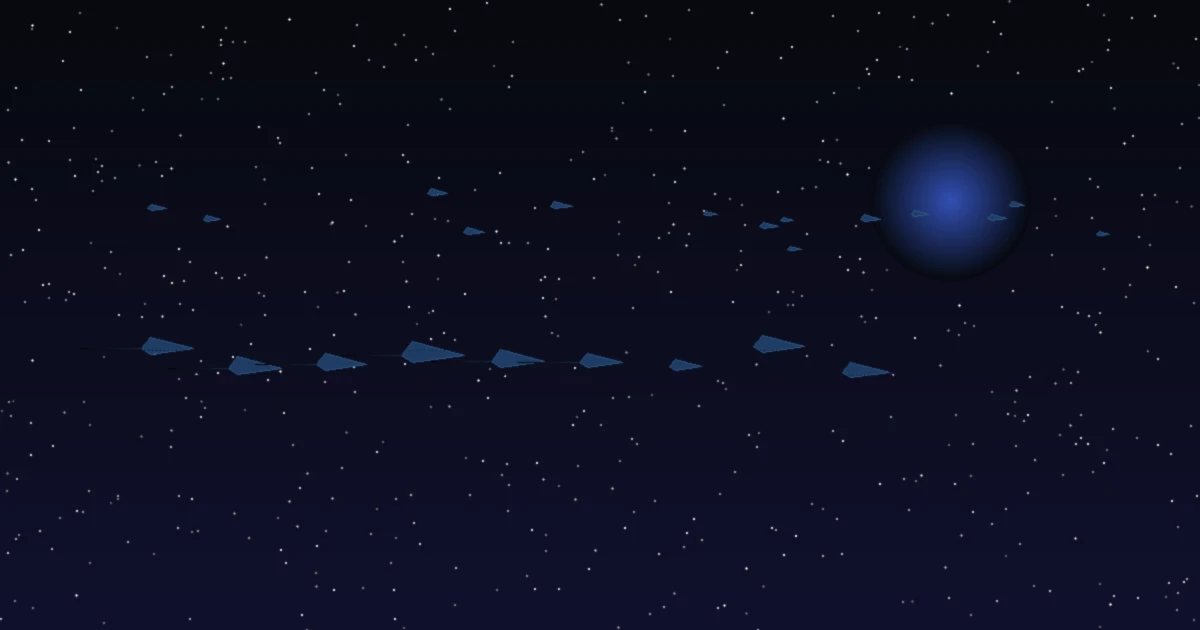
The Trisolaran Invasion Fleet: Four Centuries of Waiting
Four hundred years is a long time to wait for a war.
When humanity first learned that a Trisolaran invasion fleet had been launched toward Earth, the news was simultaneously terrifying and almost abstract. The fleet would not arrive for four centuries. No one alive at the moment of discovery would live to see it. Every strategist, every Wallfacer, every bureaucrat who devoted their life to the Planetary Defense Council was preparing for a conflict they would never witness firsthand. This temporal vertigo — the gap between knowing doom was coming and the impossibility of experiencing its arrival — defined the Crisis Era more than any other single fact.
Understanding the fleet itself — its scale, its structure, and its strategic implications — is essential to understanding why the entire trilogy unfolds the way it does.
The Scale of the Armada
The Trisolaran fleet that departed for Earth numbered in the hundreds of ships, though the novels are deliberately imprecise about exact figures. What matters is the implied technological and industrial capacity required to build it. Trisolarans had mastered interstellar travel and possessed propulsion systems sophisticated enough to cross 4.2 light-years in roughly four centuries — a feat that remained beyond humanity's grasp even centuries into the Crisis Era.
Each ship in the fleet was a marvel of engineering by any standard available to humanity. But perhaps more remarkable than their construction was what the fleet represented: the singular goal of an entire civilization. A species that had survived thousands of years of chaotic orbital conditions, dehydrating and rehydrating through dozens of extinction-level events, had focused its collective will on a single destination. Earth.
The fleet carried weapons, but its most important cargo — from a strategic standpoint — was the two sophons humanity already knew about. Those quantum-entangled probes, unfolded from protons and refolded into weapons of surveillance and scientific interference, had already arrived and were already at work. The fleet itself was almost secondary. The true invasion had begun the moment Ye Wenjie pressed send.
The Journey: Physics and Time
The fleet traveled at a fraction of the speed of light — impressive by human standards, but still slow enough to require multiple human generations to complete the crossing. This matters enormously.
Because the fleet was not relativistic travel (the ships weren't approaching light speed closely enough to experience dramatic time dilation), the crews aboard experienced something close to the same passage of time as the civilization they left behind. Trisolaran dehydration physiology partially addressed this challenge: in extreme conditions, Trisolarans could shed water from their bodies and enter a dormant state, surviving environments that would kill a human. Whether and how extensively the fleet used this capability during transit is left somewhat ambiguous, but it implies that the journey may not have felt subjectively like four centuries to every crew member.
What we do know is that Trisolaran civilization did not simply wait. They monitored Earth through their sophon surveillance network, observed every human military development, tracked every technological advance, and updated their strategy in real time. The fleet was not flying blind.
The Fleet as Strategic Deterrent
Here is the central paradox of the Trisolaran invasion fleet: it functioned as much as a psychological weapon as a physical one.
From the moment humanity learned of the fleet's existence, every major decision — technological, political, philosophical — was made under its shadow. The Planetary Defense Council's entire structure existed to respond to it. The Wallfacer Program was specifically designed to develop strategies the fleet's sophon surveillance couldn't detect. The Great Ravine, the period of social collapse that followed the revelation, was in large part a product of the fleet's existence in humanity's imagination.
A fleet still centuries away caused more behavioral change than most weapons ever fired in anger.
This is not unusual in military history. The knowledge that a force is coming — even a distant one — reshapes everything. But Liu Cixin amplifies this dynamic to cosmic scale. The fleet didn't need to fire a single weapon to begin defeating humanity. The panic, the nihilism, the factional infighting among humans who disagreed about how to respond — much of this was triggered by the mere existence of an armada none of them would ever see.
The Trisolarans understood this. The sophons weren't just surveillance tools; they were instruments for managing humanity's psychological response. By selectively revealing certain information and suppressing others — blocking particle physics research, for instance, while allowing humanity to observe that it was being blocked — the Trisolarans kept their future conquest in a state of calculated despair.
What Humanity Prepared
The human response to the fleet's existence was the largest coordinated effort in history: centuries of shipbuilding, weapons development, strategic planning, and social reorganization. The Crisis Era saw the creation of the Asian Fleet, the European Fleet, and eventually the combined Earth Defense Fleet — thousands of warships built and crewed by multiple generations of soldiers who trained for a war their grandchildren might fight.
The scale of this preparation was genuinely impressive. By the time of the Doomsday Battle, humanity had assembled a fleet of its own that dwarfed anything previously built, armed with weapons it believed could challenge the invaders. Fusion drives, magnetic confinement weapons, conventional kinetic systems — centuries of development had produced real results.
It was, of course, not enough. Two Trisolaran water-drop probes destroyed the entire Earth Defense Fleet in a matter of hours. The fleet humanity spent centuries building lasted an afternoon.
The Moral Weight of an Invading Civilization
The Trisolaran fleet complicates easy moral reasoning in ways the trilogy earns rather than imposes. The Trisolarans are invaders, unambiguously. They intend to colonize Earth and are willing to destroy humanity to do it. But Liu Cixin takes care to show that this decision did not emerge from malice. It emerged from desperation.
Trisolaris was dying. Three unstable suns, chaotic orbital conditions, and a civilization pushed to the absolute limit of its endurance had produced a species that would do anything to find a stable home. Earth, with its single predictable star, was paradise by comparison. From the Trisolaran perspective, the invasion was survival.
This doesn't make the fleet's mission less threatening. But it does make the conflict feel less like a story about evil against good and more like one about two civilizations with incompatible survival requirements occupying the same universe — which is precisely the dark sociology Liu Cixin wants to explore.
The Fleet After Dark Forest Deterrence
Luo Ji's establishment of Dark Forest deterrence changed the fleet's strategic situation fundamentally. For the first time, the armada en route to Earth had a reason not to attack — because the person holding the trigger could broadcast Trisolaris's location to the universe if they did.
The fleet didn't turn back. It couldn't; there was nothing to return to. But it stopped advancing. For decades, it held its position in interstellar space, caught between a destroyed home world and a destination it could no longer safely reach. The fleet that had seemed unstoppable became, in effect, a hostage.
This is one of the trilogy's most striking reversals. Four hundred years of travel, centuries of human fear and preparation, an armada of technical sophistication humanity could barely imagine — and in the end, the fleet was neutralized not by weapons, but by a single man willing to press a button.
The fleet still waiting in the dark when Cheng Xin became Swordholder is a reminder of how completely the deterrence framework had transformed the strategic situation. And its eventual fate — rendered irrelevant by the two-dimensional attack on the solar system — underscores the trilogy's core thesis: that in the Dark Forest, the threats you plan for are never quite the ones that kill you.
Four hundred years. An armada crossing the void. A civilization that waited, watched, and ultimately lost to forces neither side could have predicted.
That's the Trisolaran invasion fleet — the threat that defined an era and then became a footnote.