The Problem With Being Visible
In Liu Cixin's Death's End, humanity learns the hard way that existence in the Dark Forest universe is a liability. Every civilization broadcasting its location is painting a target on itself. The natural question — one that haunts every reader — is whether there was a better option. Not deterrence. Not hiding in the shadows between stars. Something more radical: making the entire solar system invisible.
That proposal is the Black Domain strategy.
What Is a Black Domain?
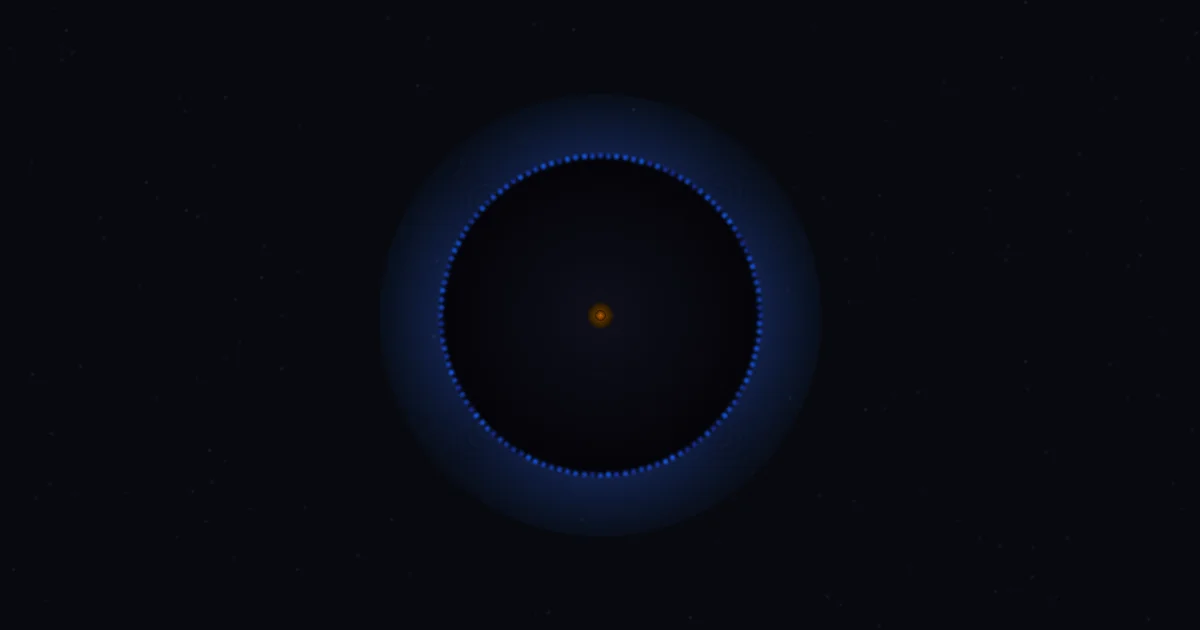
A Black Domain is a region of space where the local speed of light has been artificially reduced — so drastically that no electromagnetic signal can escape. In the novel's cosmology, the speed of light is not an absolute constant across the universe; it is a value that has been degraded over billions of years as civilizations have weaponized it. The universe began with light traveling at a far higher velocity. What we observe as c — roughly 300,000 km/s — is a diminished remnant of that original constant.
A civilization capable of locally manipulating this constant could, in theory, reduce the speed of light within a bounded region to something approaching zero. No light leaves. No radio signals leave. No evidence of existence leaks out into the Dark Forest. The solar system becomes a black spot — invisible, undetectable, silent.
It is, on paper, the perfect hiding strategy.
Why It Was Considered
The Black Domain surfaces as a desperate proposal during the period in Death's End when humanity is reeling from exposure. The Wallfacer deterrence has collapsed — the failure of Cheng Xin to hold the Sword being a central moment in that unraveling. The Dark Forest broadcast has revealed Earth's coordinates. The solar system is now a known address in a universe where every known address eventually gets a visit.
Dimensional reduction — the two-dimensional foil attack — is one possible end. The actual solar system destruction sequence makes the stakes viscerally clear. An antimatter strike is another. The Black Domain is proposed as a third path: not fighting back, not broadcasting threats, but simply disappearing.
It has an intuitive appeal. If the Dark Forest logic holds, civilizations attack because they fear the unknown future capabilities of other civilizations. A civilization that cannot be detected cannot be feared. A civilization that cannot be feared will not be struck.
The logic is elegant. The problems are severe.
The Tradeoffs That Kill It
The Prison Is Perfect
A Black Domain works in both directions. If no light can leave, no light can enter either. The solar system would be cut off from all external observation — but also from all external energy. The Sun's radiation would be trapped. Thermal dynamics inside the domain would become radically altered. More critically, any attempt to travel beyond the domain boundary would face the same constraint: nothing moving at or below the local speed of light could exit.
Humanity would be safe from the Dark Forest. Humanity would also be permanently sealed inside it.
No Exit
The Black Domain is not a temporary measure. You cannot dial the speed of light back up after the threat passes. It is a one-way door. Every generation that follows would live in a self-imposed cosmic prison, cut off from any possibility of expansion, exploration, or contact. In a universe where the Dark Forest already enforces silence, this strategy enforces it from the inside — permanently and irrevocably.
This is not deterrence. It is self-entombment.
The Problem of Execution
Even setting aside the consequences, creating a Black Domain requires technology that does not exist and may never exist: the ability to deliberately alter a fundamental physical constant across an entire stellar region. The civilizations in The Three-Body Problem universe that can do this are operating at technological levels so far beyond humanity that the comparison barely registers. Trisolaris cannot do it. Humanity in the novel's timeframe certainly cannot.
The proposal, for all its conceptual elegance, is technologically unreachable in any timeframe relevant to Earth's survival.
Why It's Still a Fascinating Idea
The Black Domain is rejected. But it lingers in the mind — and that is by design.
Liu Cixin uses it to illustrate a recurring theme of the trilogy: that every escape from the Dark Forest closes another door. Deterrence requires accepting the moral weight of threatening genocide. Escape ships require abandoning billions — a choice Cheng Xin agonizes over across the later novels. (The Gravity and Blue Space represent this very dilemma made real, as do the Escapist Fleet preparations that preceded them.) The Black Domain requires accepting permanent isolation from the cosmos. There is no clean answer, no option without catastrophic cost.
The strategy also implicitly asks: what does survival mean? If humanity survives inside a Black Domain but can never again look at the stars, reach beyond its own system, or grow — is that survival, or is it just a slower extinction? The trilogy repeatedly returns to this question and never flatters the reader with an easy resolution.
The Fan Theory Angle
Among readers who engage seriously with the cosmological mechanics of the trilogy, the Black Domain has inspired a specific class of speculation: what if other civilizations have already done this?
If a sufficiently advanced civilization could create a Black Domain, it would be, by definition, undetectable. We would see a region of space with no apparent emissions, no observable structure. We already have a name for regions of space where light cannot escape: black holes. Most black holes have entirely conventional explanations. But the fan theory asks whether some dark, quiet regions of the observable universe might be something stranger — civilizations that chose to vanish rather than risk exposure.
It is unprovable. It is also exactly the kind of question the trilogy is built to generate.
The Lesson
The Black Domain strategy, taken seriously, is a mirror held up to the human instinct to hide from danger. It works — completely, perfectly, and permanently. Which is why it cannot work at all. The moment you eliminate every risk from outside, you have also eliminated every possibility from outside. The universe stops being something to explore and becomes a threat to be sealed out forever.
In the Dark Forest, there are no good options. Only the question of which costs you are willing to pay, and what remains of you afterward.
The Black Domain answers that question by taking everything the universe has to offer and trading it for silence.
For some, that trade might be worth it. For humanity in the novels, the decision was made before anyone got a vote — and the answer was no.