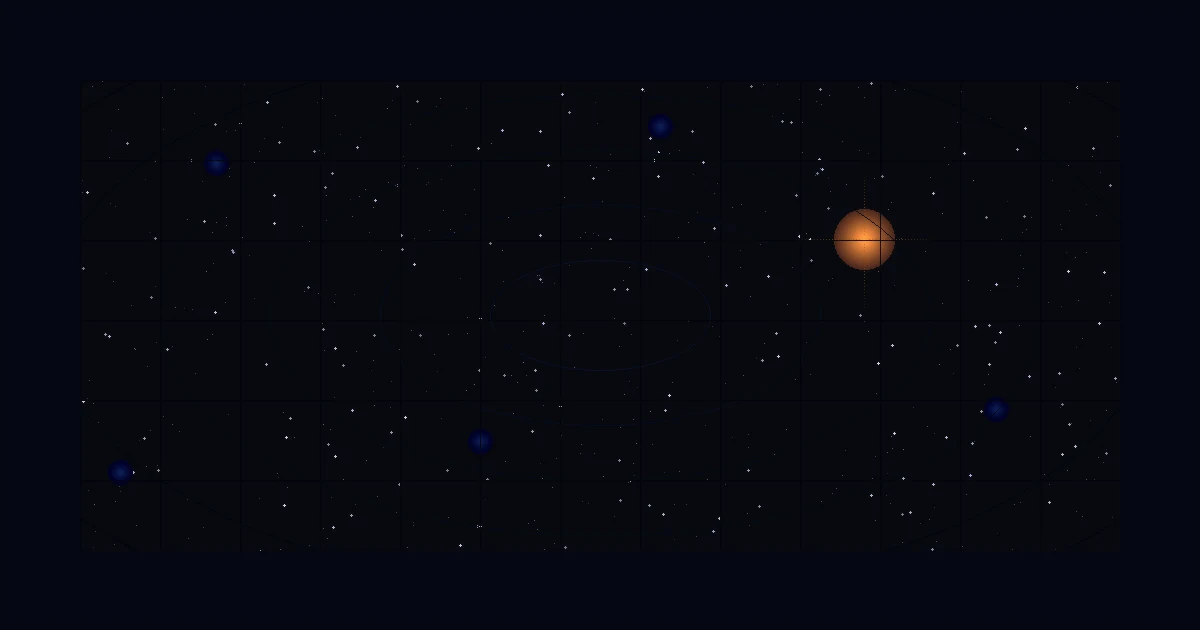
The Question That Keeps Astronomers Up at Night
In 1950, physicist Enrico Fermi sat down to lunch at Los Alamos and asked a simple question: Where is everybody?
The universe is roughly 13.8 billion years old. It contains hundreds of billions of galaxies, each containing hundreds of billions of stars, many of them orbited by rocky planets. Even with conservative estimates of how often life emerges, the math suggests the cosmos should be teeming with intelligent civilizations — some of them millions of years older and more advanced than us. Statistically, we should have heard something by now. A signal, a probe, a stray transmission. Anything.
We've heard nothing.
This is the Fermi Paradox, and for decades before Liu Cixin wrote The Three-Body Problem, scientists and philosophers had been wrestling with it. Their answers range from hopeful to unsettling — but few are as darkly elegant as the Dark Forest theory.
The Optimists: Maybe They're Just Far Away
The gentlest explanations for the Great Silence don't require anything sinister. Perhaps the distances between stars simply make contact impractical. At the speed of light, it takes over four years to reach the nearest star system. Crossing the galaxy takes a hundred thousand years. Even a civilization broadcasting continuously might go undetected simply because their signals are too faint or aimed in the wrong direction.
This "communication gap" explanation is reassuring, but it doesn't fully satisfy. A sufficiently advanced civilization with millions of years of technological development should be capable of making its presence known in ways that would be hard to miss — Dyson spheres harvesting stellar energy, for instance, would be detectable from thousands of light-years away. We see no such structures.
The Zoo Hypothesis: We're Being Watched
In 1973, radio astronomer John Ball proposed a more unsettling possibility: advanced civilizations exist and are aware of us, but have collectively chosen not to make contact. Earth is, in essence, a nature reserve.
The Zoo Hypothesis (sometimes called the Planetarium Hypothesis in a darker variant) posits that we exist in a kind of cosmic quarantine — observed but not disturbed, allowed to develop on our own timeline. The silence isn't absence; it's deliberate.
It's a comforting idea in some ways — it implies we're not alone, and that whoever is watching us has decided we're worth protecting. But it requires an extraordinary degree of coordination among all intelligent civilizations, all agreeing never to break the silence with any species that hasn't reached some threshold. In game theory terms, the Zoo Hypothesis requires a stable equilibrium that seems implausible to maintain indefinitely across millions of independent actors across cosmic timescales.
The Great Filter: Something Kills Civilizations
Robin Hanson's 1998 paper introduced the concept that has haunted SETI researchers ever since: the Great Filter.
The idea is straightforward. If the universe should contain abundant intelligent civilizations but clearly doesn't, something must be filtering them out. Either the emergence of life (or intelligent life) is extraordinarily rare, or something destroys civilizations before they can expand beyond their home systems.
If the Great Filter lies behind us — if the hard step was, say, the emergence of eukaryotic cells, or of multicellular life — then we may be genuinely rare survivors who made it past the bottleneck. That's good news.
If the Great Filter lies ahead of us, the implications are catastrophic. Something — nuclear weapons, engineered pandemics, climate collapse, runaway AI — reliably ends civilizations before they mature enough to colonize the stars. The absence of other civilizations would then be a death notice for our own future.
The Great Filter doesn't require cosmic malice. It just requires that advanced civilization is inherently self-destructive, or that some technological threshold (fusion, nanotechnology, artificial general intelligence) reliably triggers extinction.
Rare Earth: Life Is the Miracle
The Rare Earth Hypothesis, developed by Peter Ward and Joe Kirschvink, inverts the optimistic assumptions built into the classic Drake Equation. Instead of assuming that the emergence of complex life is common, it catalogs all the specific conditions that allowed it here on Earth:
- A large moon stabilizing axial tilt
- A gas giant diverting incoming asteroids
- A position in the galactic habitable zone
- Plate tectonics recycling nutrients
- The right kind of star, the right kind of system
Stack enough of these requirements together and the probability of another Earth-like biosphere drops toward vanishing. Perhaps complex, intelligent life is extraordinarily rare not because something destroys it, but because the preconditions for it almost never align.
The Rare Earth view offers a strange comfort: perhaps we're alone not because the universe is hostile, but because it's indifferent, and we got lucky.
The Dark Forest: The Answer Nobody Wanted
Then came Liu Cixin.
The Dark Forest theory, articulated in the second novel of the trilogy, doesn't require that civilizations are rare, or self-destructive, or hiding us for our own protection. It requires only two axioms described in Cosmic Civilization Theory and developed more deeply in the Cosmic Sociology Framework: that survival is the primary need of any civilization, and that civilizations grow but resources remain finite. From these premises — and from the impossibility of trusting a civilization you cannot observe continuously — Liu Cixin — through the character of Luo Ji — derives a cosmos where the rational strategy for any intelligent species is to eliminate any other intelligent species the moment it becomes detectable. For the moral dimensions of this logic, see Civilization Chains: The Ethics of Cosmic Survival.
The universe isn't silent because it's empty. It's silent because everyone is hiding. And anyone who reveals themselves becomes a target.
It's a solution to the Fermi Paradox, but it works by making the absence of contact more frightening, not less. Every civilization that sends a signal is announcing its coordinates in a shooting gallery. The rare civilizations that haven't been destroyed yet are the ones smart enough to stay quiet.
Where the Dark Forest Stands Apart
What makes the Dark Forest theory so intellectually striking — and so disturbing — is how little it requires. For those who find this framework compelling, the METI real-world debate shows how it has entered serious scientific discussion.
The Zoo Hypothesis demands improbably sustained cooperation across all civilizations. The Great Filter demands that something reliably destroys civilizations. Rare Earth demands that the biophysical conditions for intelligence almost never occur.
The Dark Forest demands only that civilizations are rational and mortal. It derives cosmic genocide from game theory alone — no rare catastrophes, no benevolent zookeepers, no improbable coincidences. Just two civilizations, unable to fully trust each other, doing the math.
There are real objections. Some philosophers argue that cooperation is also a rational strategy in iterated games, and that the universe is old enough for cooperative norms to have emerged. Others note that Liu Cixin's axioms assume resource scarcity at scales that may not apply to a Kardashev Type III civilization. The theory has attracted serious academic criticism alongside serious admiration.
But as a piece of speculative reasoning — as a story about why the stars are silent — it remains the bleakest and most logically compact answer anyone has offered. Fermi's lunch question, finally given the answer it deserved: everyone is hiding from everyone else, in a darkness that has no bottom.
The Silence Has Always Been There
What's remarkable about revisiting these theories through Liu Cixin's lens is how thoroughly the Dark Forest reframes the options. The Zoo Hypothesis becomes naïve: why would a Dark Forest civilization bother with reserves when elimination is cleaner? The Great Filter becomes almost redundant: if civilizations aren't filtering themselves out through self-destruction, the universe may be doing it for them. Rare Earth becomes a possible explanation for why we've survived this long — not because we're protected, but because we've been too quiet and too primitive to notice.
The Fermi Paradox has never had a satisfying answer. It may never get one. But Liu Cixin's contribution to the question — offered through the voice of a fictional scientist — Luo Ji — at a chalkboard, in a novel about betrayal and survival — is that the silence itself might be the most terrifying signal of all. For the ultimate escalation of this silence, see Dimensional Reduction Attacks. For a deep look at who pulls the trigger in the Dark Forest — the civilizations Liu Cixin calls Singers — see The Singer and the Coordinates.