The Problem with Space: Everything Moves
In space, there is no ground. No anchor. Every object that doesn't burn rocket fuel is perpetually falling — around a planet, around a star, around the common center of mass of everything in the solar system. For early planners imagining human settlements off Earth, this presented a fundamental problem: where do you put things so they stay put?
The answer, at least for the inner solar system, came from an eighteenth-century mathematician who never left France.
What Lagrange Actually Discovered
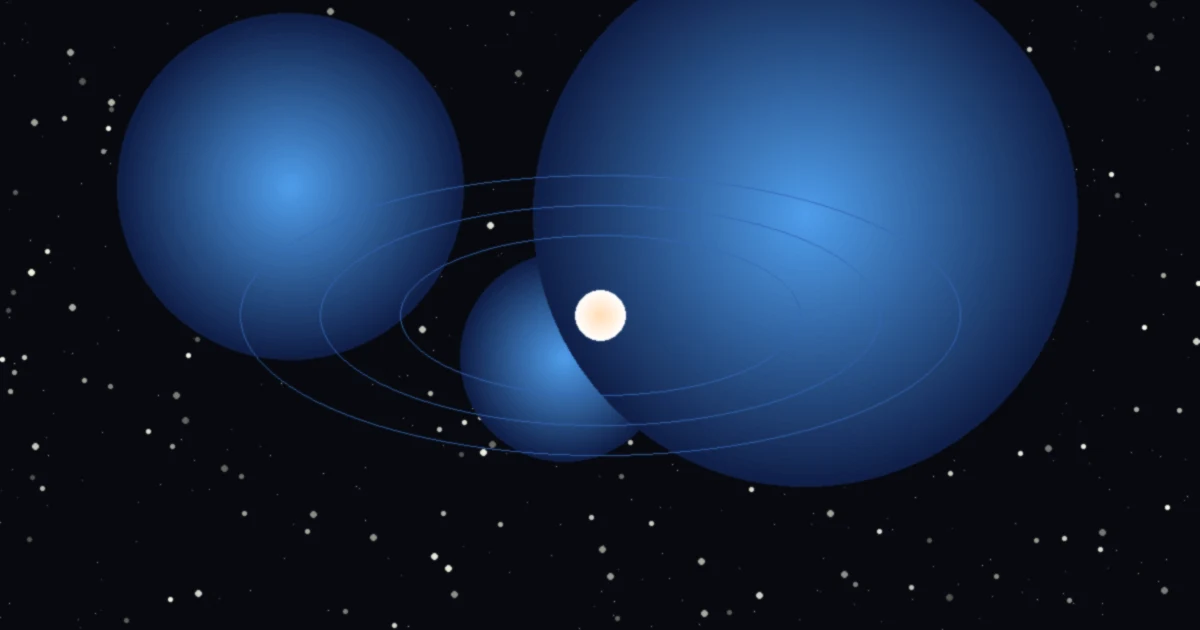
In 1772, Joseph-Louis Lagrange solved a restricted version of the three-body problem — the same problem that gives Liu Cixin's trilogy its name. He asked: given two large bodies (say, a star and a planet) orbiting their common center of mass, are there positions where a much smaller third body could orbit in a stable configuration, moving in lockstep with the other two without requiring constant thrust?
The answer was yes. There are exactly five such positions, now called Lagrange points, labeled L1 through L5.
L1 sits directly between the two large bodies — in Earth's case, between Earth and the Sun. It's not a comfortable location; it's gravitationally unstable, like a ball balanced on a hill. Nudge a satellite at L1 and it will drift away. But with occasional small corrections, it's maintainable, and it has the useful property of providing uninterrupted sunward visibility. The James Webb Space Telescope occupies a nearby position.
L2 is on the opposite side — directly behind Earth relative to the Sun. Also unstable, also maintainable, and shielded from solar radiation by Earth's bulk. Webb orbits here as well.
L3 lies on the far side of the Sun, perpetually hidden from Earth's view. It has captivated science fiction writers for decades as the natural location for a "counter-Earth," though its gravitational instability makes long-term habitation without constant correction impractical.
L4 and L5 are where things get genuinely interesting. These points sit on Earth's orbital path, sixty degrees ahead of and behind the planet respectively, forming equilateral triangles with the Earth and Sun. Unlike L1, L2, and L3, they are genuinely stable — a satellite displaced slightly from L4 or L5 will actually return to the point rather than drifting away. The physics that produces this stability involves a subtle interplay between gravitational attraction and the Coriolis forces of the rotating reference frame. Objects can accumulate at L4 and L5 over geological time; Jupiter's Trojan asteroids, over a million objects, have been parked at that planet's L4 and L5 for billions of years.
The Crisis Era's Real Estate Boom
When the Crisis Era's Planetary Defense Council needed locations for orbital habitats, staging depots, and naval anchorages, the Lagrange points were the obvious answer. Not because they were convenient — they weren't particularly close to anything — but because they were the only locations where large structures could be maintained without continuous propellant expenditure.
At L4 and L5, a habitat the size of a small city could remain in position indefinitely. Supply ships arriving from Earth would always find it in the same relative location. Warships staging for deep-space patrols could return to a predictable anchorage. The gravitational geometry of the Sun-Earth system provided free station-keeping, which at the scales the fleet program required was an enormous industrial advantage.
The real appeal was logistics. A warship that never needs to burn fuel just to maintain its parking orbit can devote all of its propellant mass to actual maneuvering. An orbital station at a stable Lagrange point doesn't need to be resupplied with stationkeeping propellant at all. When you're building thousands of warships and the resource cost of the construction program is already contributing to civilizational collapse, eliminating unnecessary fuel expenditure from the equation matters.
Not All Points Are Equal
The five Lagrange points served different purposes in the Three-Body universe's expanding off-Earth civilization, and their different stability properties made them suitable for different applications.
The unstable points — L1, L2, L3 — were preferred for installations requiring precise positioning that might need to be moved: communications relays, observation platforms, scientific stations. Their instability is a feature if you want to be able to leave. The small correction burns needed to maintain position are manageable for crewed or robotic stations with long operational lifespans.
The stable points — L4 and L5 — were where the serious mass went. Habitats housing tens of thousands of people, industrial platforms processing asteroid ore into warship components, naval staging grounds for the growing fleet. The Trojan asteroid populations at Jupiter's L4 and L5 had already been industrially surveyed; humanity's expansion toward them tracked natural resources as much as gravitational convenience.
Beyond Earth, every major planet has its own Lagrange points with the Sun, and the large moons of gas giants have Lagrange points with their parent planets. As the Crisis Era fleet program expanded into the outer solar system, the Lagrange architecture of Jupiter and Saturn became strategically significant — large stable regions near enormous reserves of raw material, far from Earth's increasingly crowded inner system.
The Military Logic
For the human fleet planners constructing their response to the approaching Trisolaran invasion, Lagrange points weren't merely convenient. They were strategically essential.
A battle fleet needs to be able to assemble, resupply, repair, and disperse. In open space, every one of those activities costs propellant — and the rocket equation is ruthless. Every kilogram of fuel you need to carry to a rendezvous point requires fuel to carry the fuel, which requires more fuel to carry that fuel. The exponential tyranny of the rocket equation means that free gravitational anchors are the most strategically valuable real estate in the solar system, and there are exactly five of them per planet-star pair.
In a solar system preparing for an existential conflict, this meant the Lagrange points were simultaneously the most valuable habitable locations and the most obvious military objectives. Any adversary planning to disable Earth's industrial and military capacity would logically target L4 and L5 installations. Any defender would need to protect them. They become, in the language of military geography, commanding ground — the high points that determine who controls the surrounding territory.
The Trisolaran strategy, deploying sophon surveillance well in advance of military action, meant that every construction project, every ship that docked, every repair and resupply that happened at a Lagrange point was observed and catalogued. The orbital map of humanity's defensive infrastructure was known to the approaching fleet in real time.
Real Lagrange Infrastructure
Outside the Three-Body universe, the Lagrange points have been occupied — modestly — by human civilization for decades. SOHO and ACE orbit near Earth's L1, monitoring the Sun. James Webb operates at L2. The WISE infrared telescope mapped the sky from L1. NASA's planned Gateway lunar orbital station will occupy the Moon's L4 or L5 relative to Earth.
But these are small probes and stations, not city-sized habitats or naval anchorages. The step from a few-ton scientific satellite to a habitat housing thousands of people is not merely a larger version of the same thing; it requires life support at a scale that generates its own resource chains, agriculture or extensive food import capacity, medical facilities, water recycling systems sophisticated enough to operate indefinitely. The physics of Lagrange stability is easy. The biology of keeping large numbers of humans alive in vacuum is hard.
The crisis economics of Liu Cixin's universe provide the motivation that peacetime economics can't quite generate. When the alternative is extinction, the investment calculus for orbital habitat construction changes fundamentally. The question shifts from "is it worth building?" to "how fast can we build it?"
The Contested Real Estate of Any Space Civilization
In any realistic near-future space civilization — Three-Body universe or otherwise — the Lagrange points are where the gravitational debt finally gets paid down. Everywhere else in the solar system, every kilogram of presence costs continuous propellant. At L4 and L5, the universe gives you a free anchor and asks only that you find a way to get there.
This makes them both the most valuable locations in the solar system and the most contested. Not just militarily but economically, legally, politically. Who owns L4? Can a habitat staked out there claim sovereign territory? When two nations both want to station shipyards at the same gravitational point, what governs priority?
These aren't abstract questions. Real international space law is already struggling with analogous problems in the more crowded near-Earth orbital environment. Extend the timeline a century and the Lagrange points become the chokepoints of an interplanetary economy — the ports of call, the refueling stations, the places where the geometry of space forces convergence.
Liu Cixin understood this when he populated them. In a universe where the solar system itself has become contested territory, the five Lagrange points per planet aren't just good locations for habitats. They're the hinge points around which an entire civilization reorganizes its relationship to the void. For how humanity dispersed from these staging grounds after the Doomsday Battle, see the Bunker Era.