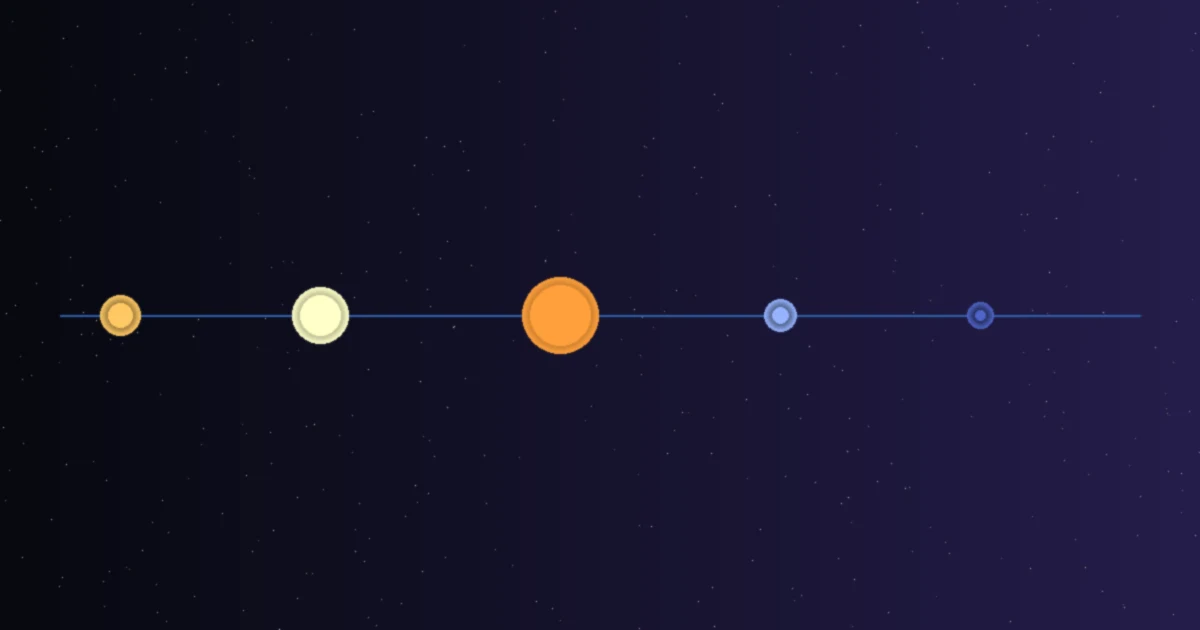
A Civilization Running Out of Options
By the time the Bunker Era began, humanity had already lost almost everything.
Dark Forest deterrence had collapsed — the consequence of the Trisolarans correctly calculating that Cheng Xin, the new Swordholder, would not press the trigger. The two-dimensional foil — a weapon of incomprehensible scale — had been launched into the solar system and was expanding at the speed of light, converting three-dimensional matter into a flat, luminous sheet. Earth was gone. Most of the inner solar system was gone. The brief, fragile peace of the Deterrence Era had ended not with a battle but with a geometric inevitability: a spreading plane of two-dimensional matter that nothing could stop and nothing could escape — except, perhaps, a planet big enough to stand behind.
The Bunker Era was humanity's attempt to survive inside the shadow of the outer gas giants. It was audacious, enormously costly, and ultimately inadequate. But for a time, it worked.
The Logic of the Shadow
The two-dimensional foil expanded in a plane — a flat wavefront radiating outward from where it was launched. This geometry, so catastrophic for the inner solar system, created an unexpected opportunity at the solar system's edge.
A gas giant is massive. Jupiter alone contains more than twice the mass of all other planets combined. If a civilization could cluster its surviving settlements directly behind Jupiter — in the geometric shadow that the planet cast against the foil's expansion plane — those settlements would be physically shielded. The foil, traveling in a flat expansion, could not wrap around a planet large enough to block its path.
This was not a solution. It was a reprieve. The foil's expansion geometry might shift. Other attacks might follow. The gas giants themselves would eventually be consumed. But reprieve, when the alternative is annihilation, is worth nearly anything.
The Bunker Project was thus humanity's concentrated, desperate effort to relocate its remaining population to settlements positioned in the gravitational and geometric shadow of Jupiter, Saturn, Uranus, and Neptune.
Building a Civilization in the Outer Dark
The practical challenges were immense.
The outer solar system is cold, distant, and poorly suited to human habitation. The gas giants themselves cannot be landed on. Useful real estate meant their large moons — Europa, Ganymede, Callisto around Jupiter; Titan and Enceladus around Saturn — and orbital habitats positioned with geometric precision to remain within the shadow as both the planet and the expanding foil moved.
Constructing viable habitats in these environments required resource extraction at scales that stretched the remaining industrial capacity of a civilization already shattered by decades of crisis and war. The populations who survived the destruction of Earth and the inner solar system were transported outward — a migration not across continents but across hundreds of millions of kilometers of vacuum.
The social order that emerged was a product of extreme constraint. Space was limited. Resources were allocated with brutal precision. The democratic ideals that had characterized the Deterrence Era gave way, in many settlements, to more authoritarian arrangements justified by survival necessity. For a closer look at the orbital habitats and moons that housed humanity at this stage, see the Bunker Project: Gas Giant Strategy. Liu Cixin depicts the Bunker Era as a time of cold pragmatism: a civilization that had learned, at tremendous cost, that sentiment could be fatal.
Life in the Shadow
The Bunker Era lasted decades. For the humans born into it, the outer solar system was simply the world — the vast, dark, cold world with its enormous gas giant hanging overhead, its thin habitats, its rationed everything.
There was culture. There was science. There was love and ambition and politics. A civilization does not become inhuman simply because it is pressed against the edge of oblivion. But the shape of daily life was defined by proximity to catastrophe in ways that permanently marked the societies that emerged from it.
The psychological burden of knowing what was behind the planet — the spreading two-dimensional ruin of everything that humanity had built over millennia — was not something that could be easily compartmentalized. The Bunker Era produced its own philosophies, its own religions, its own ways of accounting for how a species could lose its home star and keep living anyway.
The settlements were also politically fragmented. With Earth gone and no single surviving authority commanding universal legitimacy, different habitats developed different governance structures, different resource agreements, different relationships with the concept of a unified humanity. The Planetary Defense Council's successor institutions maintained a formal framework of coordination, but real authority was local in ways it had never been when a living Earth provided a symbolic and physical center.
The Flaw in the Shadow
The Bunker Era's logic rested on the two-dimensional foil behaving predictably — expanding in a plane that the gas giants could interrupt. But this assumption had limits.
The foil was not the only weapon that could be used against humanity. A civilization capable of launching a two-dimensional expanding sheet at a solar system was certainly capable of varying its approach. A foil launched from a different direction would cast different shadows. A foil launched from multiple angles simultaneously would leave no shadows at all.
More fundamentally, even a perfect bunker strategy was only a delay. The outer solar system's moons and habitats could sustain a population, but not indefinitely. The foil was still expanding. Eventually, the geometry of expansion and the motion of the gas giants would bring the foil into regions the bunker positions could no longer avoid.
Humanity in the Bunker Era knew this. The era was not premised on the illusion of permanent safety — it was premised on the hope that time bought in the outer solar system could be converted into something more durable: curvature-drive ships capable of leaving the solar system entirely, or contact with civilizations whose technology operated at a different level.
Why Even This Wasn't Enough
The Bunker Era ultimately gave way to the Roaming Era not because the foil immediately overcame the shadow strategy, but because the outer solar system habitats simply could not support humanity's long-term survival. The gas giants were themselves finite refuges. The foil's expansion continued. And — perhaps most importantly — the existence of curvature-drive technology made interstellar dispersal possible for those with access to it. Ships equipped with these drives would eventually seed the Galaxy Era.
The real end of the Bunker Era was not a single catastrophe but a gradual dissolution: ships departing for interstellar space, habitats abandoned as populations thinned, the slow recognition that the shadow of Jupiter was a resting place rather than a home.
What the Bunker Era represents in Liu Cixin's grand narrative is something important about the character of human civilization under pressure — the same stubborn refusal to concede that had driven Zhang Beihai to commandeer a ship and Luo Ji to threaten the cosmos. Given a geometric loophole in an extinction-level weapon, humanity spent decades and enormous resources to exploit that loophole — not to survive permanently, but to buy time. The Bunker Era was not a victory. It was humanity refusing to give up.
In a trilogy that often seems to argue that the universe is indifferent to whether civilizations survive, that refusal carries its own kind of weight.
A Stage in a Longer Ruin
The Bunker Era occupies a middle chapter in the long catastrophe of the solar system's destruction. It comes after the loss of Earth, after the collapse of deterrence, after the Doomsday Battle and the Battle of Darkness, the Doomsday Battle, and all the accumulated disasters of the trilogy's second and third volumes. It comes before the full dispersal of humanity into interstellar space, before the Roaming Era, before the events at the end of the universe. The full arc from this point is traced in the Human Civilization Timeline.
It is not a hopeful chapter. But it is a chapter that demonstrates something Liu Cixin clearly believes is worth demonstrating: that even a species that has lost almost everything will look for the shadow of the nearest large object and press itself against it, and keep looking for a way through.