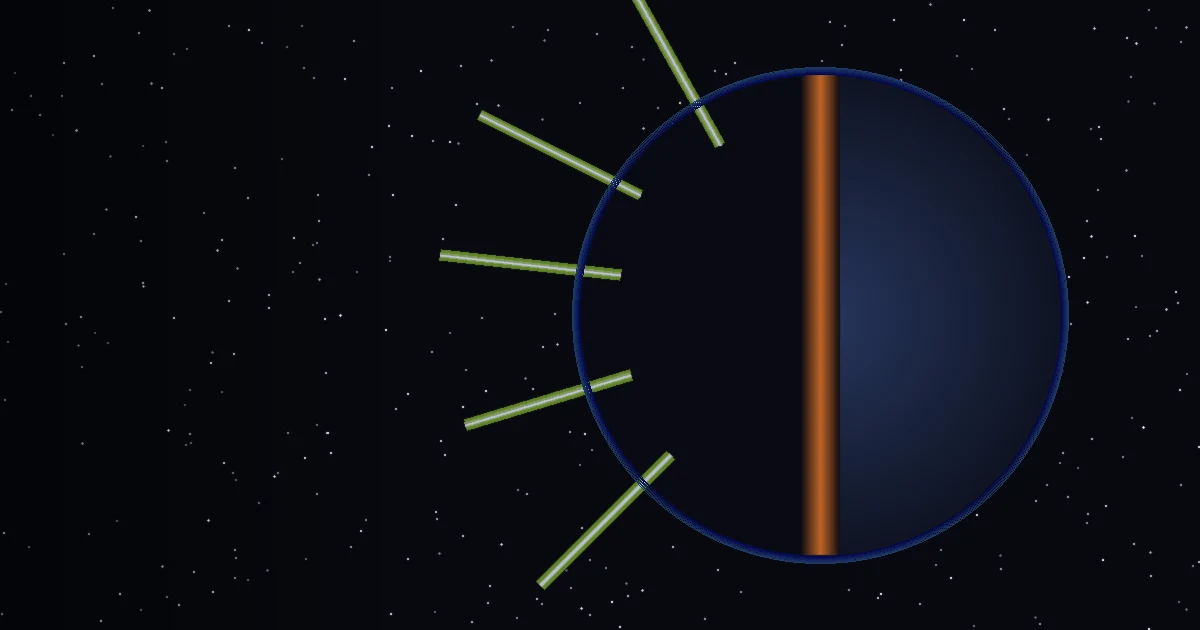
When Liu Cixin describes the ignition of Earth's planetary engines in Death's End, he frames it as humanity's most audacious engineering achievement. Thousands of mountain-sized fusion thrusters, anchored into the bedrock of continents, firing in coordinated bursts powerful enough to move a world. The scale is breathtaking. So is the damage.
The planet engine project — the so-called Wandering Earth plan — was not a clean salvation. It was a catastrophe layered on top of an extinction threat, a cure that caused its own form of dying. Understanding what the engines actually did to Earth means looking past the engineering triumph to the ecological and human wreckage the plan left in its wake.
The Permanent Division of a Planet
Before the engines fired, Earth had days and nights, seasons, a globe where sunlight reached every latitude across a year. After ignition, that ended.
The engines were arrayed across the planet's surface in a way that created asymmetry by design. The hemisphere facing away from the direction of travel received the thrust exhaust; the hemisphere facing the direction of travel was shielded from it. But more dramatically, the engines themselves became the only source of sustained light and heat over vast regions of the surface. The sun — growing dimmer as Earth pulled away from it — could no longer be relied upon.
What emerged was a planetary geography organized around proximity to engine output rather than solar distance. Regions near active engine clusters were blasted with infrared radiation, chemical exhaust, and artificial thermal loading. Regions far from engines experienced temperatures dropping toward those of deep space. The old categories of climate — tropical, temperate, polar — became meaningless. A new geography of survival emerged: you were either near enough to an engine to be warm, or you were freezing to death.
Agricultural Collapse
No aspect of Earth's biosphere proved more fragile under these conditions than agriculture.
Food production on Earth depends on a precise ensemble of conditions: consistent solar radiation, predictable seasons, viable temperature ranges for seed germination and crop maturation, stable precipitation cycles driven by atmospheric dynamics that were themselves driven by differential solar heating. The engines disrupted every one of these systems simultaneously.
Photosynthesis requires light. With solar input diminishing and the light from engines concentrated in narrow zones rather than distributed across latitudes, the agricultural land available for crop production contracted sharply. The vast grain-producing plains of North America, Ukraine, and Central Asia found themselves either too cold, too dark, or — near active engines — too hot and too toxic. Soil chemistry changed as engine exhaust settled into farmland. Precipitation patterns shifted as the atmosphere responded to the new thermal regime.
The result was a collapse that extended through the transition centuries: first shortages, then famines, then the death of entire agricultural traditions that had sustained human civilizations for millennia. What the novels call the Great Ravine — the catastrophic population collapse of the early Wandering Earth era — had multiple causes, but the destruction of food systems was central to it. The full scope of that collapse is documented in the Great Ravine Timeline.
Mass Extinction Events
The human cost was enormous. The non-human cost was total.
Ecosystems that had evolved over millions of years to track the sun could not adapt to a world that had abandoned it. Migratory species that navigated by solar cues found their behavioral programs pointing toward a star that was no longer in its expected position. Pollinator populations collapsed as flowering plants that had co-evolved with reliable seasonal cues fell out of synchronization with the insects that sustained them.
Coral reefs, already under stress from industrial civilization's earlier centuries, were finished by the combination of temperature disruption, acidification from engine exhaust dissolving in ocean water, and the loss of the solar cycles that regulated reef biology. The deep oceans, always the last reservoir of stability in previous extinction events, were penetrated by the same acoustic and chemical disturbances that the engine firings generated at geological scale.
What the trilogy implies but does not fully enumerate is that the planet-engine project probably constituted one of Earth's major extinction events — comparable in scale of biodiversity loss, if not in mechanism, to the events that ended the Permian or the Cretaceous. The difference is that this one was chosen. Humanity looked at the loss of its biosphere and weighed it against the loss of the entire solar system, and accepted the trade.
The Abandonment of the Surface
As conditions deteriorated in regions far from the engines, human populations migrated. The global geography of habitation was remapped along an axis no pre-engine civilization would have recognized: engine proximity was life, engine distance was death.
Underground habitation — a recurring image in the Wandering Earth narratives — became the dominant survival architecture. Cities moved subsurface, where geothermal energy could provide warmth independent of either the fading sun or the capricious heat of exhaust zones. The surface, in most regions, became a transitional space: traversed, worked in protective suits, eventually abandoned.
This migration was itself a catastrophe nested inside the larger catastrophe. Population concentrations shifted on a scale that no infrastructure was designed to support. Communities that had existed for centuries were abandoned. The social fabric of civilizations built around particular landscapes, agricultural traditions, and seasonal rhythms was shredded by a relocation that had no reference point in human history.
The Compounded Tragedy
What makes the ecological cost of the planet engines particularly devastating — in the moral accounting of Death's End — is that it was ultimately unnecessary.
The Wandering Earth plan was conceived to escape a sun that the models of the time predicted would undergo helium flash and expand catastrophically. The fleet spent centuries suffering, dying, and burning its biosphere on the altar of this prediction. And the prediction was wrong — or at least, it was made irrelevant when darker threats arrived.
The Trisolaran invasion, the loss of Dark Forest deterrence, and ultimately the dimensional reduction attack — the solar system's destruction by a Singer's dark forest strike — meant that the planet never reached its destination. The centuries of suffering, the extinct species, the permanent scar left on Earth's climate and ecology — it was all expenditure without return. The plan that cost so much failed not because it was badly engineered, but because the universe had other plans.
What the Engines Reveal
The planet engine sequences in Liu Cixin's work are not really about engineering. They are about the mathematics of civilizational desperation: the willingness to accept enormous, irreversible costs in exchange for a chance — not a certainty — at survival.
The ecological destruction is not a side effect Liu Cixin dwells on. It registers as background, as the price paid and noted and moved past. That restraint is itself meaningful. The engineers who designed the planet engine project did the same math: they acknowledged the cost and decided it was acceptable. They were operating at civilizational scale, where the unit of loss is not an ecosystem or an agricultural tradition or a species, but a planet.
Whether that arithmetic is defensible is a question the trilogy poses without quite answering. The engines did what they were designed to do. The world they preserved was not the world they started with. For the billions who lived and died in the shadow of the engines — in the cold, in the famine, in the slow extinction of everything that had existed before the crisis — that distinction may not have offered much comfort.
The planet moved. Almost nothing else survived the moving.