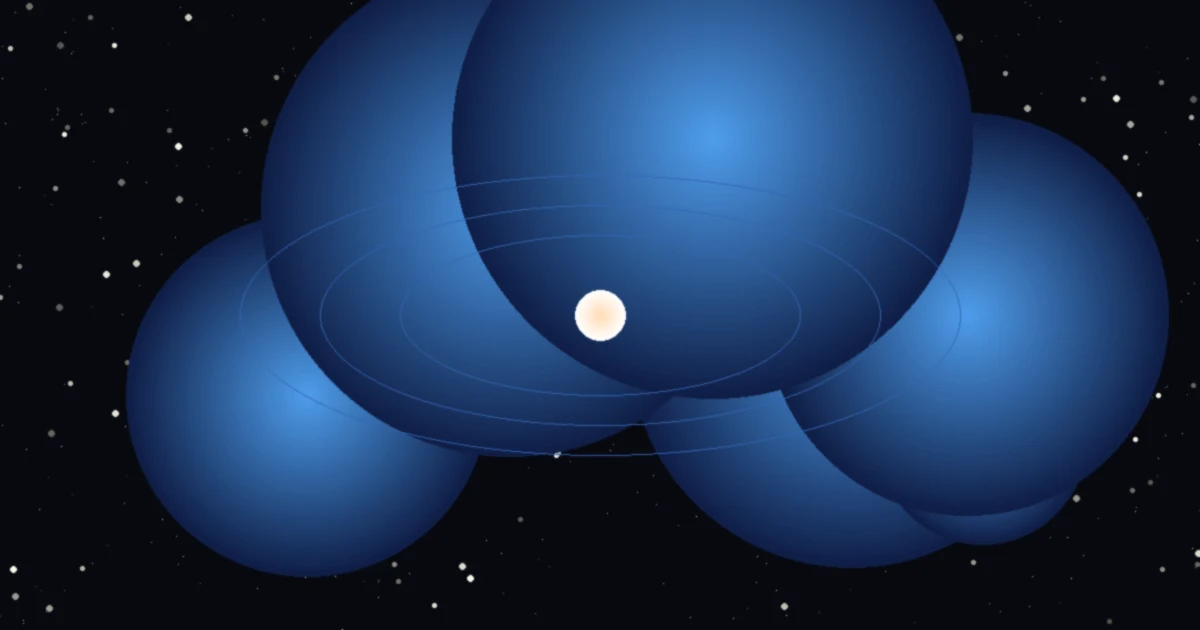
A World With Three Suns
Imagine waking up not knowing whether today will be warm or searing. Whether the sky will hold one sun, two, or three — or none for the next century. This is not a thought experiment. It is the reality Liu Cixin imagines for the inhabitants of Trisolaris, a planet caught in the gravitational embrace of three stars.
In The Three-Body Problem, the Trisolar system is more than a setting. It is the engine of an entire civilization's psychology. The chaos overhead — real, mathematical, inescapable — explains why the Trisolarans became the species they are: fatalistic, pragmatic, and desperate enough to abandon their home world entirely. The science behind their unstable eras is covered in detail in Trisolaran Chaotic Eras.
The Real Alpha Centauri System
Liu Cixin placed the Trisolar system in Alpha Centauri, Earth's nearest stellar neighbors. This is not arbitrary. The Alpha Centauri system genuinely consists of three stars:
- Alpha Centauri A: a star slightly larger and brighter than our sun
- Alpha Centauri B: slightly smaller and cooler, orbiting A in a tight binary pair over roughly 80 years
- Proxima Centauri: a dim red dwarf orbiting the AB pair at an enormous distance — around 13,000 astronomical units — completing one orbit approximately every half-million years
In 2016, astronomers confirmed the existence of Proxima b, a rocky planet within Proxima Centauri's habitable zone. In 2021, a candidate planet was detected around Alpha Centauri A. The real system is not quite as dramatic as the trilogy imagines — Proxima is so distant from the AB binary that its gravitational influence on any inner planets would be minimal — but Liu Cixin takes the real architecture and amplifies it: in the novel, all three stars orbit closely enough to pull Trisolaris into genuine, catastrophic instability.
The Three-Body Problem Itself
The trilogy's title refers to a real and famous unsolved problem in mathematics: given three masses exerting gravitational force on each other, predict their future positions and velocities. For more on the mathematical underpinnings, see The Three-Body Problem: Physics. For two bodies, this is straightforward — planets orbit in clean, elliptical paths that Newton and Kepler described precisely. Add a third body, and something breaks.
In 1890, Henri Poincaré proved that no general closed-form solution exists for three-body gravitational systems. For most configurations, the motion becomes chaotic — extraordinarily sensitive to initial conditions. Change the starting position of one body by a millimeter, and the system's long-term behavior diverges completely. This is not a failure of human mathematics. It is a fundamental property of the physical system.
Trisolaris lives at the mercy of this mathematics. Its orbital path around the three stars follows no predictable cycle. It may swing close to one sun for decades of scorching heat, drift into a brief stable period of temperate climate, then be flung into the outer dark for centuries of frozen night. There is no pattern to predict, no calendar to build, no planting season to trust.
Stable Eras and Chaotic Eras
The Trisolaran civilization organizes its history around two alternating conditions:
Stable Eras are periods when Trisolaris happens to occupy a roughly predictable orbit around one of the stars. Seasons exist. Agriculture becomes possible. Civilization builds. These eras can last decades or, rarely, centuries.
Chaotic Eras are what happens when the gravitational geometry shifts. The planet may receive lethal doses of stellar radiation from multiple simultaneous suns. It may be hurled away from all three stars into deep cold. Civilizations are destroyed. The surface becomes uninhabitable.
In the novel, Trisolaran civilization has been wiped out and rebuilt hundreds of times. Each iteration inherits fragments of what came before — preserved on materials that could survive the eras of heat and cold — and races to advance as far as possible before the next catastrophe. This cycle of destruction and reconstruction is the formative experience of the Trisolaran species. It does not make them philosophical about impermanence. It makes them ruthless about survival.
Can Life Actually Exist Here?
This is the question Liu Cixin asks his readers to accept — and it is not entirely implausible. Life on Earth has survived mass extinction events that eliminated the majority of species multiple times. Extremophiles thrive in environments that would kill most organisms instantly: volcanic vents, hypersaline lakes, the interiors of nuclear reactors. If Trisolaran life evolved dehydration as a survival mechanism (and in the novel it did — Trisolarans can voluntarily desiccate themselves into thin, hard sheets that endure extreme conditions), the fundamental biological challenge is not impossible, just brutally selective.
What is genuinely extraordinary is not that life survived on Trisolaris but that intelligence did. The development of complex cognition, language, culture, and eventually technology requires sustained periods of stability. Earth's intelligent life emerged during a period of remarkable long-term climate and astronomical stability. That Trisolarans achieved technological civilization at all, given the conditions, implies a survival drive operating at a level of intensity humans have never needed to develop.
Three Suns in the Sky
One of the novel's most visually striking motifs is the appearance of multiple suns. In a Trisolaran text that Wang Miao reads through the in-universe VR game, the characters describe the sky with multiple stellar objects visible simultaneously — a configuration that would produce strange lighting, extreme radiation, and temperatures far outside the range that liquid water can survive.
Real astrophysics supports the drama here. A planet in a close multi-star system would receive radiation from multiple directions simultaneously when the stars' positions aligned. Ultraviolet and X-ray flux from stellar flares — already damaging from a single star — would become compounded. Photosynthesis, which evolved for a single consistent spectral output on Earth, would need to operate across wildly varying light conditions.
Liu Cixin doesn't try to solve all of these problems. He uses the astronomy honestly enough to make the scenario credible, then focuses on what it means for the beings who have to live it: not a physical curiosity, but a civilizational crucible.
What the Trisolar System Means for the Trilogy
The chaos of the Trisolar system is not just background. It is the moral engine of the entire trilogy.
The Trisolarans do not invade Earth because they are evil. They invade because their world is dying — not from any single catastrophe, but from the mathematical inevitability of their location in a three-body gravitational system. Understanding their biology and culture helps explain their desperate calculus: see Trisolaran Physiology and Culture. At some point, the simulations all agree, Trisolaris will be flung out of the system entirely, or consumed by one of its stars. The timeline is uncertain; the outcome is not.
Their decision to cross 4.2 light-years and displace an existing civilization is horrifying. It is also, from inside their experience of reality, the only rational response to a universe that has spent millions of years trying to kill them. The three suns that made them desperate are the same three suns that made them survivors. Liu Cixin does not excuse the invasion — but he makes it comprehensible, and that comprehensibility is the source of the trilogy's deepest discomfort.
The Trisolar system is not just an astronomical set piece. It is the reason the story exists.
Further Reading
For readers interested in the real science behind the Trisolar system:
- Henri Poincaré's work on the three-body problem and the origins of chaos theory
- The ongoing search for planets in the Alpha Centauri system, including Proxima b
- Research on tardigrades, bdelloid rotifers, and other extremophiles as models for life in hostile environments
- The mathematical field of celestial mechanics, which continues to find new solutions for specific three-body configurations even as the general problem remains unsolved