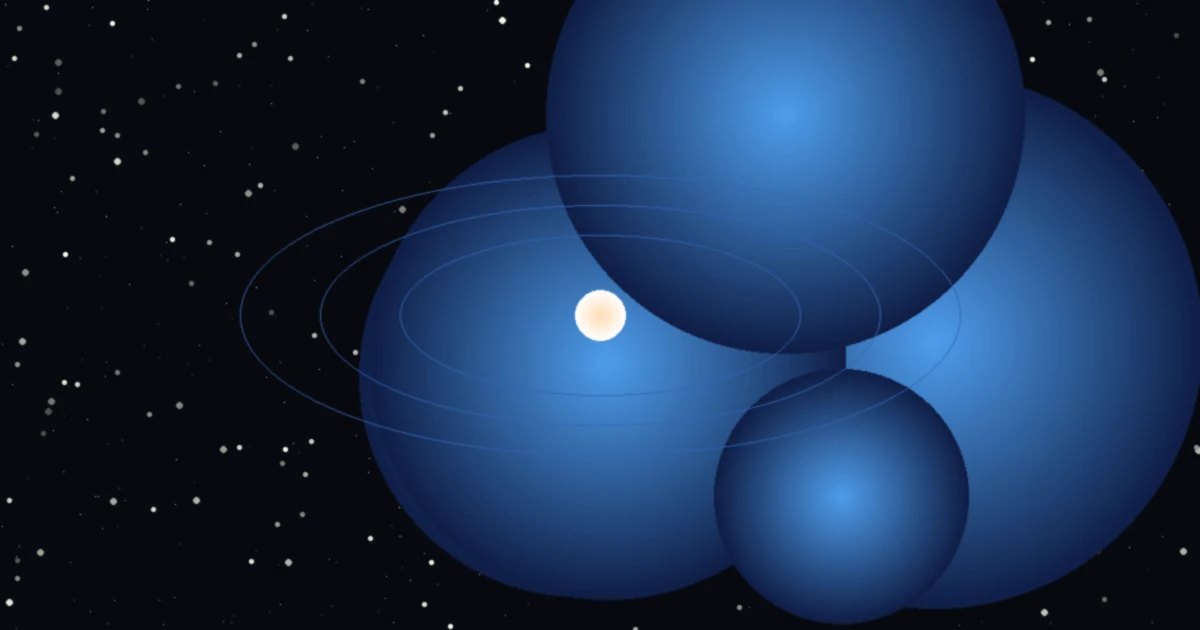
A Universe That Was Never Supposed to Look Like This
Near the end of Death's End, Cheng Xin and Guan Yifan arrive at a shattering realization: the three-dimensional universe they have always taken as a given is not the universe as it was originally made. It is the universe as it has been left — scarred, diminished, and fundamentally altered by billions of years of warfare between civilizations that used spatial geometry itself as their weapon of choice.
The cosmos, Liu Cixin implies, began with many more dimensions than the three we can perceive. What reduced it to its current state was not entropy or physics but strategy: the cold, lethal logic of the Dark Forest applied not just to individual stars but to the fabric of spacetime itself.
This is one of the most ambitious ideas in the trilogy, and one of its quietest. It arrives almost as an aside, embedded in a conversation between two people sheltering in a pocket universe while the main universe crumbles around them. But it recontextualizes everything that came before.
The Original Universe
String theory and its descendants propose that the universe has more than the three spatial dimensions we navigate — typically ten or eleven, depending on the formulation. The remaining dimensions are "compactified," curled into loops so small they are undetectable by any instrument humans have yet built. Liu Cixin takes this seriously as a cosmological starting point.
In the beginning, according to the backstory that Death's End sketches, the universe had more accessible dimensions. Civilizations arose in this richer geometry. They fought. And at some point, one of them discovered that reducing a region of space from a higher to a lower number of dimensions was not just destructive — it was a weapon. A dimension lost cannot be recovered. An attack on the geometry of space is permanent in a way that the death of a star is not.
The logic is a natural extension of the Dark Forest. If broadcasting your coordinates invites destruction, then attacking the very medium through which coordinates can be communicated — the dimensionality of space — is the ultimate preemptive strike. You do not just destroy your enemy. You change the rules of the universe in a way that may disadvantage every civilization that comes after, but that guarantees your own temporary survival.
Dimensional Reduction as a Weapon
The two-dimensional attack on the solar system, the event at the climax of Death's End, is the most vivid demonstration of this principle. A thin foil of two-dimensional spacetime expands outward at the speed of light, converting three-dimensional matter into a flat geometry that no longer supports the chemistry, physics, or biology of the world it was.
From the perspective of a civilization advanced enough to deploy it, this is a relatively modest weapon — the equivalent, perhaps, of what a photoid is to a conventional nuclear device. Somewhere in the galaxy's history, civilizations were using dimensional reduction at far larger scales, attacking not solar systems but regions of space, not single stars but the dimensional structure of entire volumes of the universe.
The result, accumulated over billions of years, is the universe as we know it: a three-dimensional space where the higher dimensions that once provided more room for civilizational complexity have been locked away. The compactified dimensions of string theory are, in Liu Cixin's telling, not a feature of how the universe was born. They are the archaeological record of ancient wars.
The Evidence in the Physics
This backstory is not purely speculative fantasy. Liu Cixin grounds it in a genuine puzzle of theoretical physics: the hierarchy problem, which asks why the four fundamental forces have such wildly different strengths. Gravity, in particular, is enormously weaker than the other three forces — perhaps because it is the only force that leaks into higher dimensions that the others cannot access.
If those higher dimensions were once more open, gravity would have been correspondingly stronger. The progressive reduction in accessible dimensions would have weakened gravity over cosmic time — a signature of the ancient wars that Liu Cixin implies without spelling out. He does not insist on this interpretation, but he clearly found it suggestive.
Similarly, dark energy — the mysterious force accelerating the expansion of the universe — may be, within this framework, a symptom. A universe that has been repeatedly compressed into fewer dimensions carries scars. Its geometry has been disturbed. What we call dark energy might be the residue of dimensional violence on a cosmic scale, the universe still reacting to wounds inflicted billions of years ago.
The Haunting Implication
What Liu Cixin asks us to sit with is not just the violence of the idea but its loneliness. The higher-dimensional civilizations that fought these ancient wars are gone. Whatever they were — however complex, however beautiful, however alien — they are not here. The weapons they deployed outlasted them. The universe they damaged continues without them.
The laws of physics that human scientists have spent centuries mapping are not fundamental truths about reality. They are, in a meaningful sense, accident and wreckage: the physical laws of a three-dimensional space that only exists because civilizations chose to force their wars into that geometry.
Guan Yifan, the astrophysicist who pieces this together alongside Cheng Xin, arrives at a quiet moral conclusion: every civilization that uses dimensional reduction as a weapon is not just killing its enemy but participating in the long degradation of the universe itself. Every strike reduces what future life will be able to be. The Dark Forest logic — which is already a logic of mutual diminishment — turns out, at the largest scale, to be a logic of self-destruction so vast it encompasses the cosmos.
What Remains
Death's End ends with Cheng Xin and Guan Yifan returning the mass in their pocket universe to the main universe — a small, deliberate act of restitution. The gesture is symbolic of something the trilogy keeps returning to: that even within the most crushing cosmological pessimism, the choice to give rather than take carries meaning.
The universe lost its dimensions to fear, to survival instinct, to the iron logic that said: destroy before you can be destroyed, reduce before you can be reduced. The question the ending leaves open — quietly, without insistence — is whether any civilization can choose differently. Whether, given the same pressures, the same Dark Forest, it is possible to be the one that refused to make the geometry of existence into a weapon.
We have no evidence either way. The higher-dimensional universe that might have told us is gone.