The Droplet: Trisolaris's Most Terrifying Weapon
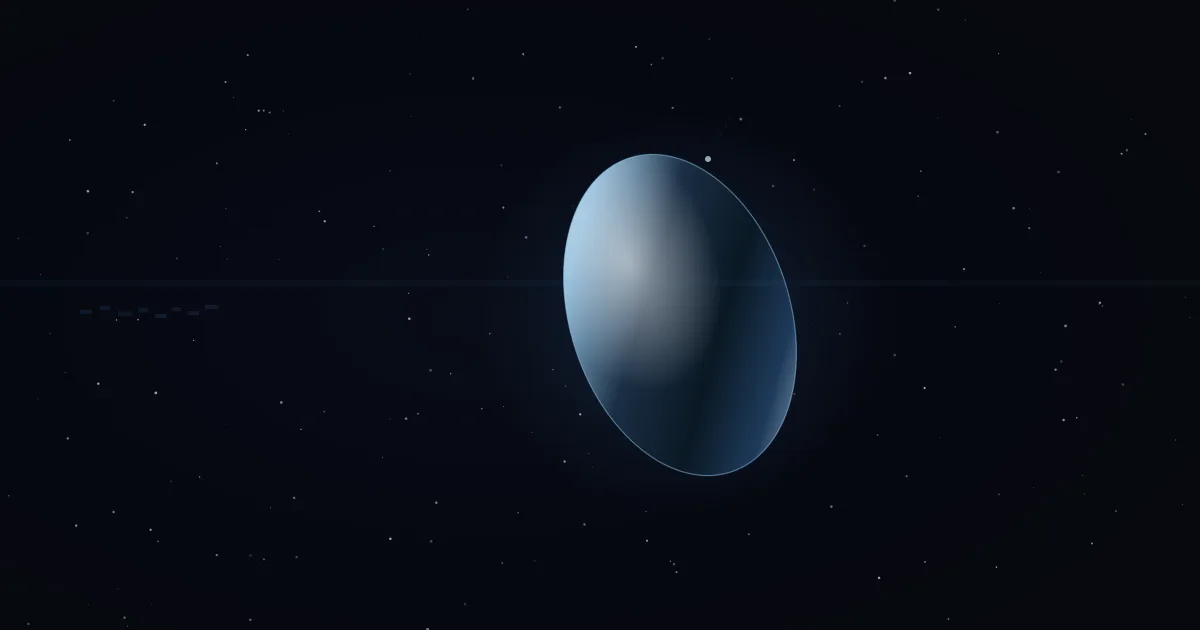
When humanity first detected the Droplet approaching the solar system, scientists were awed. A teardrop-shaped probe roughly four meters long, made of strong-interaction matter, its surface polished to a perfect mirror finish — it seemed like a message of peace, or at minimum a marvel of engineering. It was neither. The Droplet was a weapon, and it was already too late.
What Is the Droplet?
The Droplet is a probe dispatched by the Trisolaran civilization, introduced in The Dark Forest and most devastatingly deployed in that novel's climax. For the broader context of the technological gap it reveals, see Alien Technologies. In Chinese, it's called 水滴 (shuǐdī) — literally "water drop" — and its teardrop silhouette lives up to the name. But its beauty is purely incidental to its function.
The probe is composed of strong-interaction matter: material in which the fundamental particles are bound by the strong nuclear force rather than the electromagnetic force that governs ordinary atoms. This is the same force that holds protons and neutrons together inside atomic nuclei — one of the most powerful forces in the universe. Matter structured at this level is, for all practical purposes, indestructible by any conventional means humanity possessed.
A Perfect Mirror Surface
One of the Droplet's most unsettling properties is its surface. Under examination, it is found to be geometrically perfect — smoother than anything humanity could manufacture, with no surface irregularities at the atomic scale. This was initially interpreted as a gesture of goodwill, a kind of artistic perfection signaling advanced civilization.
The real significance is darker. The mirror surface reflects everything — including humanity's own communications, radar signals, and sensor sweeps. The Droplet is essentially invisible to analysis. It tells you nothing about what's inside. No material samples can be taken. No internal structure can be scanned. You can look at it forever and learn only that it is beautiful.
This inscrutability was a deliberate design choice. Humanity spent years studying the Droplet while it coasted toward the fleet, learning nothing. That delay was the point.
Indestructibility in Practice
Human weapons are built around the idea of disrupting molecular or atomic bonds. Explosives, kinetic rounds, directed energy weapons — they all work by overpowering electromagnetic forces holding matter together. Against strong-interaction matter, none of these approaches function. The Droplet doesn't crack, doesn't deform, doesn't heat up meaningfully. Every attempt to damage it simply fails.
In the novel, characters realize this only in the moments before disaster. The Droplet had been traveling peacefully alongside the fleet for years. Then it moved.
The Battle of Darkness
The human fleet assembled near the edge of the solar system represents one of the most significant military buildups in Earth's history — around two thousand warships, the combined defensive force meant to stop or slow any Trisolaran invasion. The fleet carried humanity's best technology: fusion drives, nuclear weapons, electromagnetic railguns, point-defense systems. It was powerful by any human standard.
The Droplet dismantled it in a matter of hours — a moment described in the Trilogy Timeline as the turning point of the Crisis Era.
The attack was not complex. The probe accelerated to high speed and began moving through the fleet in a direct path. Because it was indestructible and moving fast, every ship it struck was destroyed. It didn't need to target vital systems or overcome defenses. It simply passed through each vessel like a bullet through paper, and the ship ceased to exist.
Human weapons were useless — anything fired at the Droplet either missed or struck its surface and accomplished nothing. The fleet's attempts to coordinate a counterattack were hampered by the speed of events and the psychological collapse of crews watching thousands of ships evaporate in sequence. The Droplet didn't need to fight. It needed only to move.
By the end of the engagement, nearly the entire human fleet had been destroyed. A handful of ships escaped by executing emergency light-speed-adjacent acceleration — the very technology the Trisolarans feared. The loss of life was catastrophic. The loss of strategic capability was complete.
What the Droplet Reveals About Trisolaran Strategy
The Droplet's deployment is a masterclass in asymmetric deterrence. The Trisolarans didn't send an invasion fleet. They sent a single probe, weighing a few tons, that obliterated humanity's primary military force without sustaining any damage whatsoever.
This tells us several things about Trisolaran thinking:
Technological disparity as message. The Droplet was not just a weapon — it was a demonstration. Humanity needed to understand, viscerally, that the gap between human and Trisolaran technology was not a matter of degree but of kind. No amount of additional ships, better weapons, or improved tactics would have changed the outcome.
Patience as strategy. The Droplet traveled for years before acting. It waited, observed, and neutralized humanity's fleet at the moment of maximum psychological impact — just as the fleet was deployed in its full strength, believing itself capable of resistance.
Economy of force. One probe. Two thousand ships. The calculus is deliberate. The Trisolarans expended a trivial resource to eliminate a significant threat and a significant hope.
Strong-Interaction Matter: The Science Behind It
The strong nuclear force is real, and it really is extraordinarily powerful over short distances — roughly 100 times stronger than electromagnetism at the scale of atomic nuclei. However, it drops off extremely sharply with distance, which is why ordinary matter doesn't naturally form strong-interaction structures.
Liu Cixin extrapolates that a sufficiently advanced civilization could engineer matter in which this force is harnessed at larger scales — essentially compressing and restructuring matter the way ordinary matter compresses electrons into atomic shells, but one level deeper. The result would be extraordinarily dense, extraordinarily strong, and completely immune to any process that merely rearranges electrons.
This is speculative physics, but it is grounded in real science rather than pure fantasy. The strong force exists. The question is only whether it can be controlled in this way — and the novel answers with a firm, terrifying yes.
Legacy of the Droplet
The Battle of Darkness marks a turning point in the Remembrance of Earth's Past trilogy. For a detailed breakdown of the engagement, see Battle of Darkness: Fleet Combat. Before it, humanity still believed in the possibility of military resistance. After it, that belief is gone. The Droplet doesn't just destroy ships — it destroys a framework for thinking about the future. It made cosmic deterrence — not military force — the only viable path for Luo Ji and those who came after him. See Luo Ji's character arc for how this responsibility shaped him.
In retrospect, this was the moment the Dark Forest theorem stopped being theory. The universe had shown its hand. Humanity was prey, and the hunter had demonstrated its tools.
The Droplet remains one of the most memorable weapons in science fiction — not because it is explosive or dramatic, but because it is quiet. It does not rage or burn. It simply moves, perfectly, through everything humanity built, and leaves silence behind.