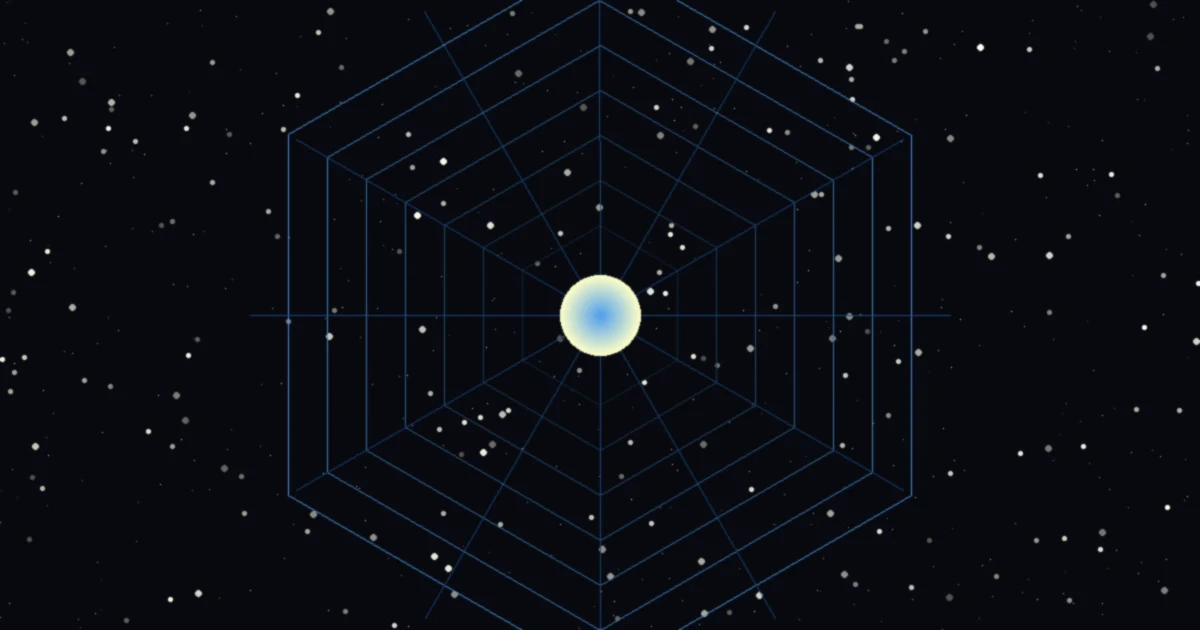
A Game That Was Never Just a Game
When Wang Miao first logs into the Three-Body virtual reality game, he expects the kind of experience any massively multiplayer online world offers: escapism, competition, community. What he encounters instead is something far stranger — a civilization at the edge of extinction, trying to solve an astronomical problem it cannot even fully describe.
The Three-Body game, as it appears in Liu Cixin's novel, is not a product of entertainment. It is a recruitment tool, a philosophical trap, and one of the most elegant pieces of worldbuilding in modern science fiction. Its purpose is to make you understand Trisolaran desperation from the inside — and to identify, among the millions of players drawn in, the rare human minds who might help. For context on the organization behind the game, see the Earth-Trisolaris Organization.
The Rules of an Impossible World
The game drops players into a civilization on a planet orbiting not one sun but three. The fundamental problem is immediately apparent: without predictable seasons, without a stable calendar, without any reliable pattern in the sky, civilization cannot plan. Agriculture fails. Infrastructure collapses. Society rebuilds from scratch, only to be annihilated again when a sun departs or two suns converge and incinerate everything.
This instability maps directly to the real mathematical concept underlying the novel's title. The three-body problem — the challenge of predicting the long-term motion of three mutually gravitating masses — has no general closed-form solution. You can calculate where the bodies are now, and extrapolate a little way into the future, but eventually the errors compound. The system is chaotic in the technical sense: tiny differences in initial conditions produce wildly different outcomes over time.
Liu Cixin uses the game to make this abstraction visceral. Players don't read equations. They watch the sky. They watch crops burn and rivers freeze and civilizations they spent hours building get scorched off the map by a triple sunrise. They feel what the mathematics means.
Stable Eras and Chaotic Eras
The game divides Trisolaran history into alternating epochs. Stable Eras are periods when the three suns happen to follow a predictable enough configuration that seasons approximate regularity, agriculture is possible, and civilization can accumulate knowledge and infrastructure. Chaotic Eras are everything else — periods of orbital instability when the planet might be frozen for centuries or scorched for decades, when no planning horizon longer than a year is reliable.
Players learn to read the sky with desperate attention. Is a second sun rising? That could mean months of double heat. Are all three suns visible simultaneously? That might mean a brief, terrifying "Triple Solar Day" in which the surface temperature climbs past survivability. Or it might mean a long cold period follows as the suns swing apart.
What the game captures brilliantly is the asymmetry of this existence: a century of careful progress can be erased in weeks. The Trisolarans are not lazy or primitive — they are gifted engineers and scientists hamstrung by an environment that punishes long-term investment. Every great work they build is built under the shadow of its potential destruction.
Historical Epochs as Game Levels
The game moves through recognizable periods of Earth-like technological development, from ancient pastoral civilizations to modern science — but the parallel breaks down immediately in the details. Trisolaran history is not a steady march of progress. It is cyclical collapse and recovery, with each revival standing on the ash of the last.
Players encounter a succession of historical figures — lords, philosophers, scientists — each grappling with the same core question from a different vantage point: how do you stabilize a civilization when the environment itself is unstable? Some pursue military solutions: control of food stores and water lets you survive Chaotic Eras at the cost of authoritarian rule. Others pursue technological solutions: could you predict the sun's behavior well enough to prepare? Others turn philosophical: perhaps civilization itself is the wrong approach. Perhaps only creatures who dehydrate — who go dormant and wake when conditions improve — can survive in the long run.
This last insight connects to one of the novel's most important pieces of alien biology. Trisolarans can dehydrate their bodies, reducing themselves to near-inert shells that can endure extreme temperatures, then rehydrate when the environment permits. It is their deepest survival adaptation — and one that makes them profoundly different from humans in how they relate to death, dormancy, and the continuity of self. For a closer look at this biology, see Trisolaran Physiology and Culture.
The Real Three-Body Problem
The orbital mechanics driving all of this are genuine physics. In classical mechanics, the two-body problem — predicting the motion of two masses under mutual gravitational attraction — has an exact solution. Johannes Kepler described it in the early seventeenth century: the bodies trace ellipses, the math is clean, the future is perfectly predictable.
Add a third body and the clean math disappears. Henri Poincaré proved in 1887 that no general analytic solution exists. The three-body problem can only be solved numerically — simulated step by step with computers — and the simulations diverge rapidly. Small errors propagate. The system exhibits sensitive dependence on initial conditions: the hallmark of mathematical chaos.
This is not a limitation of our models. It is a property of the physics itself. Three masses pulling on each other under gravity can, in many configurations, trace trajectories so complex that no formula could ever compress them into a finite description. The future of the system is, in a precise technical sense, unknowable beyond a certain horizon.
What Liu Cixin understood is that this mathematical fact, transplanted into lived experience, is existential horror. If you live on a planet in a three-body system, the universe itself refuses to be predicted. The sky is not a reliable clock. It is a threat with an unknown probability distribution.
The Recruitment Function
The game serves the Earth-Trisolaris Organization as a filter. Its puzzles — which grow increasingly sophisticated, asking players to propose solutions to the stability problem — identify humans with the kind of scientific and philosophical imagination the ETO values. Players who engage seriously, who develop original theories about Trisolaran orbital mechanics, who show genuine empathy for a civilization under impossible pressure, are tracked and eventually approached.
This recruitment logic is itself a piece of worldbuilding. The ETO is not looking for soldiers or hackers. It is looking for people who, having understood the Trisolaran predicament from the inside, choose to help anyway — who translate the game's emotional experience into ideological commitment. The VR immersion is the conversion mechanism. It is harder to dismiss an alien civilization as the enemy when you have spent weeks watching it burn.
Wang Miao's journey through the game is the reader's journey through the novel's central moral question: once you understand why the Trisolarans are coming, can you still side with humanity without qualification?
Worldbuilding as Emotional Technology
What makes the Three-Body game exceptional as a narrative device is that it does the novel's heaviest expository work while remaining experiential rather than didactic. Liu Cixin could have explained Trisolaran history in a series of information dumps. Instead he gives us a world you inhabit — one whose lessons you derive from observation and failure rather than from lecture.
The chaos of the three-body problem is not explained to Wang Miao. He watches a sky full of unpredictable suns and feels it. The desperation of a civilization facing extinction is not summarized. It is lived, epoch by collapse by epoch, across the game's historical campaign. By the time the novel reveals that this game is training players to understand an alien species, the player — and the reader — already does.
That is the game's real achievement. It is not a puzzle to be solved. It is an empathy machine. And in Liu Cixin's universe, empathy for the alien is the first step toward something far more complicated than peace.