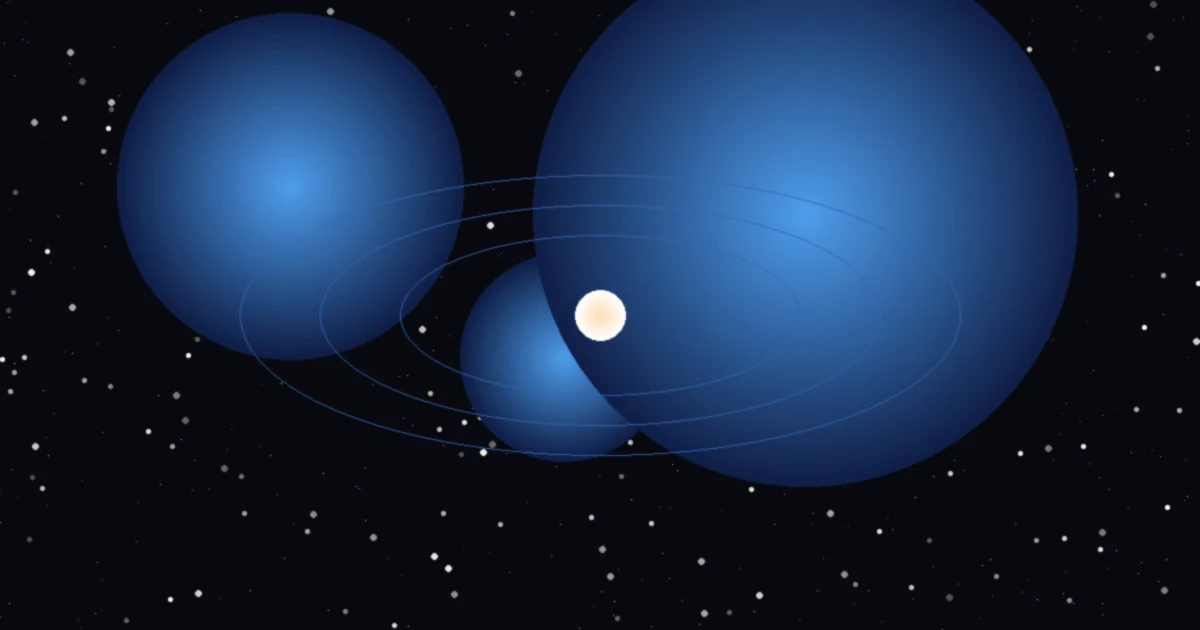
A Planet With No Tomorrow
Imagine waking up on a world where you cannot predict whether your next sunrise is six hours away or six hundred years. Where the sky might hold one sun, or three, or none for centuries. Where the concept of a stable season has never existed, and the word "forecast" has no practical meaning beyond a few decades.
This is the world of Trisolaris — and the horror of it is entirely grounded in real mathematics.
The three-body problem is not a fictional crisis invented for Liu Cixin's novel. It is one of the most famous unsolved problems in classical physics, studied for over three centuries. Liu Cixin didn't invent the catastrophe. He simply populated it with people.
What Is the N-Body Problem?
At its most basic, the n-body problem asks a deceptively simple question: given the positions and velocities of n gravitating masses at some moment in time, can you predict exactly where they will be at any future moment?
For two bodies — a star and a single planet — the answer is yes. Isaac Newton solved this in the seventeenth century. Two masses pull each other through gravity, and the resulting motion traces a perfect ellipse. The math is clean, the solution is exact, and the orbit is perfectly predictable as far into the future as you care to calculate. Earth will be in more or less the same position relative to the Sun in a million years as it is today.
Add a third mass, and everything changes.
With three gravitating bodies, the equations of motion contain no general closed-form solution. There is no formula you can write down and evaluate. The system doesn't simplify. It is, in the formal mathematical sense, nonintegrable — the motion cannot be expressed as a smooth function of time.
This was proven rigorously by Henri Poincaré in 1887, when he was working on a prize competition set by King Oscar II of Sweden. Poincaré's investigation of the three-body problem essentially founded the modern mathematical theory of chaos. He discovered something that shook the deterministic foundations of Newtonian physics: systems that follow perfectly deterministic laws can still be, in practice, unpredictable over long timescales.
Chaos Is Not Randomness
This point is worth dwelling on, because it's often misunderstood.
The three-body problem is not random. Every position and velocity is determined by exact physical laws. If you could know the starting conditions with infinite precision, you could in principle calculate the future perfectly. The equations are not probabilistic.
The problem is sensitivity. In a chaotic system, an infinitesimally small difference in starting conditions — a rounding error invisible to any instrument — grows exponentially over time. Errors double, redouble, and double again until the gap between your prediction and the system's actual behavior is as large as the system itself. You don't know which of a thousand possible futures will occur.
On Trisolaris, this means that orbital calculations are not merely difficult. They are fundamentally limited. A sufficiently advanced civilization could calculate the near-term motion of their three suns with extraordinary precision — but the long-term future is not just unknown, it is unknowable from any position inside the system. The Chaotic Eras that devastate Trisolaran civilization are not bad luck. They are the price of living in a mathematically unstable gravitational system.
What Mathematicians Have Actually Found
The three-body problem has no general solution, but mathematicians have spent centuries finding special cases.
Euler and Lagrange discovered configurations where three bodies could maintain fixed geometric relationships — specific arrangements of masses that produce stable periodic orbits. These are the famous Lagrange points, now used by space agencies to park satellites in gravitationally stable positions in the Earth-Sun and Earth-Moon systems.
In 1993, physicist Cris Moore discovered the "figure-eight" solution: three equal masses chasing each other around a figure-eight path in perfect choreography. It is beautiful, mathematically exact — and extraordinarily fragile. Any perturbation and it collapses.
More general periodic solutions have been found in large numbers by computational search. Hundreds of families of solutions are now known. But they share a common feature: they require very specific mass ratios and very specific initial conditions. A real planetary system, subject to slight perturbations from other bodies, gas clouds, and the accumulated rounding errors of time, will not stay on these special orbits. They are islands of order in a sea of chaos.
For a system like the Trisolar star cluster Liu Cixin imagines — three stars of roughly comparable mass at relatively close distances — the overwhelming majority of possible orbital configurations are unstable on astronomical timescales. The system would tend to eject one body and settle into a two-body configuration. The extraordinary premise of the novel is that Trisolaris orbited within this unstable system long enough for life to develop at all.
Hard Science, Human Scale
What makes Liu Cixin's use of this physics so effective is that he never lets it remain abstract. The n-body problem is not background information in The Three-Body Problem. It is the engine of the novel's tragedy.
The three-body VR game Wang Miao encounters in the virtual reality is a pedagogical device — a way of letting readers feel, rather than merely understand, what it means for a civilization to live without orbital predictability. Each session in the game ends in disaster. Civilizations built up over centuries are wiped out in hours when the suns shift. The lesson is not just scientific. It is emotional: this is a species that has endured extinction thousands of times in its recorded history and built its entire psychological architecture around the expectation of annihilation.
That architecture — the compulsive need to escape, the willingness to do anything to survive, the desperate transmission of a signal to anyone who might answer — follows directly from the mathematics. Trisolaran aggression is not evil in the conventional sense. It is the evolved response of organisms that live inside an equation with no solution. Their desperation also explains the deployment of sophons to block human scientific progress. For how this desperation played out in first contact with humanity, see the First Contact Timeline.
The Real Alpha Centauri System
Liu Cixin placed Trisolaris in the Alpha Centauri system — the nearest stellar neighbors to Earth, at approximately 4.24 light-years. This was not arbitrary. Alpha Centauri is a genuine triple-star system: Alpha Centauri A and B are a closely bound binary pair orbiting each other, while Proxima Centauri is a distant red dwarf that may be gravitationally bound to the pair.
The real system is considerably more stable than Trisolaris, because A and B are widely separated from Proxima and any planets in the habitable zones of A or B would experience stable orbital mechanics dominated by the nearest star. The three-body chaos in Liu Cixin's version requires his Trisolar stars to be much closer together than Alpha Centauri's real components.
But the choice of setting is still scientifically honest in spirit. Alpha Centauri is a real three-body system. The question of whether complex life could persist there is a genuine subject of ongoing research. And the orbital dynamics Liu Cixin amplifies to catastrophic effect are rooted in real mathematics — not speculation, but the proven chaotic behavior that Poincaré identified over a century ago.
Why This Matters
Most science fiction extrapolates. It takes something real and stretches it — faster engines, smarter computers, longer lives. What Liu Cixin did with the three-body problem is different. He didn't stretch or extrapolate. He found a piece of mathematics that had been sitting in the heart of physics for three hundred years, recognized its existential implications, and built a civilization inside the consequences.
The Trisolarans are not an arbitrary alien menace. They are what survives inside an unsolved equation. Their invasion of Earth is not conquest for its own sake. It is the logical endpoint of a species that has internalized, over millennia, the knowledge that their home cannot last.
The mathematics was always there. Liu Cixin just made it personal.