On Earth, every calendar ever devised has rested on the same foundation: the sky repeats itself. The sun rises and sets. Seasons return in sequence. The stars wheel overhead in reliable arcs. For ten thousand years of human civilization, timekeeping has been the art of tracking patterns in a sky that cooperates.
Trisolaran civilization had no such luck.
The Problem at the Core
The three-body problem — the mathematical heart of Liu Cixin's trilogy — is not merely a dramatic name. It describes a real and profound limitation in classical mechanics: while the motion of two mutually gravitating bodies can be solved exactly, the addition of a third body produces a system that is, in general, chaotic. Small differences in initial conditions produce wildly divergent trajectories over time. The future of such a system cannot be predicted indefinitely far in advance, no matter how powerful the computation.
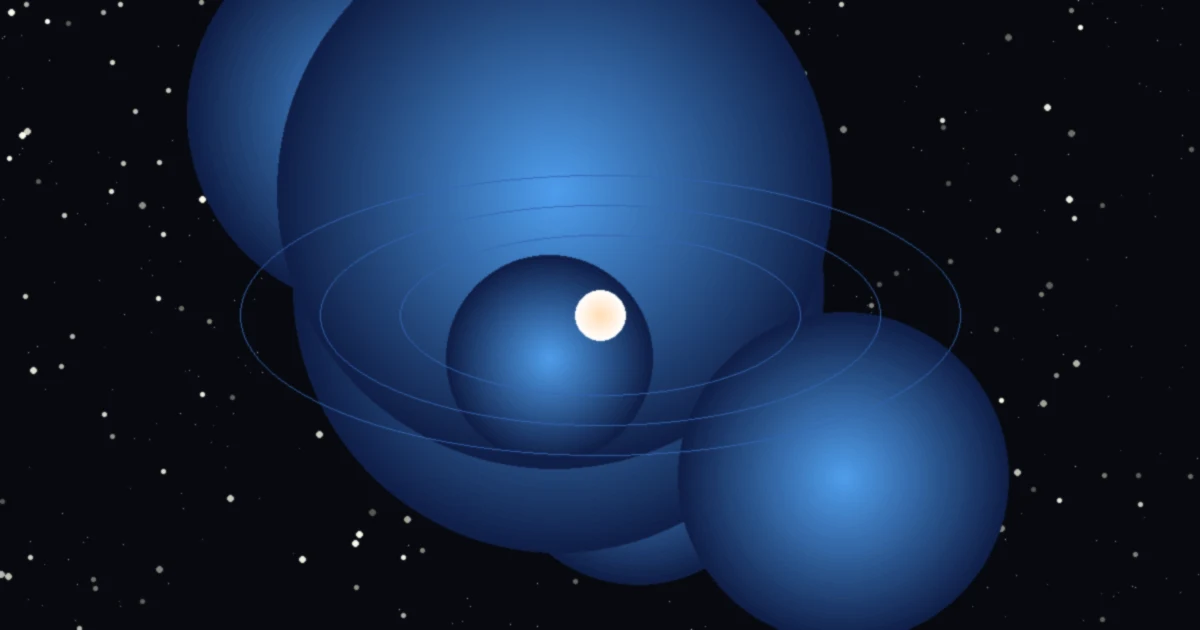
For the Trisolarans, this was not an abstract mathematical curiosity. It was the defining condition of their existence. Their planet orbited three suns in a configuration that could remain stable for centuries — and then tip, without warning, into violent chaos. A sun might approach too closely, roasting the surface. Two suns might recede simultaneously, plunging the world into a freeze that would kill everything that had not prepared. There was no way to know when the next Chaotic Era would begin, or how long it would last, or what sequence of catastrophes it would contain.
What "Stable Era" and "Chaotic Era" Actually Mean
The Trisolaran calendar, to the extent one can speak of such a thing, was organized around this fundamental distinction: Stable Eras and Chaotic Eras. These were not seasons in any human sense — they did not repeat on a predictable cycle or arrive in a predictable order. They were, rather, a classification of the present moment.
A Stable Era meant that the three suns had entered a configuration — however temporary — in which their mutual gravitational influences produced orbits that were, for the time being, regular enough to sustain life. Temperatures were tolerable. Agriculture was possible. Civilization could function.
A Chaotic Era meant that the configuration had broken down. The suns moved unpredictably. Temperature swings could be catastrophic. The only survival strategy was dehydration: compressing the body into a desiccated form capable of enduring extremes, and waiting.
This meant that the most important temporal distinction a Trisolaran could make was not between morning and evening, or summer and winter, but between now and not yet. The clock that mattered most was the one counting down to the next extinction event — and that clock had no reliable face.
Measuring Time Without an Anchor
Human calendars work by anchoring abstract time to observable astronomical phenomena. The day is defined by Earth's rotation relative to the sun. The year is defined by Earth's orbit around the sun. Everything else — weeks, months, centuries, eras — is a layer of abstraction built on those two fundamental cycles.
Trisolaran time had no equivalent anchors. The three suns rose and set, but not on any consistent schedule. There was no single "day length" that a civilization could rely on, because the dominant sun in the sky could change as orbits shifted. A "year" — if defined as one orbit around a primary star — was meaningless in a system where the concept of a primary star was itself unstable.
What Trisolaran civilization almost certainly developed, instead, were local and provisional measures. During Stable Eras, when orbital patterns were consistent enough for a few centuries, a working calendar could be constructed from whatever regular phenomena existed: the dominant sun's daily arc, perhaps, or the observable period of one of the other stars' apparent motion. These calendars would be useful for planning within the Stable Era, but they carried the explicit knowledge that they were temporary — that the stability underpinning them would eventually fail.
The broader unit of time — the measure across Chaotic Eras and the dehydrations they required — would be reckoned differently. Each civilization's rebuilding after a Chaotic Era began with an audit of what had survived: physical materials, stored records, the memories of those who had rehydrated. Time before the last Chaotic Era was, in an important sense, simply before — a different epoch of existence, connected to the present primarily through the fragments that endured.
The Mathematics of Uncertainty as a Cultural Foundation
Human cultures have generally treated calendrical precision as a mark of advancement. The Julian and Gregorian calendar reforms were significant events; accurate clocks were strategic military assets; atomic time standards are a cornerstone of modern infrastructure. We treat the ability to know exactly what time it is as fundamental.
Trisolaran civilization, forced to confront the mathematical reality of three-body chaos, would have developed a radically different relationship with temporal certainty. Their most sophisticated astronomers understood, at the level of formal mathematics, that long-term prediction was impossible — not because their instruments were crude, but because the system itself contained irreducible unpredictability.
This is actually consistent with what Henri Poincaré proved for human mathematics in 1890: that even with perfect knowledge of initial conditions, the three-body problem diverges exponentially over time. No computational improvement closes this gap. The chaos is intrinsic to the physics.
A civilization that had internalized this truth for millennia would not experience it as frustrating limitation. It would be the basic texture of reality — the deepest thing they knew about the universe they inhabited. Their philosophy, their religion (if they had one), their social structures and their attitude toward planning would all be shaped by the foundational understanding that the future cannot be known, and that survival depends not on prediction but on preparation for discontinuity.
What This Did to Trisolaran Culture
The cultural implications of living under chaotic orbital conditions are not incidental to understanding Trisolaran civilization — they are central to it. The fatalism and pragmatism that Liu Cixin attributes to the Trisolarans, their ruthless prioritization of species survival over individual life, their willingness to dehydrate and endure and begin again: all of this flows from centuries of living without the temporal security that human civilization has always taken for granted.
A species that has faced annihilation hundreds of times and survived each time through preparation and endurance develops a very specific relationship to time. The past is a record of catastrophes survived. The present is an opportunity to be used before conditions change. The future is uncertain in a way that is not merely a matter of inadequate information — it is uncertain in the deepest physical sense.
This also explains the Trisolaran interest in Earth with a clarity that goes beyond mere resource competition. A world with a single, stable star — with seasons that return, with calendars that hold, with a future that can be predicted from astronomical tables — would appear, from the Trisolaran perspective, as something almost incomprehensibly fortunate. Not just a resource to be taken, but a proof that the universe, in at least one corner, had been willing to cooperate.
The Irony of Leaving
When the Trisolaran fleet departed for the solar system, it carried a civilization whose entire intellectual history had been shaped by the impossibility of long-range planning. They were crossing four light-years toward a world whose greatest advantage over their own was not military power or technological sophistication — it was simply that its calendar worked.
The Trisolarans were coming to take stability from a species that had never had to earn it. And in doing so, they were, in the deepest sense, trying to solve the same problem their civilization had always faced: how to survive in a universe that offers no guarantees.
The three-body problem, in the end, is not just a mathematical puzzle. For the Trisolarans, it was the entire shape of history — and its unsolvability is what ultimately drove them to pursue the Dark Forest strategy against humanity.